NASA
SpaceX cargo launch slips a day after rodent experiment snag
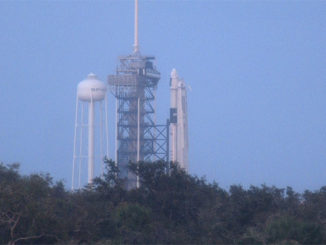
NASA has announced a one-day delay in SpaceX’s next cargo launch until Wednesday to allow time for ground teams to replace moldy food bars meant for 40 mice heading for the International Space Station as part of a biological research experiment, denying the launch company a chance at two Falcon 9 missions on back-to-back days.
Soyuz crew enjoys problem-free launch, docks with space station
A Soyuz FG rocket thundered to life and shot into orbit smoothly Monday carrying three crew members on a six-hour flight to the International Space Station. The problem-free ascent came less than two months after an Oct. 11 launch abort that forced a different crew to carry out safe-but-scary emergency landing.
Live coverage: Russia launches first crewed mission since Soyuz failure
Veteran Russian cosmonaut Oleg Kononenko, flanked by Canadian flight engineer David Saint-Jacques and NASA astronaut Anne McClain, launched toward the International Space Station at 6:31 a.m. EST (1131 GMT) Monday from the Baikonur Cosmodrome in Kazakhstan, the first crew launch for Russia’s space program since a Soyuz booster failure led to the emergency landing of a two-man crew in October. The Soyuz MS-11 spacecraft docked with the station at 12:33 p.m. EST (1733 GMT).
Soyuz crew rocket arrives on the pad for first time since dramatic launch abort
Keeping up a tradition dating back to the dawn of the Space Age, a Russian Soyuz rocket emerged from a hangar at the Baikonur Cosmodrome in Kazakhstan before sunrise Saturday for rollout to Launch Pad No. 1 at the Central Asia space base, moving into position for liftoff Monday with a U.S.-Russian-Canadian crew heading for the International Space Station.
NASA picks nine companies to compete for commercial lunar lander missions
NASA announced Thursday nine companies that will be eligible to compete for up to $2.6 billion in contracts over the next decade to ferry scientific instruments and tech demo payloads to the moon aboard commercial robotic landers, a first step in what agency officials said will foster expanded private investment in deep space exploration and an eventual return of humans to the lunar surface.