SpaceX launched 119 payloads to a Sun-synchronous, low Earth orbit on a rideshare mission from Vandenberg Space Force Base.
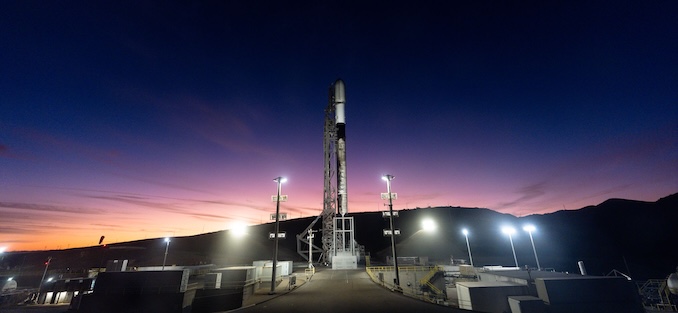
Liftoff of the Transporter-16 mission from Space Launch Complex 4 East aboard a Falcon 9 rocket occurred at 4:02 a.m. PDT (7:02 a.m. EDT / 1102 UTC).
The Falcon 9 first stage booster for this mission was B1093 making its 12th flight. Previously it launched a pair of missions for the Space Development Agency and nine batches of Starlink satellites.
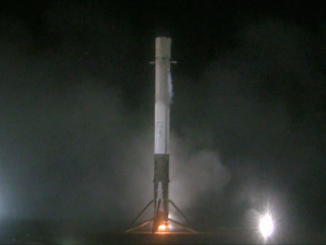
A little more than 8.5 minutes after liftoff, B1093 landed on the drone ship, ‘Of Course I Still Love You,’ positioned in the Pacific Ocean. It was the 187th landing on this vessel and the 592nd booster landing for the company to date.
What’s onboard?
Like previous SpaceX’s rideshare missions, this flight carried dozens of customers, from companies to sovereign governments to academia.
Exolaunch, with 57 payloads, and Seops Space, with 19 were responsible for booking the majority of the customers.
“Exolaunch is enabling launch access for more than 25 commercial, institutional, and government customers from the United States, the United Kingdom, Bulgaria, France, Finland, Greece, Italy, Spain, South Korea, Taiwan, Turkey, and more on this mission,” Exolaunch said in a statement in February.
The payloads overseen by Seops Space are a combination of 14 CubeSats and five PocketQubes. The latter of which are from a company called Alba Orbital and are Earth observation satellites.
“The Seops Transporter-16 manifest represents a truly global cross-section of the small satellite community, with payloads originating from 13 countries, including Canada, France, Malaysia, Nepal, Norway, Romania, Scotland, Spain, Switzerland, Taiwan, the United Kingdom, the United States, and Vietnam,” Seops said in a statement.
Other notable payloads include Varda Space’s sixth reentry satellite bus, designed for on-orbit manufacturing, and the so-called ‘cake topper,’ the Gravitas satellite from K2 Space.
The Gravitas satellite has a wingspan of 40 meters with its solar panels unfurled and weighs about two metric tons. It’s designed to produce 20 kW of electricity. It will test technologies that will be needed for power-hungry in-orbit data centers.
At K2 Space, we’re Building Bigger to deploy the largest satellites ever on orbit.
Matt Cooper, our Principal Mission Assurance Engineer, describes what it’s taken to get Gravitas on orbit. As our first free-flying satellite, it meant working through every step end-to-end, from… pic.twitter.com/pEJ1tOkdfj
— K2 Space Corporation (@K2SpaceCo) March 23, 2026