NASA
Koch, Meir conclude first all-female spacewalk
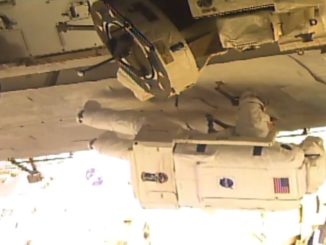
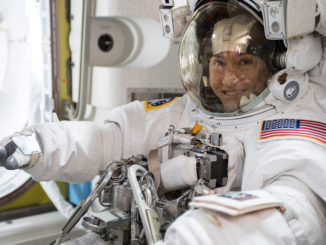
Astronauts Christina Koch and Jessica Meir carried out history’s first all-female spacewalk Friday, floating outside the International Space Station and successfully installing a 230-pound replacement battery charger in the lab’s solar power system. The historic excursion was carried out in a blaze of public interest that rose all the way to the White House.
NASA names new chief of human space operations
Douglas Loverro, a veteran manager with broad experience in national security space operations, has been selected by NASA to lead the agency’s human space flight programs. He takes over at a critical moment as the agency assesses the readiness of new commercial crew ships amid a full-court press to land astronauts on the moon in 2024.
Boeing reveals target dates for initial Starliner test flights
Boeing officials said Wednesday that the company is targeting Dec. 17 for the launch of the first unpiloted orbital test flight of the new Starliner crew capsule from Cape Canaveral on a week-long demonstration mission to the International Space Station, a precursor to a mission with astronauts next year.
Live coverage: NASA’s ICON satellite successfully launched
After a 24-hour delay due to poor weather, an air-launched Northrop Grumman Pegasus XL rocket fired into orbit at 9:59 p.m. EDT Thursday (0159 GMT Friday) after release from a carrier jet at an altitude of 39,000 feet over the Atlantic Ocean northeast of Cape Canaveral. The Pegasus rocket carried NASA’s ICON satellite into orbit to collect measurements of the ionosphere.
Pegasus rocket ready for airborne launch with NASA scientific satellite
After a year-long delay to troubleshoot recurring erroneous data signatures from the rudder of Northrop Grumman’s air-launched Pegasus XL rocket, NASA is eager to send a $252 million research satellite into orbit as soon as Thursday night off Florida’s east coast on a mission to probe the ionosphere, a region near the boundary between Earth’s atmosphere and space.
NASA opens competition to build human-rated lunar landers
Companies have until Nov. 1 to submit proposals to NASA for a human-rated lander that could be ready in time to carry astronauts to the moon’s surface by the end of 2024, and the agency is leaving open the option for contractors to develop a descent craft that would bypass the planned Gateway mini-space station in lunar orbit, at least for the first landing attempt.