United Launch Alliance oversaw the completion of a critical milestone in mid-April on the road to resuming flights with its Vulcan rockets.
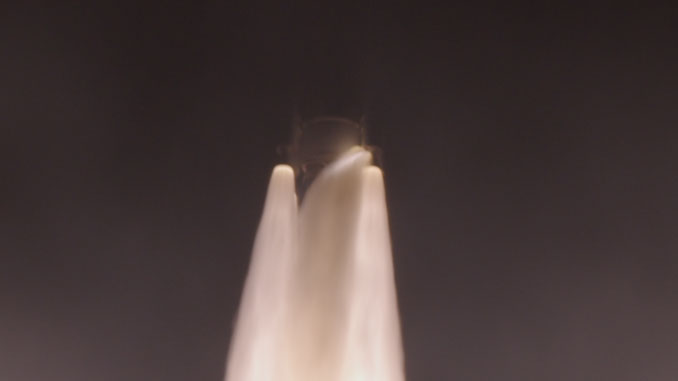
On April 15, the company said Northrop Grumman performed a successful static fire test of a Graphite Epoxy Motor (GEM) 63XL Solid Rocket Booster (SRB). A spokesperson told Spaceflight Now on Thursday that the test served to “demonstrate nozzle design enhancements which were already in work and an advanced propellant technology for future solid rocket motors across their portfolio.”
“The information gathered from this test, along with findings from the investigations will provide critical data to validate analytical models and support Vulcan’s return to flight,” the spokesperson said.
During the launch a mission for the United States Space Force, dubbed USSF-87, one of the four SRBs attached to the Vulcan booster suffered a nozzle problem prior to SRB separation. The rocket rolled more than intended following the incident.
“There was some asymmetric thrust when we had that solid motor fail, it reduced performance,” said Gary Wentz, vice president of Government and Commercial Programs at ULA. He spoke with Spaceflight Now in the days leading up to the Artemis 2 launch.
“The BE-4s and our avionics system gimbaled to control that. We did see some roll, and the BE-4s were able to compensate to arrest that roll. We were well within our environments and limits, so it was nothing overly concerning for the BE-4s.”
Both the Vulcan booster and the Centaur upper stage performed as expected and ultimately delivered the USSF-87 mission payload to its intended geosynchronous orbit.
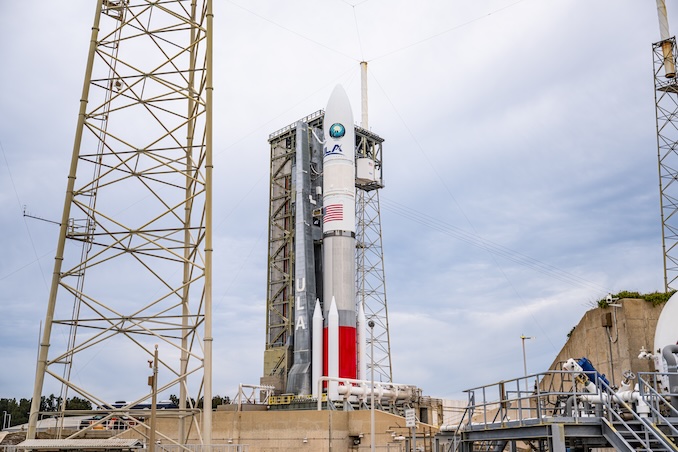
“The integrated U.S. government and contractor team is reviewing the technical data, available imagery and have collected any debris,” the ULA spokesperson said. “We are in the process of conducting a thorough investigation and will implement any corrective action necessary before we launch the next Vulcan mission.”
Wentz said where the pieces of the SRB nozzle came off landed in water that was likely too deep for them to recover, unlike the previous nozzle issue that occurred during the second certification flight of Vulcan back in October 2024.
“Vulcan’s going to get back to flight by the end of the year and then we’ll launch our manifest backlog that we have,” Wentz said in response to a question about the increase in launch demand driven in part by NASA’s Moon Base objectives.
“We’re available for other missions. [The Commercial Lunar Payload Services program] had a lot of smaller landers and things that we could fly to do some of those precursor efforts with the Moon and the mission that NASA’s laying out. So, we’re really excited about the opportunities.”
Return to flight
While the timing of a return to flight mission for Vulcan is still be assessed, during his remarks to Spaceflight Now, Wentz said that the customer for the return to flight mission would more than likely be Amazon.
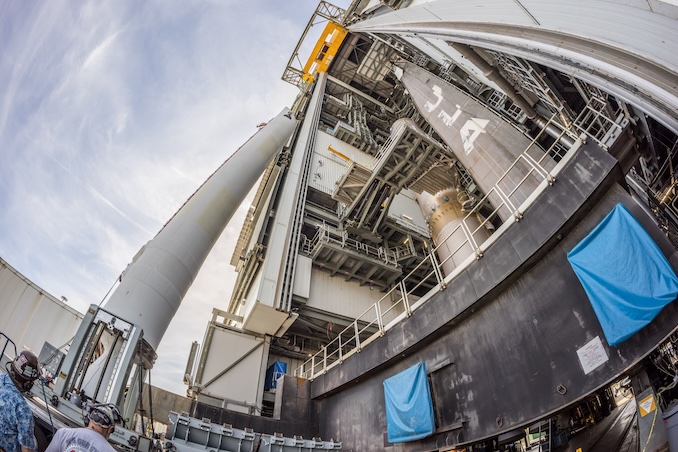
On Wednesday, ULA hoisted the first Vulcan booster inside its newly finished Vertical Integration Facility – Amazon (VIF-A) near Space Launch Complex 41 at Cape Canaveral Space Force Station. Its introduction gives the company two physical lanes with which it can stack its Vulcan rockets in the future.
Here’s a short video of yesterday’s milestone! pic.twitter.com/IITatZYEe4
— ULA (@ulalaunch) May 14, 2026
ULA can now stack either an Atlas 5 rocket or a Vulcan rocket in the original VIF, called VIF-G (Government), while a Vulcan rocket uses the new VIF-A.
“This marks the first operational hardware to be stacked for testing in advance of future launch operations,” a ULA spokesperson said. “This milestone gives the team the opportunity to test first use technology and hardware supporting launch processing as we gear up for a wet dress rehearsal, the next step in preparing for future Amazon Leo launch operations. We will share the date of the WDR in the future.”
Amazon Leo purchased 38 Vulcan rockets to fly its broadband internet satellites into orbit. That’s in addition to the nine Atlas 5 rockets it bought, seven of which have already been used.
“Satellites are already stacked for LV-01 and subsequent Leo Vulcan missions on the manifest, and this integrated test configuration will help ULA teams validate the procedures, interfaces, and ground systems needed to support a sustained, high-cadence launch campaign for Leo,” Amazon Leo said in a post on social media.
Amazon Leo’s next flight is scheduled to be the Leo Atlas 07 (LA-07) mission, which is scheduled for no earlier than May 22. The final batch of Leo satellites to fly on an Atlas V rocket will launch later this year on the LA-08 mission. The launch date of that mission should be announced shortly after the flight of LA-07.