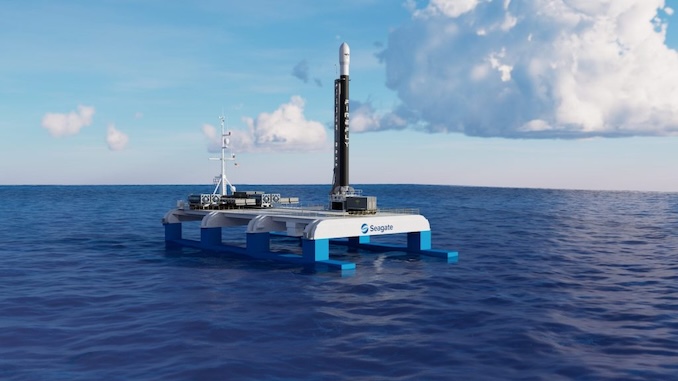
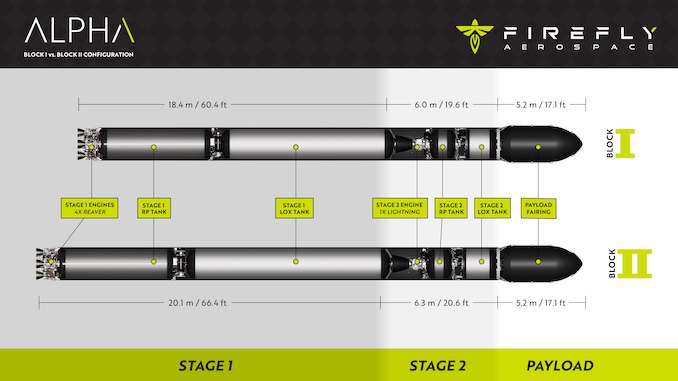
Lockheed Martin is joining in the effort to support a sea-based approach for launching Firefly Aerospace’s Alpha rocket. The 29.48-meter-tall (96.7 ft) rocket currently only launches from Space Launch Complex 2 at Vandenberg Space Force Base in California.
On Monday, Jonathan Caldwell, the vice president and general manager of Lockheed Martin’s Strategic and Missile Defense Systems, announced Lockheed Martin’s participation in this proposal in a post on his LinkedIn profile on May 4. He said it was a fusion of Lockheed Martin’s “legacy” in national security matters and “the innovative spirit” of the comparatively much younger companies of Firefly Aerospace and Seagate Space.
“The three companies will work together on mission‑application concepts and flight‑demonstration projects that leverage Seagate’s Gateway offshore launch platform,” Caldwell wrote. “This sea‑based launch facility, combined with Firefly’s responsive Alpha launch vehicle, will provide rapid, flexible access to space from diverse locations, an essential capability for tactical payloads and national‑security missions.”
The inclusion of Lockheed Martin comes nearly a month after Seagate Space announced a memorandum of understanding with Firefly to create off-shore infrastructure for its Alpha rockets. It would use what it calls its Gateway Series, a “purpose-built offshore spaceport designed specifically for launch operations.”
“Partnering with Firefly to align our Gateway platform with their Alpha vehicle is a major step toward making offshore launch a practical reality for the industry,” said Sean Fortener, President & COO at Seagate Space, in a statement. “We’re building a platform designed for mobility, responsiveness, and global access – key factors that complement our current launch infrastructure.”

In a statement to Spaceflight Now, Caldwell said Lockheed Martin wanted to direct some of its future payloads to this aquatic undertaking in order to support the needs of the Department of Defense.
“With our mission understanding in missile defense and targets systems, we are well aware that our warfighter’s operational requirements are rapidly evolving to stay ahead of growing adversarial threats,” Caldwell said. “A unique, mobile, sea-based launch platform like this — which is not dependent on the availability of a fixed, terrestrial launch location — provides not only increased rapid responsive launch capabilities but also can help alleviate some of the traffic pressure on current ground launch facilities.”
He added:
“With more than 70 percent of the Earth covered by water, that greatly increases our mission flexibility by taking advantage of the platform’s mobility to generate multi-azimuth launch geometries driven today by limited availability for air launched target delivery and unconstrainted by typical land-based launch locations. Our payloads integrated with the Alpha rocket allow us to accelerate end-to-end delivery solutions for our customers that are focused on delivering effects at speed while leveraging commercial approaches. We’re involved in this project because it will get mission into the hands of our warfighters faster. Firefly’s flexible Alpha rocket will help Lockheed Martin rapidly launch future spacecraft, including new payload technologies. With Seagate Space potentially making any ocean our launch pad, this collaboration could redefine responsive space operations.”
The collaboration between Lockheed and Firefly goes back a few years. Back in December 2023, Firefly launched its first mission for Lockheed, which was called ‘Fly the Lightning.’
The payload, Lockheed’s Electronically Steered Antenna (ESA), flew on the fourth Alpha rocket to date. However, Firefly failed to deliver the payload to the intended orbit due to “an error in the Guidance, Navigation & Control (GNC) software algorithm that prevented the system from sending the necessary pulse commands to the reaction control system (RCS) thrusters ahead of the stage two engine relight,” according to Firefly in a post-mission analysis.
The orbit into which the ESA payload was delivered as sufficient enough to allow Lockheed “to successfully complete their primary mission objectives, including rapid commissioning of the satellite following insertion,” Firefly said.
About six months later, in June 2024, Firefly announced a 25-launch purchase from Lockheed using its Alpha rockets. Two of those missions took place on flights six and seven of the Alpha rocket, with the former resulting in an anomaly that caused Firefly to begin shifting to a Block 2 version of its rocket, beginning with some technology demonstrations with the seventh Alpha rocket launch in March 2026.
“The collaboration further aims to accelerate the development of responsive launch solutions, delivering cutting‑edge technology that supports the warfighter’s evolving operational requirements,” Caldwell said on Monday. “Having a capability to address the growing need for speed and flexibility to launch payloads on tactical timelines from diverse locations is key to national security.”
This partnership is just one of Firefly’s avenues into supporting the United States’ national security endeavors. Also on Monday, ahead of its first quarter earnings call, Firefly announced that its subsidiary, SciTec, was one of 20 companies — including Lockheed Martin — to receive an Other Transaction Authority (OTA) agreement from the U.S. Space Force’s Space Systems Command to support the burgeoning Space Based Interceptor (SBI) program.
“We’re proud to contribute our proven AI-powered defense technologies to our nation’s critical Golden Dome program and honored by the trust placed in our team,” said David Simenc, SciTec’s President on Monday in a statement. “SciTec has always focused on delivering the technologies that strengthen decision advantage, and this agreement allows us to continue that work at a pivotal moment for national defense.”
Expanding beyond California
While the Alpha rocket currently only launches from Vandenberg, Firefly is working to bring its rockets beyond the Golden State. In June 2024, it announced two new launch sites were in the works.
The first was a partnership with Northrop Grumman to allow its Alpha rockets to fly from Launch Pad 0A (LP-0A) at the Mid-Atlantic Regional Spaceport (MARS) within the Wallops Flight Facility in Virginia. The site will also be used for launches of the Antares 330, which uses a Firefly-built first stage, and later the medium-lift Eclipse rocket (formerly called the Medium Launch Vehicle).
Days after the Wallops announcement, Firefly said it was working with the SSC Space (formerly the Swedish Space Corporation) to allow for Alpha rocket launches from the spaceport at the Esrange Space Center in Sweden. Firefly would use Launch Complex 3C for its missions.
That capability was expected to come online in 2026, but in a March 2026 press release, SSC Space said that an agreement with the Swedish Defense Materiel Administration would allow for the “execution of satellite launches for the Swedish Armed Forces, as well as for partners and allies […] by 2028.”