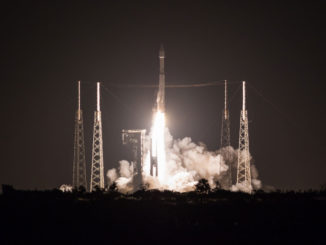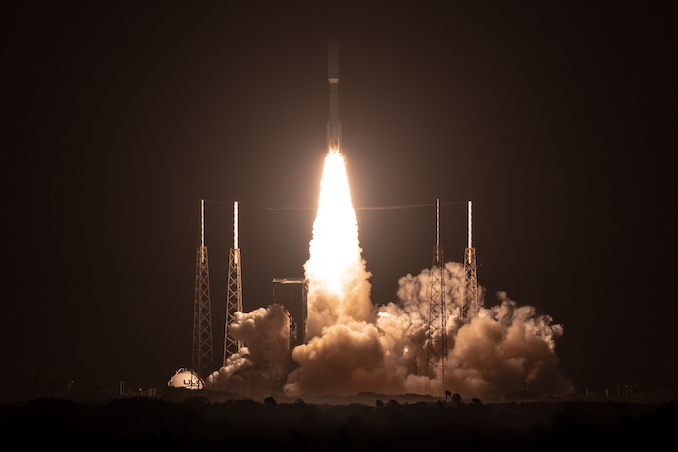
Update April 27, 9:30 p.m. EDT (0130 UTC): ULA confirmed deployment of the 29 Amazon Leo satellites.
United Launch Alliance completed its second Atlas 5 rocket launch of the month, marking the company’s fastest turnaround at Space Launch Complex 41 to date. It beats the previous record by nearly three days.
On board the Atlas 5 rocket was a batch of 29 Amazon Leo satellites. This will be ULA’s sixth flight delivering production versions of the broadband internet satellites to orbit and its seventh overall, including the two demo satellites launched on the Protoflight mission in October 2023.
Liftoff of the mission, dubbed Amazon Leo 6 by United Launch Alliance and Leo Atlas 6 (LA-06) by Amazon Leo, happened at 8:53:30 p.m. EDT (0053:30 UTC). The rocket flew on a north-easterly trajectory upon leaving Cape Canaveral Space Force Station.
This was the 108th launch of an Atlas 5 to date and the 100th under ULA.
ULA made changes to its prelaunch flow in order to help decrease the amount of time it takes to turn around its launch pad and prepare a new rocket to fly. One of those was built into this launch campaign.
Previously, the company would roll its Atlas 5 rockets to the pad at least a day ahead of a launch attempt and then load RP-1, a rocket grade fuel onto the Atlas booster. With the LA-06 mission, ULA rolled the 205-foot-tall (62.5 m) rocket out to the pad Monday morning, achieving the “harddown” milestone at 7:19 a.m. EDT (1119 UTC), when the Mobile Launch Platform (MLP) was lowered onto the piers at the pad.
“The ULA team will be divided into two shifts – the Roll and Preps Crew and the Tanking and Launch Crew – to perform all the tasks that normally are spread across two days,” ULA wrote in its launch blog.
“Not all future launches will use this compressed timeline. Operational considerations and other factors will determine which missions can employ the strategy.”
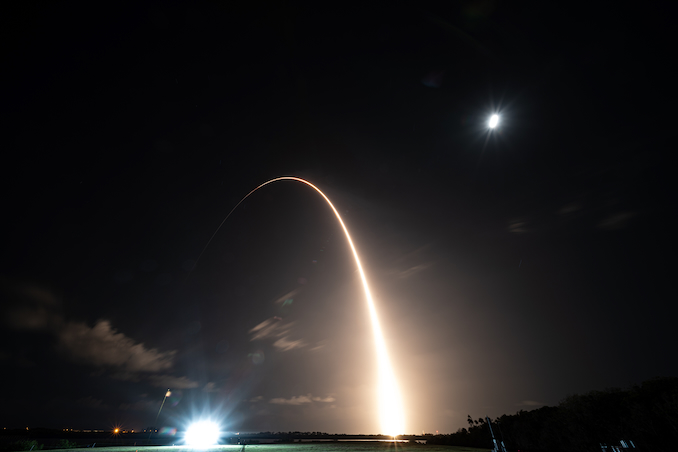
The LA-06 mission came about 23 day and 19 hours after the last Atlas V launch at pad 41. ULA’s previous turnaround record at this site was 26 days, 5 hours, 19 minutes.
The new pad flow for this mission also meant different planned holds for the countdown. Prior to the start of fueling, there was a two-hour hold in place beginning at T-minus 2 hours.
The LA-06 mission will bring the Amazon Leo constellation up to a total of 270 satellites on orbit. This is the 10th launch overall for the constellation, including three flights on SpaceX Falcon 9 rockets and one flight on an Arianespace Ariane 64 rocket.
The initial Amazon Leo constellation will contain more than 3,200 satellites.
Atlas V rolled from the VIF to the pad at SLC-41 with another 29-satellite Leo payload, exactly 23 days after our last mission with @ULAlaunch. Leo Atlas 6 (LA-06) is scheduled to liftoff tonight, Apr 27, at 8:52 p.m. ET.
ULA is using a streamlined roll-to-launch flow for this… pic.twitter.com/SA8F7UUiLg
— Amazon Leo (@Amazonleo) April 27, 2026