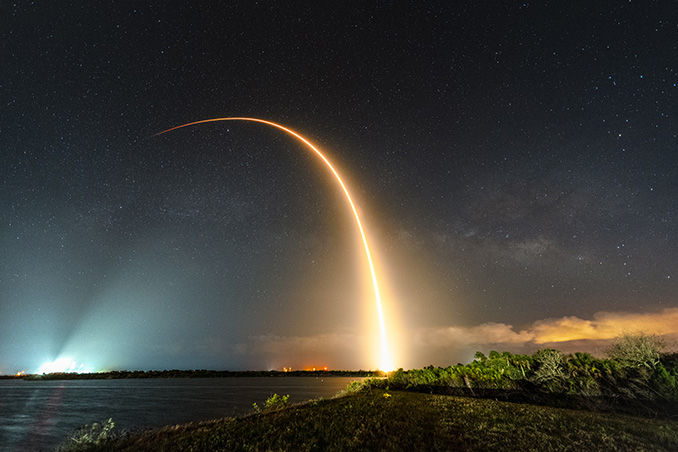
The U.S. Space Force launched its final Global Positioning System (GPS) III satellite into medium Earth orbit in the predawn hours of Tuesday aboard a SpaceX Falcon 9 rocket.
Liftoff from pad 40 at Cape Canaveral Space Force Station occurred at 2:53:25 a.m. EDT (0653:25 UTC).
The mission was delayed a day due to poor weather in the recovery zone for the first stage.
The satellite for the GPS III-8 mission is officially designated Space Vehicle 10 (SV10) satellite but is also named ‘Hedy Lamar’ after the Austrian-American actress and inventor whose frequency-hopping research led to the development of technologies, like GPS satellites, WiFi, and Bluetooth.
“Today marks an important milestone for our unit and for the entire GPS enterprise. As we prepare to launch the final satellite in the GPS III block, we’re closing out a chapter that has defined the last several years of work for this team,” said USSF Col. Stephen Hobbs, the Mission Delta 31 (MD 31) commander within Combat Forces Command.
“Closing out the GPS III block is not the end of the story, but rather it’s a foundation for what comes next. We’re excited to turn the page and continue advancing our mission with the GPS IIIF generation, bringing even greater capability to the joint force and to the global users who rely on this system every single day.”
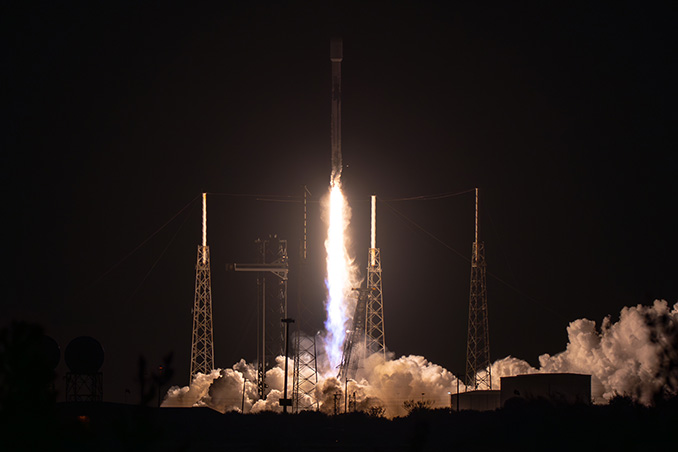
SpaceX launched the mission using the Falcon 9 first stage booster B1095, which flew for the seventh time after launching six batches of SpaceX’s Starlink satellites.
The GPS III SV10 satellite was encapsulated in two halves of the payload fairing, one of which flew for a second time and the other for a third time. One of the pair was used on the GPS III-9 mission back in January.
“So that was a huge benefit for us and for the Space Force team to take advantage of that from a mission assurance perspective,” said Anne Mason, SpaceX’s director of its National Security Space Launch (NSSL) division.
A little more than 8.5 minutes after liftoff, B1095 landed on the drone ship, ‘Just Read the Instructions.’ Both halves of the payload fairing were also to be recovered after splashing down a little further downrange than the booster.
The drone ship will be devoted to supporting the Starship program, SpaceX said.
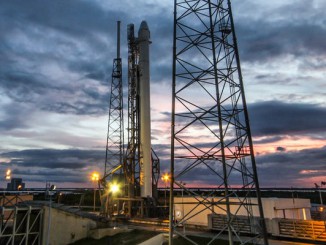
Falcon 9 vertical at pad 40 pic.twitter.com/djQW8nJINH
— SpaceX (@SpaceX) April 20, 2026
The mission also represented the fourth time that SpaceX will carry to orbit a GPS satellite that was originally assigned to United Launch Alliance as part of the NSSL Phase 2 contract with the U.S. Space Force.
Previous GPS satellites were moved from ULA’s Vulcan rocket to SpaceX’s Falcon 9 because of development delays with that rocket. Vulcan didn’t receive certification to fly NSSL payloads until the spring of 2025.
During its most recent launch, USSF-87, the rocket suffered a problem with one of its Northrop Grumman-built solid rocket boosters. The payload was able to be delivered to the intended orbit, but the launch vehicle is grounded in its most powerful configurations until an investigation is completed.
“One of the things we really pride ourselves on here on the NSSL program, is our flexibility and responsiveness, and a lot of that goes to our our contracts, the way they’re set up, that allow for swaps like this,” said USSF Col. Ryan Hiserote.
“For any of these swaps, we have to have both launch providers agree to it. So both SpaceX and ULA have agreed to all of these swaps. So just that process and teamwork has gotten a little bit faster and tighter each time.”
In exchange for putting the GPS III SV10 satellite on a Falcon 9 rocket, ULA in turn will fly the USSF-70 mission on a Vulcan rocket in 2028. That mission with an undisclosed payload was originally set to fly on a Falcon Heavy rocket.
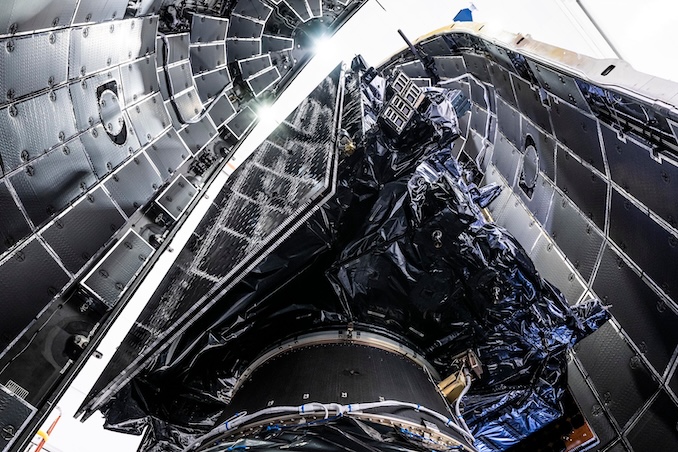
The GPS III-8 SV10 satellite will join a fleet of 38 spacecraft in medium Earth orbit, of which 32 are active. The others are held in reserve in case of a problem with the operational spacecraft.
Following the GPS III-8’s deployment, about an hour and a half after liftoff, the satellite will raise its orbit over a period of 10 days to achieve its operational position, said Fang Qian, Lockheed Martin’s vice president of its Global Positioning System program. That will be followed by two to three days of on-orbit testing before satellite operations are handed over to the Space Force.
“And on this particular launch, because we have the optical cross-link demo, we will likely be doing a little more testing to ring out what capability that has to feed in future blocks of the IIIF satellites,” Hobbs said.
The optical cross-link demonstration is a laser communications system that is being tested on this mission before it’s integrated on the next-generation GPS IIIF satellites. The SV10 satellite also carries with it a new digital atomic clock for better precision as another technology demonstration.
“The final GPS III deployment is an important milestone as we continue strengthening the GPS constellation,” Qian said in a post-launch statement. “By launching SV10 into orbit, we’re not only adding to the resiliency of today’s GPS capabilities – we’re opening the door to the next generation of GPS IIIF satellites that will provide greater resiliency and serve as the backbone of the GPS constellation for years to come.”