Update April 29, 3:30 p.m. EDT (1930 UTC): SpaceX confirms successful deployment of the ViaSat-3 F3 satellite.
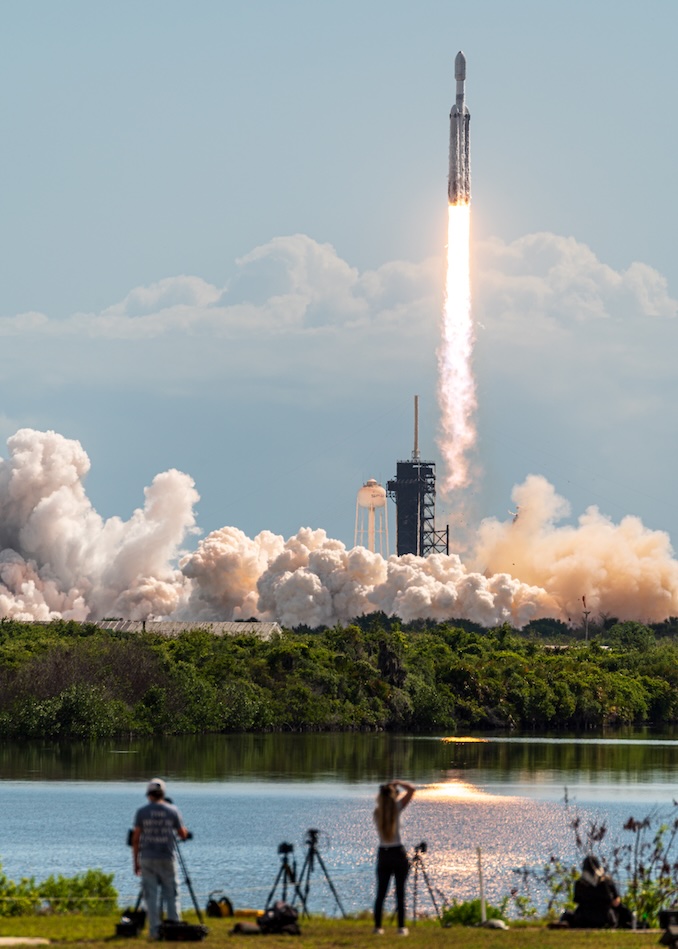
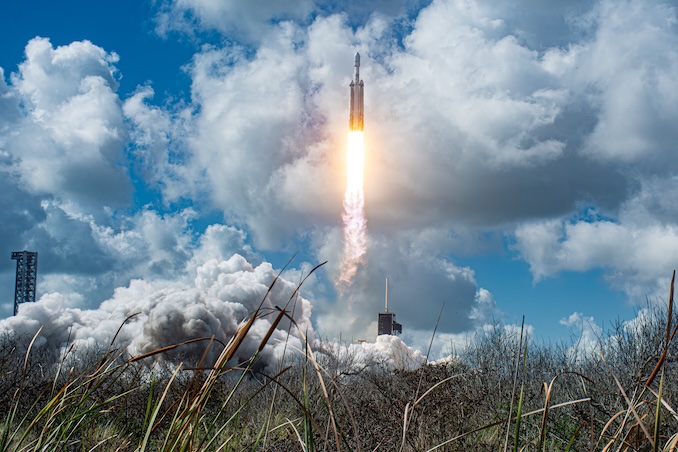
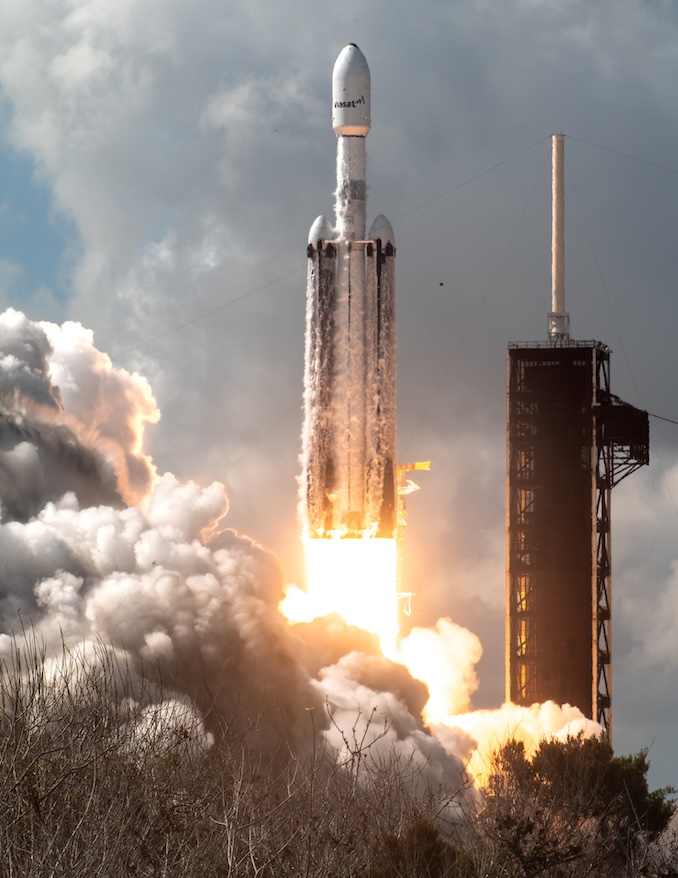
SpaceX’s most powerful operational rocket, the Falcon Heavy, lifted off Wednesday carrying a massive communications satellite on its 12th flight since 2018.
The 27 Merlin engines of the three Falcon boosters roared to life at 10:13 a.m. EDT (1413 UTC) and the 70-meter-tall (229.6 ft) rocket thundered away from Launch Complex 39A propelled by 5 million pounds of thrust.
Less than 2.5 minutes after liftoff, the side boosters, tail numbers B1072 and B1075, throttled down on their engines and separated from the center core, tail number B1098. Both side boosters performed a boost back burn lasting more than a minute to put them on track towards two landing pads at Cape Canaveral Space Force Station. The center core, B1098, continued on for another 90 seconds before the second stage separated and began the first of three burns over five hours to deliver the ViaSat-3 F3 satellite to a geosynchronous transfer orbit.
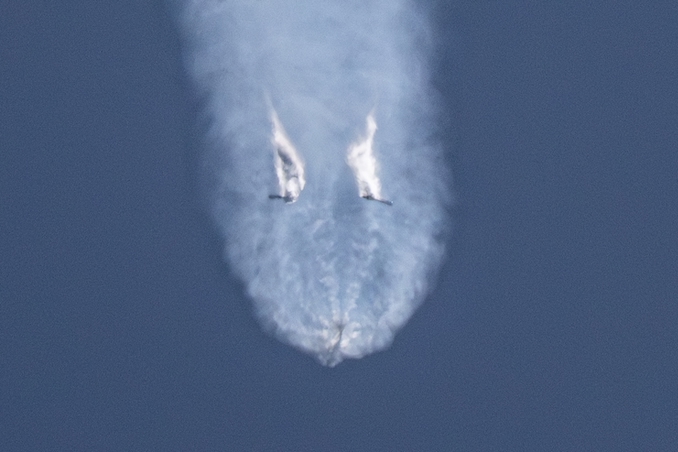
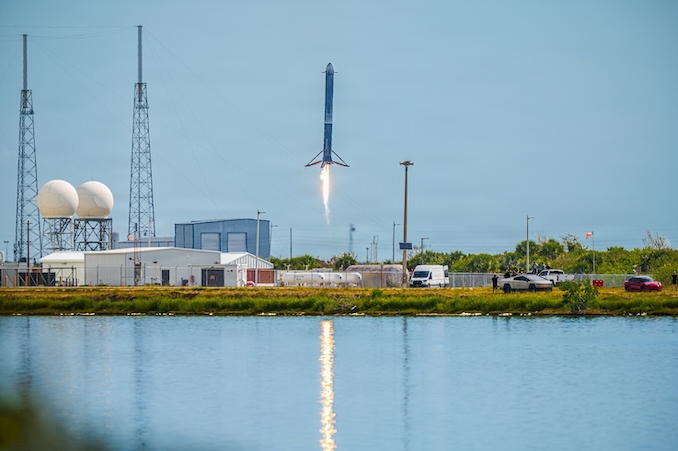
Less than eight minutes after the flight began, B1072 and B1075 reignited their center engines and touched down at Landing Zone 2 and Landing Zone 40. This was the first Falcon Heavy rocket launch to use SpaceX’s newest landing pad at Space Launch Complex 40. As with most Falcon Heavy missions, SpaceX did not recover the center core.
One more ignition of the Merlin Vacuum engine on the upper stage was on tap before deployment of the satellite came at nearly five hours after liftoff. The upper stage featured an additional thermal protection layer to ensure the fuel, a rocket-grade kerosene, does not freeze during the roughly four-hour coasting phase between the second and third engine ignitions.
The ViaSat-3 F3 satellite is the second in the series to be launched onboard a SpaceX Falcon Heavy rocket and the third and final member of this constellation. The first satellite, ViaSat-3 Americas, launched on a Falcon Heavy rocket in 2023.
Deployment of @viasat-3 F3 confirmed pic.twitter.com/wGOrxGt8jh
— SpaceX (@SpaceX) April 29, 2026
“It’s kind of the end of an era. We’ve been working this program for over 10 years now. So that’s a good chunk of life that’s gone by over the course of the program,” said Dave Abrahamian, Viasat’s vice president of Satellite Systems, during a prelaunch interview with Spaceflight Now.
“It’s a different world now than when we started the program. Back then, we had a handful of satellites in orbit. Since then, we’ve launched the two ViaSat-3s, we merged with Inmarsat, we’ve got the third one (ViaSat-3) ready to go now. So totally different world, different feeling, and its pretty cool to have been part of it all.”
After the satellite is released, there will be a roughly two-month period of orbit raising for the spacecraft before it reaches its operating position at 155.58 degrees East along the equator.
This third and final satellite in the ViaSat-3 constellation will target its area of coverage over the Asia-Pacific region and is intended to add more than one Terabit per second (Tbps) of capacity to the overall Viasat network.
“We have a number of airline customers in the APAC region that are really anxious to get this capacity online so they can start serving their customers better,” Abrahamian said. “Two of the hallmarks of the ViaSat-3 constellation are a huge amount of just absolute capacity, but also the flexibility to put it wherever you need it, whenever you need it.
“So it’s not like a traditional satellite, like a ViaSat-1, or Ka sat, or most of the Inmarsat fleet, where you’ve got a single feed per beam, beam locations are fixed, spectrum allocations are fixed and you might overload one beam over here and another beam doesn’t have anybody in it and you can’t move that capacity.”
Abrahamian said the advantage of these newer satellites is their overall flexibility.
“ViaSat-3 because we’re using a phased array technology and our antennas onboard, we can form a beam wherever we need it,” he said. “We can allocate spectrum to it as we need it. We can put multiple beams in an area as needed. So we really don’t have the issue of trapped capacity here. So it’s a matter of following the demand wherever it is, within that spacecraft’s field of view.”