Update July 7, 6:08 a.m. EDT (1008 UTC): SpaceX confirmed deployment of all payloads.
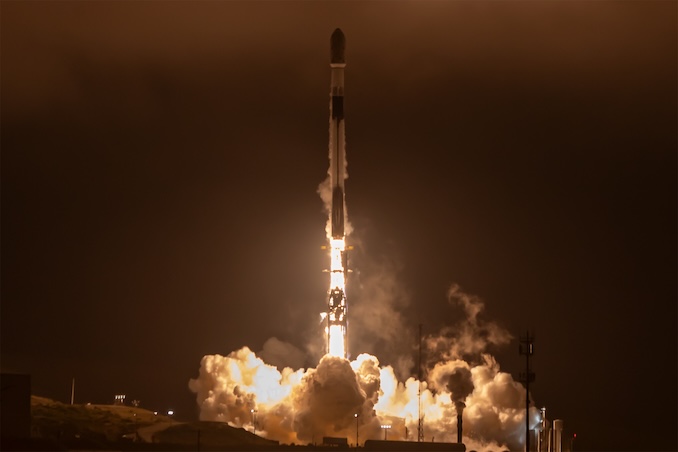
A SpaceX Falcon 9, launched from California, ferried dozens of customer satellites from around the world into a Sun-synchronous Earth orbit shortly after midnight local time on Tuesday.
The Transporter-17 mission, with 81 payloads aboard, is part of the company’s Smallsat Rideshare Program, which also includes the mid-inclination Bandwagon missions as well as the dawn-dusk Sun-synchronous orbit Twilight flight.
Liftoff from Space Launch Complex 4 East at Vandenberg Space Force Station happened at 12:12 a.m. PDT (0312 EDT / 0712 UTC).
SpaceX launched the mission using the Falcon 9 first stage booster B1097, which was its 11th flight after launching Twilight, NROL-172, and Sentinel-6B and seven Starlink missions.
Nearly 8.5 minutes into the flight, B1097 landed on the drone ship, ‘Of Course I Still Love You’, positioned out in the Pacific Ocean. This was the 208th landing on this vessel and the 634th booster landing for SpaceX to date.
Following a four-second trajectory correction burn about 51 minutes after liftoff, the first deployment sequence began. The Osiris-A payload, one of twelve satellites manifested by California-based Maverick Space System, kicked off the first deployment sequence.
All but one satellite were released during that roughly 20-minute deployment period. SpaceX reignited its Falcon 9 upper stage engine two more times before it deployed the final satellite, South Korea’s Earth observation satellite, called CAS500-4, roughly 2.5 hours after liftoff.
What’s onboard?
The Transporter-17 mission continued SpaceX’s model of launching dozens of satellites from companies around the world. Once again, the majority of the payloads hitching a ride on this Falcon 9 rocket were manifested by Exolaunch, which has placed satellites on every Transporter mission going back to the start of the Smallsat Rideshare Program in 2020.
On this flight, Exolaunch was responsible for 49 out of the 81 satellites, representing 20 international customers.
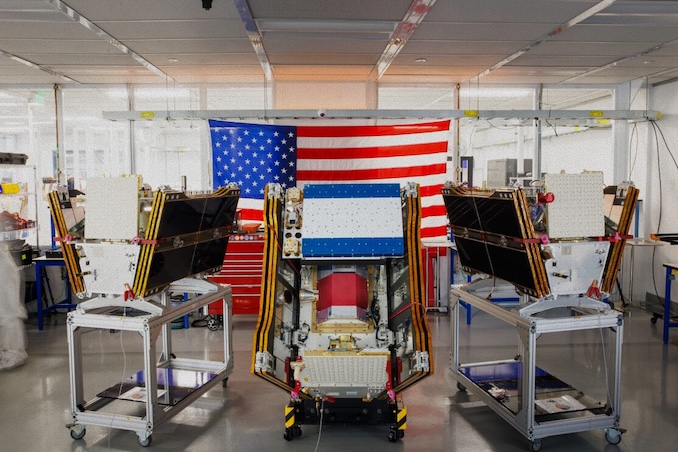
Among the Exolaunch-back payloads were three of Muon Space’s FireSat satellites, designed for the nonprofit Earth Fire Alliance. They build upon the prototype satellite launched in March 2025, which is helping to detect wildfires from orbit.
The Earth Fire Alliance stated on its website that it aims for a constellation of more than 20 satellites in low Earth orbit between 2027 and 2029, allowing it to have a roughly one hour revisit rate on wildfires with an ability to detect fires as small as five by five meters. It aims to ultimately have more than 50 satellites in orbit.
“This story is about living with fire: learning from it, adapting to it, harnessing it, and building resilience around it,” the nonprofit wrote in a LinkedIn post. “Inspired by a species of bird that has evolved alongside fire, our Black Kite Trio (BK-3) mission reflects Earth Fire Alliance’s vision of helping people, ecosystems, and communities confidently coexist with fire.”
Other Exolaunch-manifested payloads include four of Iceye’s synthetic aperture radar satellites, Bro-31, the first of Unseenlabs’ second-generation satellites designed for space-based radio detection; and Leonav-1, the United Arab Emirates first low Earth orbit PNT (position, navigation, and timing) satellite.
Another company responsible for multiple payloads was Maverick Space Systems. Among its manifested payloads are a pair from the Taiwanese National Central University. Those are SCION-X (Scintillation and Ionosphere Extended), which will study the ionosphere and upper atmosphere, and KOYO (Kinetic Optical Yaw Observer), which will test a fiber optic gyroscope.
Seops Space also has 10 payloads it manifested for customers across five countries. Those include GRITSS (Geodetic Reference Instrument Transponder for Small Satellites), a CubeSat from ISISPACE (Innovated Solutions in Space) with support from UMass Lowell and NASA, and SPEAR-1 (Space Power and Energy Advanced Recon), a satellite developed by NearSpace Launch under a contract from the Naval Research Laboratory and the Department of Defense.
“The mission is part of a three-spacecraft constellation built using NearSpace Launch’s ThinSat® architecture, a platform designed to provide a rapid and cost-effective path for testing new technologies in orbit,” Seops said in a prelaunch release. “By raising the Technology Readiness Level of critical systems, missions like SPEAR help ensure promising innovations can move more quickly from research into operational use.”
Polish-German manufacturing company, Orbital Matter, also flew its Replicator-2 satellite on this mission. It focuses on the capability of 3D printing materials in the vacuum of space.
“It has 4 of our Printer Assisted Deployment Systems (P.A.D.S) onboard, 2 of which will be used to deploy our custom in-house designed foldable solar array. The other two will be standalone printers, one of which is deploying a secret antenna payload,” wrote Robert Ihnatisin, Orbital Matter CEO, on LinkedIn.
“The goal for this mission is to not only show that 3D printing is possible directly in the harsh space environment but also to show that it can be used for deployment right now! This is the latest in a string of missions focused on advancing our printing technology, with each mission getting us closer to the target of large scale and cheap solar power in orbit.”