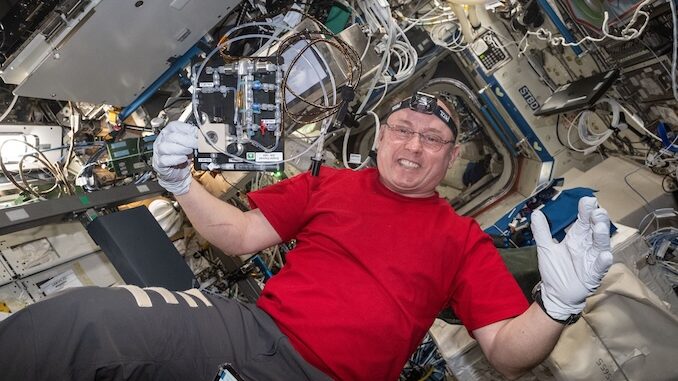
Mike Fincke, a retired United States Air Force colonel and NASA astronaut of 30 years, is retiring from the agency’s Astronaut Office. He’s one of only 13 people who launched to orbit from Earth onboard three different spacecraft.
Fincke among 44 astronauts selected in 1996 for the 16th astronaut class, nicknamed “The Sardines.” He flew to space four times: twice on Soyuz, once on Space Shuttle Endeavour, and once on the SpaceX Dragon Endeavour.
“After exactly 30 years, I am departing NASA, but I remain deeply committed to the work of exploration.” Fincke said in a statement shared by the agency. “NASA gave me the extraordinary privilege of serving alongside remarkable people, flying and helping develop spacecraft, and contributing to the International Space Station from its earliest days through command in orbit.”
Fincke’s time as a NASA astronaut saw him serve as commander of the International Space Station twice. The first time was from Oct. 22, 2008 through April 2, 2009, during Expedition 18 and the second time was from Dec. 7, 2025 through Jan. 12, 2026, during Expedition 74.
“I am profoundly grateful to my crewmates, the teams on the ground, our international partners, and the families who make this work possible. I am excited to carry those lessons forward and help prepare the next generation of engineers, explorers, and leaders,” Fincke said. “Together, we will return humanity to the Moon, travel to Mars, journey outward to the planets and moons beyond Earth, and someday reach for the stars – all while caring for Earth, the most beautiful planet in our solar system.”
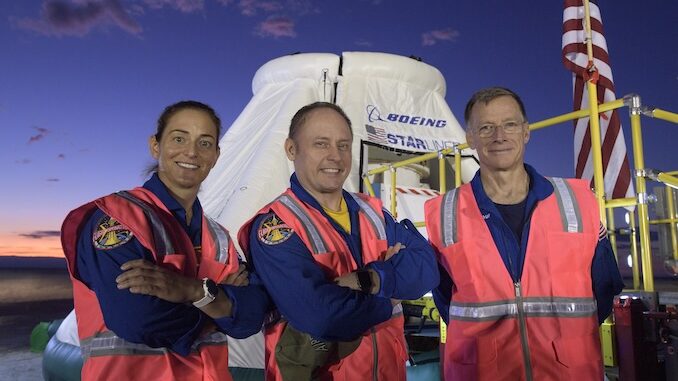
A notable chunk of Fincke’s NASA career was in service of the Commercial Crew Program. He was at one time the chief of the Astronaut Office’s Commercial Crew Branch and in January 2019, he replaced Eric Boe as one of three crew members slated to fly the Crewed Flight Test of the Boeing CST-100 Starliner spacecraft.
As development of that program dragged on and crews were shuffled multiple times, Fincke was moved to the backup pilot role on the CFT mission and eventually trained alongside NASA astronaut Scott Tingle, Canadian Space Agency (CSA) astronaut Joshua Kutryk, and Japan Aerospace Exploration Agency (JAXA) astronaut Kimiya Yui as a member of the Starliner-1 mission.
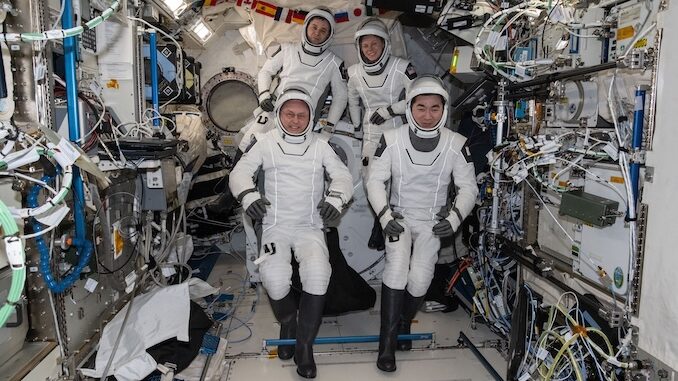
However, after the ill-fated flight of the CFT mission in 2024 with NASA astronauts Butch Wilmore and Suni Williams, Fincke and Yui were reassigned to the SpaceX Crew-11 mission. The duo launched to the space station alongside NASA astronaut Zena Cardman and Roscosmos cosmonaut Oleg Platonov on Aug. 1, 2025, for a mission that lasted 166 days.
But the mission ended early when Fincke had to be medically evacuated from the ISS.
Initially, NASA withheld the identity of the crew member that triggered the medical emergency, but Fincke later told the Associated Press he had a bizarre episode while eating dinner on Jan. 7 when he just suddenly couldn’t speak for about 20 minutes.
“It was completely out of the blue. It was just amazingly quick,” Fincke told the AP in an interview published March 7. “My crewmates definitely saw that I was in distress. It was all hands on deck within just a matter of seconds.”
Neither Fincke nor NASA have elaborated on the specifics of the incident due to medical privacy concerns.
Starliner’s future beyond Fincke
Fincke’s departure from NASA means yet another astronaut with deep knowledge of the Starliner program is now gone.
Other NASA astronauts who trained on Starliner and departed include Wilmore and Williams who retired in 2025 and 2026 respectively as well as Josh Cassada, who left the agency in October 2024, and Jeanette Epps, who departed in June 2025.
Both Cassada and Epps were assigned at one time to the Starliner-1 mission before being reassigned to Crew-5 and Crew-8 respectively.
Since Tingle became the chief of the Astronaut office along with the reassignment of Fincke and Yui to Crew-11 as well as Kutryk to Crew-12, the Starliner-1 mission became a cargo-only flight to the ISS to ensure that the vehicle can safely operate.
During the Crew-13 news conference at the Johnson Space Center in Houston, Texas, on Aug. 3, Dana Weigel, Manager of NASA’s Low Earth Orbit Program, said that there are astronauts generally training on Starliner, but didn’t name names.
“From a crew office standpoint, we have had, we always have astronauts that follow any of our major developments and we do have crew members who are following Starliner development,” Weigel said.
“It’s a structured contractual problem in terms of when astronauts have to be assigned and it’s different for the given provider, but roughly you’re looking about a year, a little bit more than a year,” said Richard Jones, Deputy Director of the Commercial Crew Office within the LEO Program. “I’m gonna keep it a little bit generic with respect to making sure that an assignment is in place. In terms of being ready for a Starliner mission, we’re making a lot of progress in that area, understanding the anomalies that have been in place.
“So we do have a lot of astronauts following every step of the way, right? They are following every single decision, assessment that are being done in that area. And so, whenever that time comes for a crewed assignment, NASA will be ready to tell the public about who it is and why.”
NASA is still assessing whether the uncrewed Starliner-1 mission will fly this year and if so, when. The timing of that will help dictate when a crewed Starliner-2 mission would happen.