Rocket Lab’s anticipated debut of its medium-lift Neutron rocket may end up slipping beyond this year and into 2027.
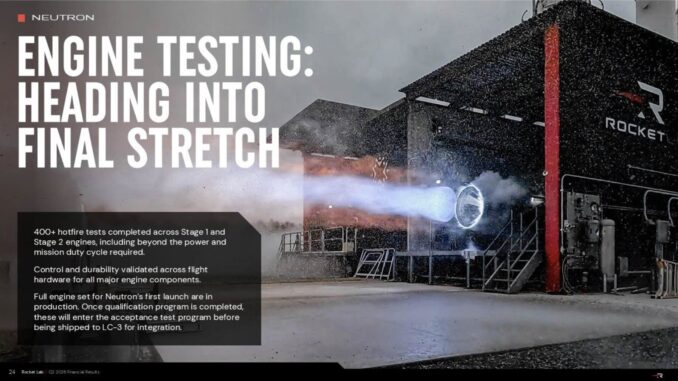
In a filing to the U.S. Securities and Exchange Commission (SES) ahead of is second quarter 2026 earnings call with investors on Tuesday, the company noted that it’s working through various qualification testing and made “significant milestones across the Neutron program.”
“Production of the Stage 1 tank is currently aligned with the target delivery of Neutron to the launch pad in Q4 2026,” the company wrote in its filing. “While the window for an end-of-year launch date is narrowing, we are balancing the schedule of the first launch with entering Neutron into service as a system ready for full-scale production and high-cadence launch beyond flight one.
“Exact launch timing will also depend on the outcome of first stage qualification and other critical tests occurring later in 2026.”
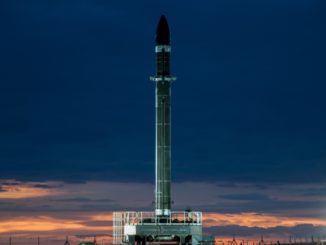
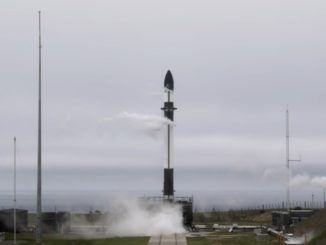
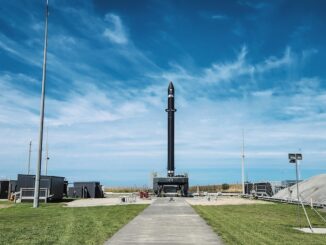
Rocket Lab’s Neutron rocket, a 43-meter-tall (141 ft.), liquid methane-fueled launch vehicle, was announced back in March 2021 and has been in development ever since. It’s designed with a reusable first stage booster that features actuating payload fairing halves that remain fixed to the booster after the second stage and payload are released.
Back on Jan. 21, the company’s first stage fuel tank ruptured unexpectedly during a water loading test called a “hydrostatic pressure trial.” That setback pushed the planned debut from the middle of the year to late 2026.
During Monday’s earnings call, Rocket Lab founder and CEO Peter Beck said the ability to reuse its rockets will be the x-factor that can unlock good launch cadence.
“As we’re working forward with the vehicle right now, and the way we’re thinking about things, it’s not just to get to the pad quickly for flight one. Of course we all want that and no one more than I, but it’s really about how do we get to flight ten in the shortest time possible,” Beck said.
“So for us, it’s all about reusability. And we’re constantly trading the timelines and the qualification criteria for the various systems and subsystems to get to the pad for flight one, but also making sure that when it comes to flight ten, that we don’t have to go back and re-qualify things,” he added. “So there’s a constant assessment along that way.”
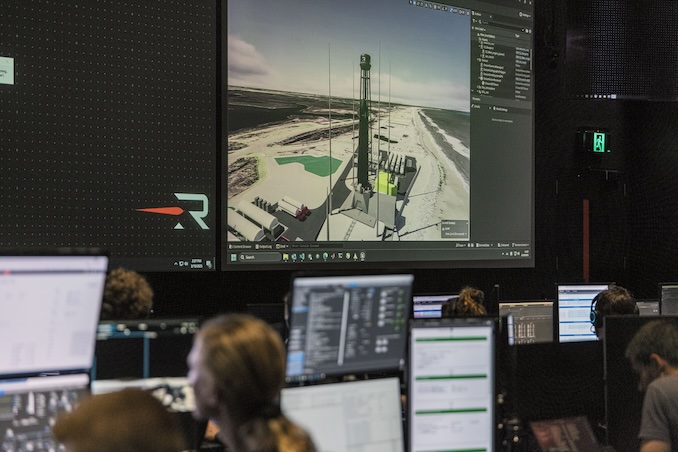
Asked about the milestone with the highest risk on the road to Neutron’s debut, Beck said it would be the integrated static fire testing that will happen at the launch pad in Virginia.
“The stage testing is always the thing that gets your adrenaline running because you have fully fueled vehicles on the pad and you’re igniting the engines for the first time. And I think you can also see for another space company that when it doesn’t go well, it really doesn’t go well,” Beck said, making a nod to the explosion of Blue Origin’s New Glenn rocket during a static fire test on May 28 prior to its fourth planned launch.
Awaiting their ride
The future for Neutron launches includes the defense sector, where Rocket Lab holds a $397 million contract for building and launching satellites for the U.S. Space Force’s (USSF) Space-Based Airborne Moving Target Indicator (SB-AMTI) program. Launch dates for this program haven’t been announced.
Neutron will also be able to compete for task orders as part of the National Security Space Launch Phase 3 Lane 1 procurement contract, managed by the USSF’s Space Systems Command.
On the commercial side of the ledger, Rocket Lab also has more than half a dozen customers lined up for flights on the rocket. The newest of those is Kepler Communications, based in Toronto, Canada.
Neutron has been selected for a dedicated launch by @KeplerComms as part of their largest network expansion yet – the first time Kepler has booked an entire rocket for constellation deployment rather than fly rideshare.
Press release: https://t.co/vQJAttEbTe pic.twitter.com/gPVrPVcAdh
— Rocket Lab (@RocketLab) August 10, 2026
Ahead of its second quarter 2026 earnings call with investors, Rocket Lab unveiled that it will fly a dedicated mission for Kepler no earlier than 2028 to “deploy multiple satellites to low Earth orbit, expanding Kepler’s constellation with additional optical connectivity, on-orbit compute, and hosted payload capacity. The satellites will support a range of commercial and government missions.”
The previous 33 satellites launched for Kepler were on rideshare missions across a series of rockets beginning in 2018. Those included China’s Long March 11, India’s PSLV-CA, Russia’s Soyuz-2.1a, and SpaceX’s Falcon 9.
The most recent batch flew as part of SpaceX’s Twilight rideshare mission in January 2026. The promised NET 2028 launch for Kepler marks its first dedicated flight, though the specific number of satellites that will fly onboard hasn’t been disclosed.
“Securing our first dedicated launch reflects the next stage of growth for Kepler,” said Beau Jarvis, Chief Revenue Officer of Kepler, in a statement. “As we continue expanding our constellation to keep pace with growing customer demand, multiple launches in 2028 will increase capacity, strengthen resilience, and enable new services for customers around the world. Rocket Lab is an outstanding partner for this important milestone.”
During the earnings call, Beck called this launch contract “another strong signal of the expectation for Neutron to become the industry’s alternate ride to space for medium-lift missions,” alongside the Falcon 9 rocket.
“We have a proven track record with Electron and HASTE (Hypersonic Accelerator Suborbital Test Electron) and customers know we develop and scale reliable launch vehicles, which is why they’re coming to us now and locking in Neutron slots early,” Beck told investors. “Neutron is going to help unblock the industry’s bottleneck, giving operators a reliable capacity that they need for years to come.”