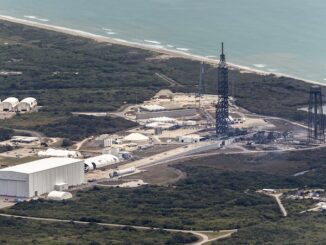
Correction Aug. 6, 8:52 p.m. EDT (0052 UTC): Fixed a line suggesting that Amazon Leo satellites were on the New Glenn rocket when it exploded. That was not the case.
Blue Origin CEO Dave Limp said an issue with the main oxygen valve on a BE-4 engine was the source of the explosion that destroyed a New Glenn rocket during a static fire in May ahead of the company’s fourth orbital flight.
“The anomaly originated at the main oxygen valve on one of the BE-4 engines, which was later confirmed by hardware recovery and inspections,” Limp wrote in a social media post that came more than two months after the blast that damaged Blue Origin’s sole orbital launch site, Launch Complex 36 at Cape Canaveral. “Extensive component-level and engine hotfire tests have been conducted to understand the failure mode better and inform mitigations.”
The New Glenn rocket is powered by a total of seven BE-4 engines on its first stage. They’re fueled by a combination of liquid methane and liquid oxygen and are each capable of producing 640,000 pounds of force at liftoff.
Blue Origin flew three New Glenn missions prior to the May 28 explosion. The rocket was being readied for a launch of 48 Amazon Leo satellites, but the payload was safe in another facility and far away from the rocket when the explosion occurred.
Since the incident, Blue Origin mostly focused its updates on the repairs being done to the launch complex in service of the goal of returning to flight before the end of the year.
New doors are going up at our Integration Facility at LC-36. Each of the six door panels on the North side stands 88 feet tall and weighs approximately 40,000 pounds for a total door opening width of approximately 196′. The South end comes next. pic.twitter.com/pIilnFZNLv
— Dave Limp (@davill) July 30, 2026
Limp said based on their understanding on the anomaly that led to the explosion, “the path forward is clear.”
“We’re making small modifications to the valve that can be quickly retrofitted to existing engines,” Limp wrote. “We’re manufacturing the updated hardware, which will be ready by the end of this month. In parallel, we’re working through the remaining fault tree analysis.”
Other engine user
United Launch Alliance (ULA) also relies on the BE-4 engine for its Vulcan rocket. It uses two BE-4 engines to power the rocket’s first stage.
The BE-4 engines designed for the Vulcan rocket are not identical to those used by New Glenn, since the latter includes features for relight, landing and reuse.
In a statement to Spaceflight Now, a ULA spokesperson said that Blue Origin will perform the necessary modifications to the Vulcan BE-4 engines. That work with happen both at ULA’s Decatur, Alabama, rocket manufacturing plant as well as at its Cape Canaveral facilities.

ULA’s most recent flight of Vulcan was the USSF-87 mission for the U.S. Space Force back in February 2026. An problem with one of the solid rocket boosters (SRB) on that mission — unrelated to the BE-4 engines — caused the launch vehicle to be grounded.
“The integrated U.S. government and contractor team (ULA/Northrop Grumman/U.S. Space Force) is actively investigating and continues to work through the technical data, available imagery and collected debris from the SRB anomaly,” the spokesperson said. “The investigation is robust including causal analysis, technical analysis, lifecycle testing and much more. While we will not fly until we conduct a thorough investigation, identify root cause and implement corrective action, but we are working hard to have Vulcan’s return to flight this year.”
Part of that return to flight plan included a series of fueling tests that have been happening out at the pad at Space Launch Complex 41. The company is working with its low Earth orbit (LEO)-optimized Centaur upper stage and was expected to perform a full wet dress rehearsal today, following early tanking tests with just new Centaur.
Ripple effects
Blue Origin continues to hope to return New Glenn to flight before the end of the year.
New Glenn is capable of launching more Amazon Leo’s satellites per flight than the four other vehicles it contracted to fly its broadband internet satellites (Atlas 5, Ariane 6, Falcon 9 and Vulcan).
In a similar vein, AST SpaceMobile was also counting on having access to New Glenn this year to fly batches of eight of its BlueBird Block 2 satellites at once. For comparison, a Falcon 9 rocket, like the one that flew the BlueBird 11-13 mission on Wednesday, can only carry three of the satellites at once.
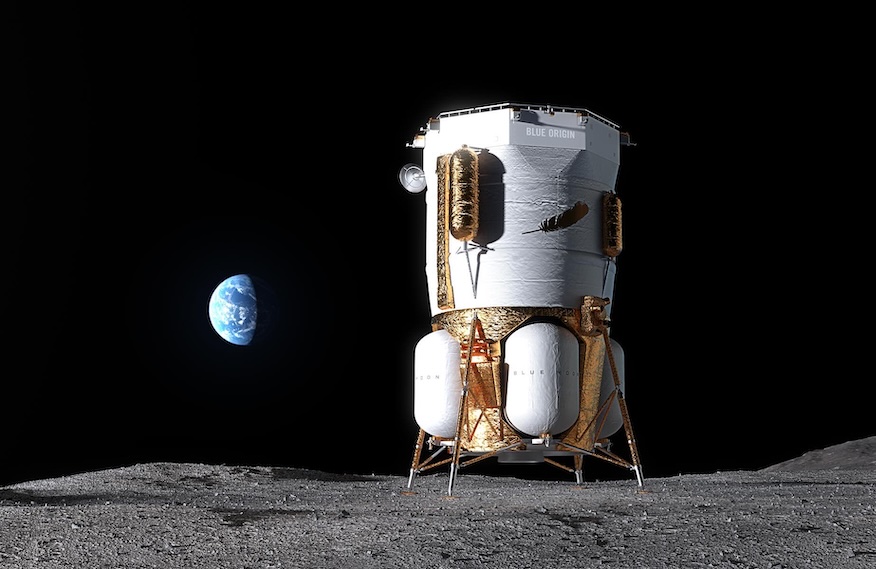
NASA is also relying on the return to flight of New Glenn in order for the company to demonstrate its cargo lunar landers called Blue Moon Mark 1. The first of these, Endurance, was originally slated to fly around the end of this summer, but is now being pushed to early next year at the soonest.
“We are working to have serial number one ready and stored in a quiescent state for when New Glenn is ready,” said John Couluris, Blue Origin’s senior vice president of Lunar Permanence, during a recent NASA tour of its Florida facilities. “We expect that launch to occur in Q1 of 2027. And once that’s complete, we’ll now continue on to serial numbers two, three and four.”