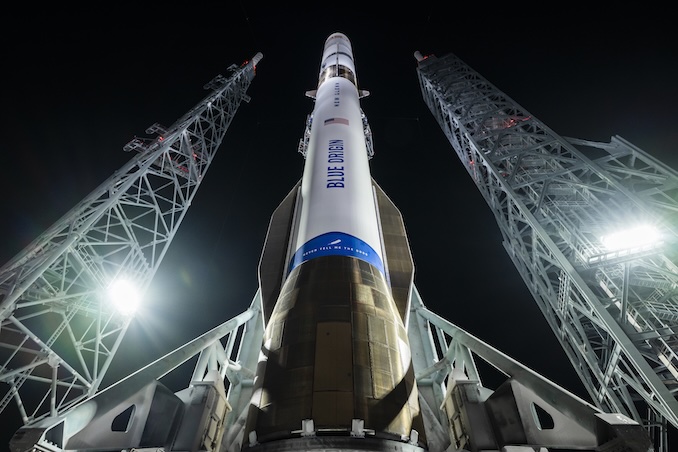
Days ahead of the planned third launch of a New Glenn rocket, Blue Origin was tapped by the U.S. Space Force to proceed towards developing its first launch site in California.
The Space Force said it picked Blue Origin’s proposal to develop Space Launch Complex 14 (SLC-14) at Vandenberg Space Force Base, the next step towards the company gaining permission for construction and future launch operations.
“The down-selection of Blue Origin to continue in the process for final determination of a lease at SLC-14 represents a critical milestone at the Vandenberg Spaceport,” said USSF Col. James Horne III, SLD 30 commander, in a statement. “By taking the next steps to further develop heavy and super-heavy space launch capabilities at SLC-14, we’re continuing to unleash our capacity to execute full-spectrum space operations for the nation.”
Back in December 2025, Space Launch Delta 30 (SLD 30) put out a Request for Information (RFI) to launch providers to gauge interest and seek preliminary proposals for how the launch site would be best used.
During a media roundtable on Tuesday afternoon at the Space Foundation’s 41st Space Symposium in Colorado, Horne noted that this is a so-called “green field development,” meaning that at present there is no infrastructure on the site, which is located near the south end of Vandenberg. He said SLD 30 would work quickly to get the Space Force’s side of the development moving along quickly.
“From a Space Force perspective, we provide the roads, how to use the services that the company needs to launch,” Horne said. “They invest in and spend their own money developing their pad to the fence line. Our job is to get to that fence line. So, you’ll see us rapidly accelerating to get there to enable launch as soon as possible.”
As for what exactly the launch site looks like, Horne deferred to Blue Origin for specifics, but did point to a “long-standing requirement” for the National Security Space Launch (NSSL) program that launch providers need to have capability for vertically integrating payloads onto their rockets.
United Launch Alliance provides vertical integration for its Vulcan rockets and previously did so for its Atlas 5 and Delta 4 rockets. SpaceX meanwhile only has horizontal integration capabilities for its Falcon 9 and Falcon Heavy rockets, but its Starship-Super Heavy rockets will vertically integrate its payloads at launch sites in both Florida and Texas.