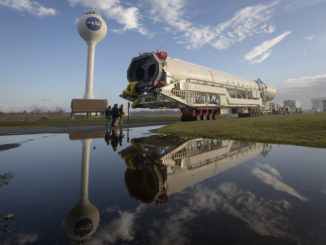
Antares Launcher

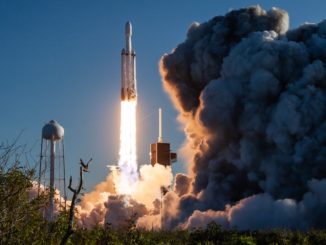
On its second flight, SpaceX’s mammoth Falcon Heavy rocket hurled an Arabsat communications satellite the size of a school bus nearly one-quarter the way to the moon Thursday, days after NASA’s administrator identified the privately-developed rocket as a backup to the agency’s behind-schedule Space Launch System for sending astronauts back to the lunar surface.

Ground teams analyzing data from a heat probe that got stuck soon after it started digging into the Martian crust under NASA’s robotic InSight lander still hope they can free the mole from an obstruction that halted its progress more than a month ago, but the mission’s chief scientist says the chances of completing the heat probe experiment — one of InSight’s two main science instruments — may not look promising.

Boeing said Tuesday the first orbital test flight of its commercial crew capsule, named the Starliner, will be delayed until August “in order to avoid unnecessary schedule pressure” and give priority on the Atlas 5 rocket’s manifest to a U.S. Air Force communications satellite. NASA confirmed Wednesday that officials have approved an extension of the Starliner’s first crewed mission to last up to several months.
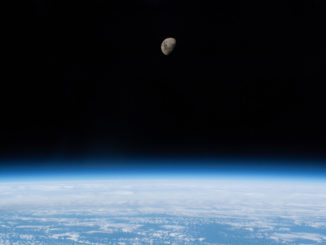
Vice President Mike Pence said Tuesday that NASA should land astronauts near the south pole of the moon within five years “by any means necessary,” calling for “new urgency” in the U.S. space program and sounding a warning for entrenched aerospace contractors to better meet schedule and cost commitments, or else lose work to other companies.
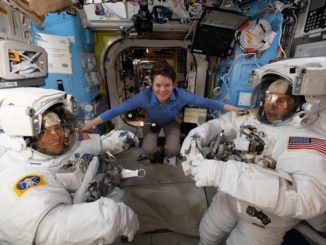
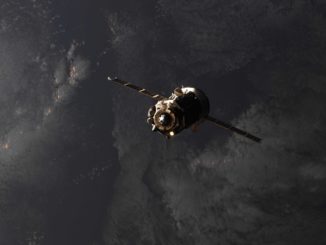
A Russian cosmonaut and his NASA co-pilot, five months after riding out a dramatic launch abort last October, finally made it into orbit Thursday and, along with a NASA astronaut making her first flight, docked with the International Space Station six hours later to boost the lab’s crew back to six.
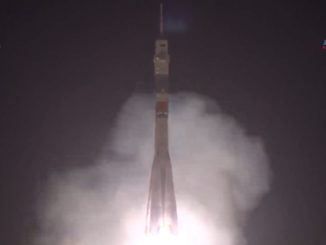
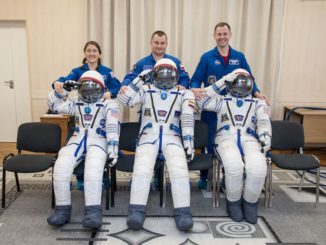
Russian commander Alexey Ovchinin, NASA co-pilot Nick Hague and astronaut Christina Koch lifted off aboard a Soyuz rocket Thursday from the Baikonur Cosmodrome in Kazakhstan, heading for the International Space Station to raise the research outpost’s crew complement back to six. The Soyuz booster launched at 1914 GMT (3:14 p.m. EDT), and docking at the space station occurred at 0101 GMT (9:01 p.m. EDT).
© 1999-2026 Spaceflight Now Inc