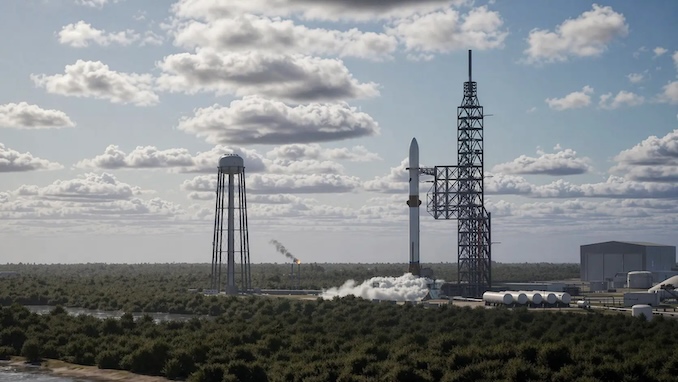
Blue Origin continues to analyze the explosion of its New Glenn rocket a little more than a month ago, but on Tuesday, CEO Dave Limp shared the company’s plan for resuming pad operations later this year.
“We continue to actively investigate the cause of the anomaly. The vehicle is highly instrumented with extensive data from multiple camera angles and sensors, giving us confidence in our ability to identify and correct the root cause,” Limp wrote. “Early analysis points to the aft section of the first stage.”
Spaceflight Now reached out to Blue Origin to inquire into whether this description indicated an issue with one or more of the Blue Origin-built BE-4 engines on the first stage. A response wasn’t provided prior to publication.
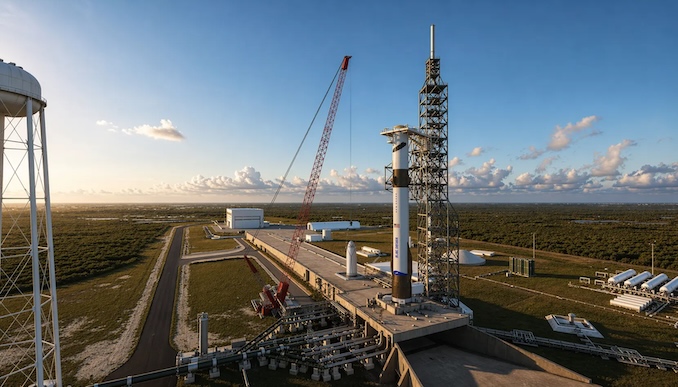
A couple days prior on June 28, Limp shared a short video to social media that showed the assembly of a large crane that will be used for the disassembly of the vehicle access tower that was left standing following the explosion, but was damaged. A few days before that, Limp noted that “wreckage recovery from start to finish was completed in nine days and all debris has been cleared from Launch Complex 36.”
The rocket was slated to launch the company’s first Blue Moon Mark 1 cargo lander, named Endurance, to the Moon as soon as late summer. It will carry some NASA science payloads onboard and was designated Moon Base 1 during an agency event on May 26.
But the damage to the pad and the mishap investigation are pushing that timeline to early 2027, according to Limp.
During the second Moon Base event on Tuesday, Carlos García-Galán, NASA’s Moon Base Program Executive, said the agency was “working with Blue Origin very closely to understand their timelines to recovery and also looking at all our options in case it doesn’t meet our timeline.”
“We’re paying a lot of attention, again, putting the entire NASA capability at the service of making this vendor successful,” García-Galán said.

He explained that for the NASA-led Moon Base, the agency wants multiple landers available for the program to keep a flow of infrastructure heading to the lunar surface to bolster learning for future, permanent infrastructure.
“We’ve been focused on helping Blue Origin with the determination of the root cause, we will help with building the infrastructure, but then we’re looking at options, like can we fly the Mark 1 lander — which is in tact and was not associated with the anomaly — can we fly that on a different rocket or then we’ll look at all the options for the payloads, depending on the timeline of the rocket getting back,” García-Galán said.
Sitting beside García-Galán, NASA Administrator Jared Isaacman added to that by stating that Blue Origin was “very committed” to resuming launches by the end of calendar year 2026. He said their recovery progress so far was “almost beyond impressive.”
“We’ve got time beyond that point, into 2027, before we’re getting nervous,” Isaacman said.
Concerning the path to launching the Blue Moon Mk.1 landers, he added, “Plan A was always New Glenn and Plan A is looking a lot better today than it was weeks ago, just based on the progress that the Blue Origin team is making.”
Beyond its first Blue Moon Mk.1 demonstration mission funded by Blue Origin, the cargo lander is also relying on New Glenn to launch NASA’s VIPER mission as well as lunar terrain vehicles developed by Lunar Outpost and Astrolab. The Blue Moon Mk.2 will be used on future crewed missions as part of the Artemis Program.
Moving to a hybrid model
As part of the company’s effort to return to flight before the end of the calendar year, Limp said Blue Origin would shift from an entirely horizontal integration model that relied on the now destroyed transporter-erector to one that utilizes some vertical integration elements as well.
“We’re going straight to a horizontal/vertical hybrid CONOPS we had already been developing for our 9×4 New Glenn launch vehicle, using existing infrastructure, skipping a new transporter-erector, and creating a common CONOPS across two pads,” Limp wrote.
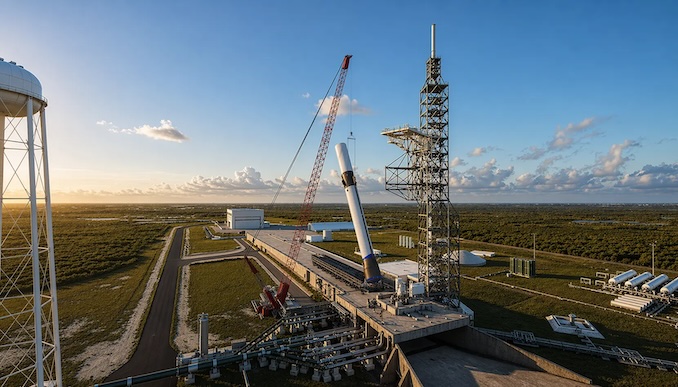
In a break down on its website, Blue Origin said for future New Glenn launches, it would integrate the first and second stages inside the horizontal integration facility adjacent to LC-36A. It would then be transported to the pad where a crane would hoist the rocket into a vertical orientation.
Blue Origin said this is “the reverse of the operation already used to offload the booster from Jacklyn.” The rocket is then placed “onto a refurbished launch table, where it mates to the launch vehicle hold-down ring. Umbilical connections are made between the main tower and the rocket.”
Renderings and an animation show that a platform fits around the upper part of the Glenn Stage 2 (GS2) upper stage as teams prepare the payload inside the fairing to be transported to the pad. That is then hoisted onto the rocket by the same crane the lifted the rocket.
The crane is cleared from the pad prior to a launch attempt. While not stated explicitly in the update, the crane may also be cleared from the pad prior to a static fire test of the booster.