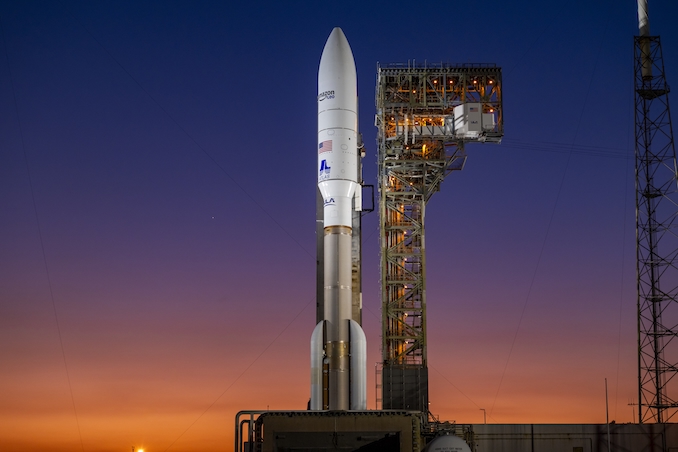
United Launch Alliance is preparing to launch its next Atlas 5 rocket, which will carry a batch of 29 Amazon Leo satellites to low Earth orbit. The mission will be the largest and heaviest payload carried to orbit by an Atlas 5 rocket to date, according to ULA.
The mission is called Amazon Leo 5 by ULA and Leo Atlas 5 (LA-05) by Amazon. This will be the fifth launch of operational satellites by ULA and the ninth for the constellation, which included one flight by Arianespace’s Ariane 6 rocket and three flights on SpaceX Falcon 9 rockets.
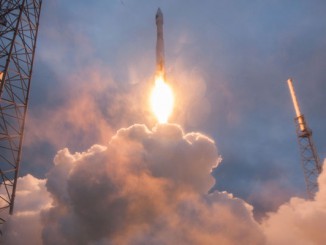
Liftoff of LA-05 is scheduled for Saturday, April 4, at 1:45 a.m. EDT (0545 UTC). The rocket will head out on a north-easterly trajectory upon leaving the launch pad. U.S. Space Force meteorologists predicted a 90 percent chance of acceptable weather for the launch.
Spaceflight Now will have live coverage beginning about an hour prior to liftoff.
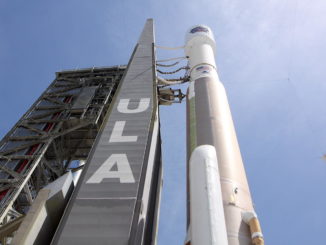
After completing its launch readiness review on March 26, the following morning, ULA began rolling out its 62.5-meter-tall (205 ft) rocket from its Vertical Integration Facility out to the pad at Space Launch Complex 41. The move began around 10 a.m. EDT (1400 UTC) and ULA reported a “hard down” at the pad at 11:16 a.m. EDT (1516 UTC).
However, with high winds forecast for the rocket’s original launch date of March 29, ULA was forced to push back the launch until the next available launch date at Cape Canaveral after NASA’s Artemis 2 launch.
The Atlas 5 rolled back to its hangar on Tuesday and returned to the pad Thursday.
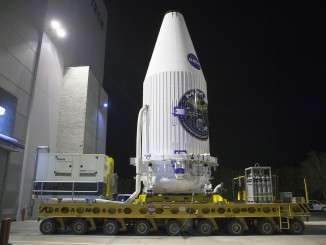
When it launches, the 29 Amazon Leo satellites will be released starting about 21 minutes after liftoff. The deployment sequence ends about 17 minutes later. The RL10C-1-1 engine on the Centaur 3 upper stage will then reignite about 55 minutes after liftoff for a disposal burn, which will end the mission.
The previous four missions for Amazon Leo launched on by Atlas 5 rockets carried 27 satellites each. ULA and Amazon Leo were able to increase the payload stack to 29 as “a result of detailed engineering work between ULA and Amazon,” according to ULA.
Amazon pointed to ULA’s use of the RL10C-1-1 engine on the rocket’s upper stage as a key reason why they were able to add two more satellites to the mission.
“While the engine has flown on previous missions, LA-05 marks the first time the program has completed the extensive engineering and safety analysis required to use it with our larger payload,” Amazon said in a blog post. “Our engineering teams capitalized on the additional performance margin, adding a fourth level to the previous three-tier dispenser configuration for Atlas 5.”