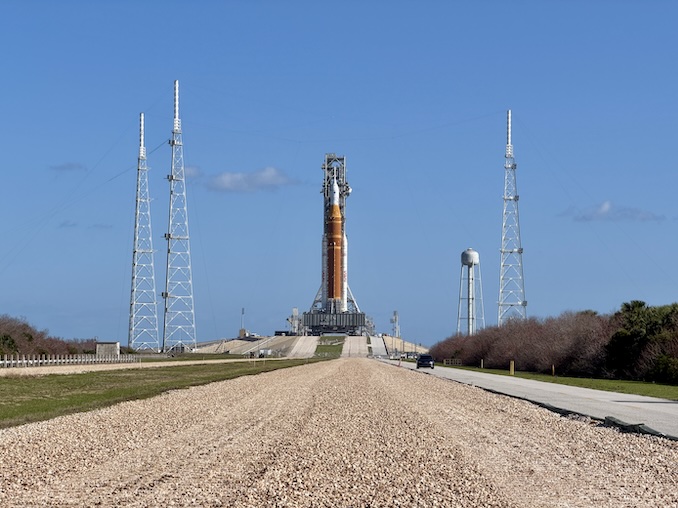
Update March 20, 12 p.m. EDT (1600 UTC): NASA confirmed completion of the Space Launch System rocket’s rollout.
NASA’s Moon rocket returned to the launch pad after repairs inside the cavernous Vehicle Assembly Building at the Kennedy Space Center. The 322-foot-tall Space Launch System (SLS) rocket, atop the 400-foot-tall Mobile Launcher 1 (ML-1), was set start the slow trek to the pad Thursday night with call to stations happening that afternoon.
The rocket’s rollout to pad 39B sets up a launch attempt for the Artemis 2 mission no earlier than April 1. First motion of the crawler transporter, that carries the launch platform, was expected around 8:00 p.m. EDT (0000 UTC), but didn’t end up moving until closer to 12:20 a.m. EDT (0420 UTC) due to high winds at NASA’s Kennedy Space Center.
NASA anticipated that the journey will take roughly 12 hours to complete. The agency confirmed Friday morning that hard down – the term meaning that the rocket and ML-1 was set down onto the pedestals at the pad – was accomplished at 11:21 a.m. EDT (1521 UTC).
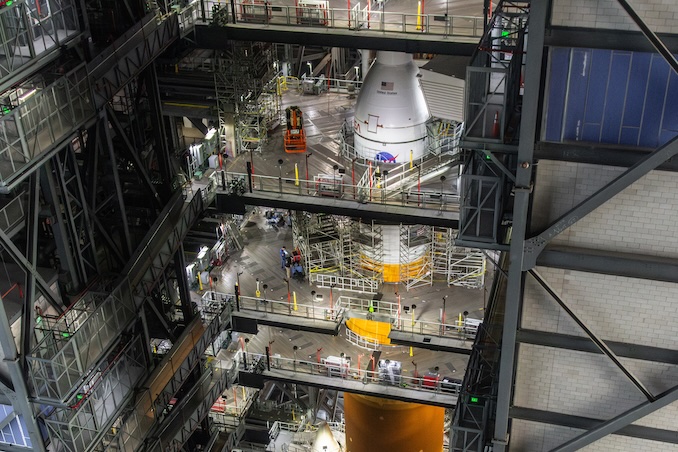
NASA returned its SLS rocket and Orion spacecraft to the Vehicle Assembly Building to fix a helium flow problem on the rocket’s upper stage. That discovery on Feb. 21, after a successful fueling test at pad 39B, caused NASA to forgo a March launch attempt and pivot to April instead.
While the helium issue was resolved, technicians conducted other prelaunch work, including replacing the batteries connected to the flight termination system on the solid rocket boosters, core stage and upper stage.
The Artemis 2 mission will see NASA astronauts Reid Wiseman, Victor Glover and Christina Koch alongside Canadian Space Agency (CSA) astronaut Jeremy Hansen fly around the Moon and splashdown in the Pacific Ocean about 10 days after liftoff.
It will be the first time that a crew lives and works onboard the Orion spacecraft. The test flight is a precursor to other crewed missions for the Artemis program, which will see astronauts heading down to the surface of the Moon starting with Artemis 4 in 2028.
NASA Administrator Jared Isaacman recently announced changes to the Artemis program. Including moving the first Moon landing from the third to the fourth Artemis mission and making the Artemis 3 flight a demonstration in Earth orbit of Orion docking with SpaceX’s Starship lunar lander or Blue Origin’s Blue Moon Mk.2 lunar lander, or potentially both.
During a March 12 sit-down interview with Spaceflight Now, Isaacman said within the next 60 to 90 days, the American public would get greater clarity about the specifics of the Artemis 3 mission.
Isaacman also teased ahead to a gathering in Washington D.C. to discuss the changes with its industry and international partners. During a briefing with members of the press on Thursday, European Space Agency (ESA) Director General Josef Aschbacher commented on the event and said he was looking forward to learning more himself.
“We look forward to the meeting next week. We will learn from NASA what the administration is planning on the Artemis architecture. This obviously is the Gateway and several other aspects,” Aschbacher said.
“I cannot obviously preempt what this discussion will be, but what is extremely important is that we had a very intense and good discussion within the ESA member states who gave their full support to me as Director General to coordinate activities among all the member states. NASA will see a very united Europe appearing in Washington.”