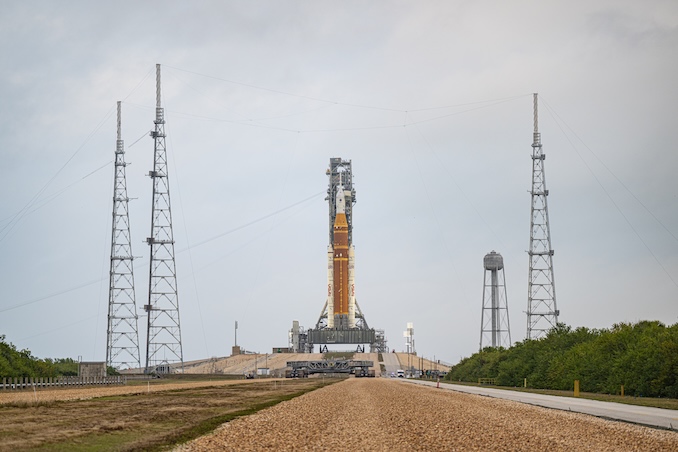
NASA will try again to fully load its Space Launch System rocket with more than 700,000 gallons of liquid hydrogen and liquid oxygen this week at the conclusion of a full launch countdown rehearsal.
The operation, called a wet dress rehearsal or a WDR, will begin with a call to stations inside Firing Room 1 at the Launch Control Center at 6:40 p.m. EST (2340 UTC) on Tuesday, Feb. 17. It will culminate in the actual fueling of the rocket on Thursday, Feb. 19, aiming towards a simulated T-0 at 8:30 p.m. EST (0130 UTC).
This second, full-length fueling demonstration comes the week after NASA conducted what it called a confidence test on Thursday, Feb. 12. During that operation, teams loaded an unspecified amount of liquid hydrogen (LH2) onto the rocket’s core stage “to assess newly replaced seals in an area used to fill the rocket with propellant.”
However, there was a new ground equipment issue that cropped up, which “reduced the flow of liquid hydrogen into the rocket,” according to a blog post shared Friday night. NASA said it managed to get enough data from “key objectives of the test” and was able to get good data from the core stage interface — called the Tail Service Mast Umbilical (TSMU) — during the same periods where leaks cropped up during the first WDR on Feb. 3.
“The confidence test related to the seals we repaired and replaced after WDR-1 provided a great deal of data, and we observed materially lower leak rates compared to prior observations during WDR-1,” said NASA Administrator Jared Isaacman in a social media post on Saturday. “I would not say something broke that caused the premature end to the test, as much as we observed enough and reached a point where waiting out additional troubleshooting was unnecessary.’
During the first WDR that concluded on Feb. 3, NASA encountered hydrogen leaks as they moved from a slow fill rate of LH2 to fast fill on the core stage, which required the loading to pause at various times. Hydrogen is highly combustible and so NASA has restrictions around how concentrated it can be once it’s airborne.
Teams exceeded the 16 percent LH2 limit during the process of pressurizing the tanks amid the terminal count on WDR-1 and the clock stopped at T-5 minutes and 15 seconds.
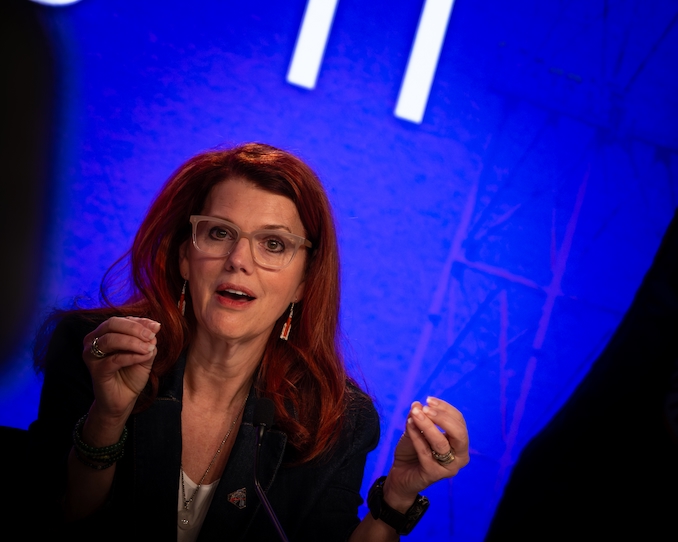
“We wanted to get inside of terminal count, we wanted to hold and we wanted to verify our three-minute hold capability, which is that you’ve got all of your cryo prop systems in a launch-ready state and you can hold them there for up to three minutes and we wanted to demonstrate the capability,” said Charlie Blackwell-Thompson, the Artemis launch director, during a post-WDR-1 press conference.
“We wanted to demonstrate a recycle, which is when you go down and you have a planned cutoff in the countdown, come back, and re-target a new T-0 and be able demonstrate that within the launch window,” she added. “Didn’t get a chance to do that. And then we would come down, do the handoff to ALS (automated launch sequencer), and then cutoff shortly thereafter. So I would say those are probably the three things that we had intended to do [on Feb. 3] that we did not get an opportunity to do.”
Those objectives are back on the table for WDR-2. Launch controllers intend to take the count down to T-1 minute and 30 seconds, hold for up to three minutes, proceed through the terminal count down to T-33 seconds and then pause again. They would then recycle the clock back to T-10 minutes and make another run through the terminal count.
Before running into issues inside the terminal count during WDR-1, Blackwell-Thompson waived off the possibility of conducing a second terminal count attempt due to the issues seen earlier during the fueling campaign.
Like with WDR-1, WDR-2 will also see the closeout crew perform a demonstration of their launch day activities, even though the crew won’t be present. At one point, NASA wasn’t going to have the closeout crew in the loop for WDR-2, but subsequently changed their minds on that.
NASA leaders have said repeatedly that a more formalized launch date won’t be established until after a successful wet dress rehearsal campaign. March 6 remains the earliest possible launch date within the March window.
“There is still a great deal of work ahead to prepare for this historic mission,” Isaacman wrote on social media. “We will not launch unless we are ready and the safety of our astronauts will remain the highest priority.”