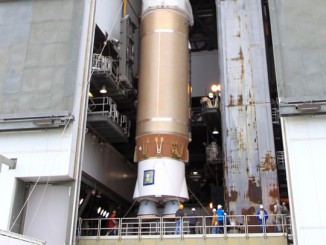
Already encapsulated in the 18-foot-diameter nose cone, the Air Force’s X-37B spaceplane is hoisted atop the Atlas 5 rocket at Cape Canaveral’s Vertical Integration Facility.
Credit: ULA
See our earlier launch coverage.
Already encapsulated in the 18-foot-diameter nose cone, the Air Force’s X-37B spaceplane is hoisted atop the Atlas 5 rocket at Cape Canaveral’s Vertical Integration Facility.
Credit: ULA
See our earlier launch coverage.
U.S. military officials said Tuesday the launch of the next satellite for the GPS navigation network — planned for April 29 on a SpaceX Falcon 9 rocket — has been delayed to no earlier than June 30 to avoid exposing launch crews to the COVID-19 viral disease. However, the next launch of the military’s X-37B spaceplane remains on track for liftoff in May on a United Launch Alliance Atlas 5 rocket, officials said.
Investigators probing the sudden failure of the Boeing-built Intelsat 29e geostationary relay station in April have concluded an electrostatic discharge, aggravated by a harness flaw on the spacecraft, or a micrometeoroid strike prematurely ended the satellite’s mission, resulting in a $382 million hit to Intelsat’s quarterly financial report.
© 1999-2026 Spaceflight Now Inc