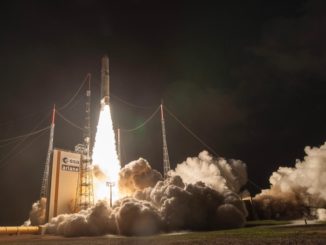
Ariane 5

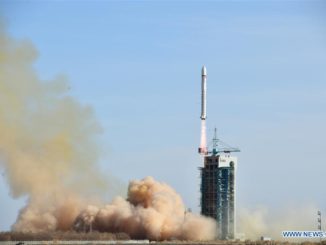
A Chinese Long March 2D rocket successfully delivered seven satellites into a 300-mile-high orbit Friday, boosting international missions to measure seismic signals that could help predict future earthquakes, take detailed imagery of planet Earth and test compact camera, propulsion and radio technology.
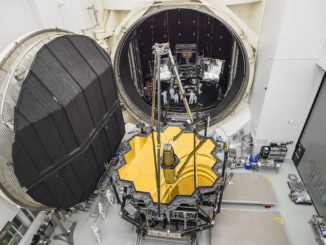
NASA’s $8.8 billion James Webb Space Telescope has completed critical end-to-end testing in a giant vacuum chamber at the Johnson Space Center, proving the telescope will work properly in the deep cold of space, bring starlight to a sharp focus and precisely track its astronomical targets when launched in 2019.

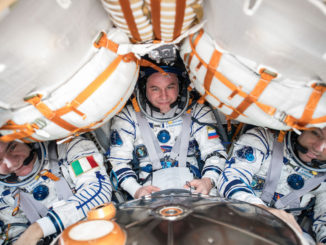
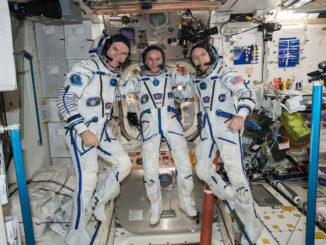
Outgoing space station commander Randy Bresnik, joined by Russian cosmonaut Sergey Ryazanskiy and European Space Agency flight engineer Paolo Nespoli, returned to Earth early Thursday after nearly five months in orbit. Their Soyuz MS-05 capsule undocked from the International Space Station at 12:14 a.m. EST (0514 GMT), and landed on the steppe of Kazakhstan at 3:37 a.m. EST (0837 GMT).
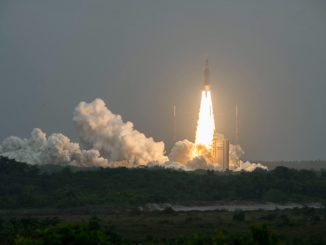
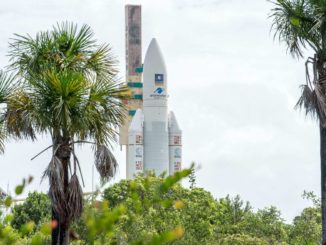
Unimpeded by rain showers and a dark gray blanket of low clouds, an Ariane 5 rocket thundered away from a European-run space base in the jungle of French Guiana Tuesday to place four Galileo navigation satellites in orbit, an on-target deployment that should improve the location accuracy of new smartphones around the world.

Four European navigation satellites fastened on top of an Ariane 5 rocket lifted off from Kourou, French Guiana, at 1836:07 GMT (1:36:07 p.m. EST) Tuesday to propel the Galileo navigation network closer to global service. The Ariane 5’s upper stage delivered the spacecraft to a circular orbit more than 14,000 miles above Earth around four hours after launch.
© 1999-2026 Spaceflight Now Inc