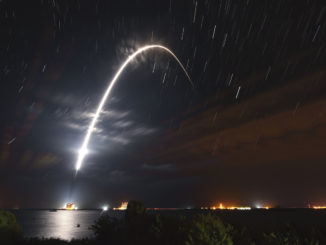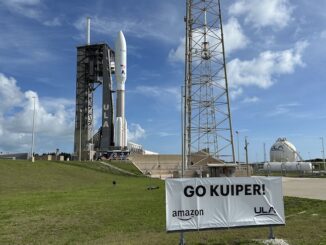
United Launch Alliance said its fledgling Vulcan rocket would return to flight Friday, November 13, after a nine-month grounding due problems with its solid rocket boosters.
This mission, carrying 40 satellites for Amazon’s Leo internet service, will be the fifth flight of Vulcan since it debuted in 2024 and will be the first time it has been fitted with six strap-on solid rocket boosters.
It was nozzle failures on the Northrop Grumman-built solid rockets that put Vulcan flights on hold earlier this year. The rocket’s second flight was marred by the disintegration of a nozzle on one of the two 63XL Graphite Epoxy Motors. United Launch Alliance thought it had put the problem behind it, but a similar nozzle failure afflicted one of the four boosters less than 30 seconds into Vulcan’s fourth flight in February 2026 on the USSF-87 mission. In both cases the methane-fueled first stage and hydrogen-fueled upper stage were able to compensate for the resulting reduced and asymmetric thrust and achieved the intended orbits.
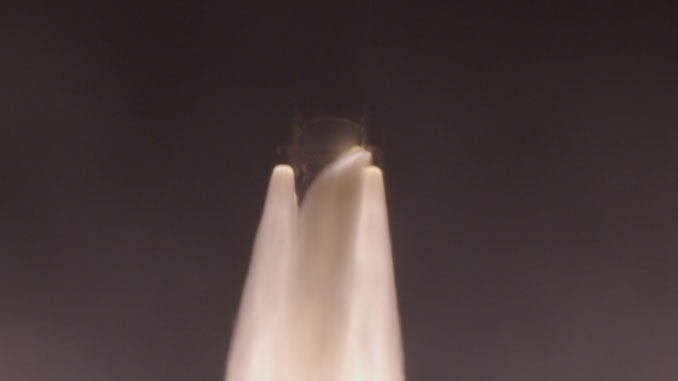
An industry-government team comprising of ULA, Northrop Grumman, and the U.S. Space Force was convened to investigate the most recent incident. ULA didn’t provide any specific details about the findings of the investigation but said in a statement: “The integrated team has made great strides in improving our understanding of the solid rocket booster (SRB) anomaly that occurred on the previous Vulcan flight and have identified several potential contributors which have been mitigated through design and process improvements to the nozzle,”
“This upcoming launch will utilize the improved nozzle design, and additional testing and analysis will continue in parallel with the mission,” the company added. “By flying the improved design, ULA gains valuable flight data that validates these improvements and is the most beneficial path in support of all our customers.”
Earlier this year, Northrop Grumman performed a test firing of a 63XL motor as part of the effort to resolve the nozzle problem.
Spaceflight Now has asked the U.S. Space Force what work, if any, remains before the Vulcan rocket is cleared to fly national security payloads again. This article will be updated, if and when we receive a response.
The Vulcan Leo 1 mission will add to the nearly 400 Amazon Leo satellites currently on orbit. The satellites will be deployed from an adapter on the Centaur upper stage over the course of about half an hour.
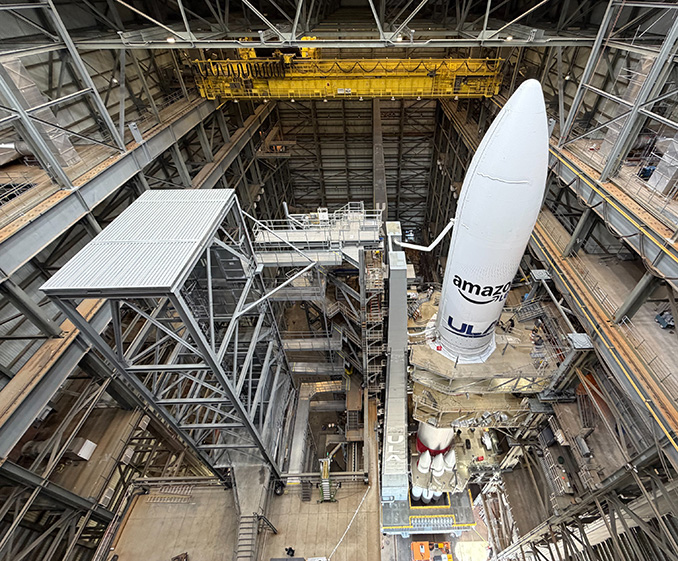
The retail and tech giant has booked a total of 38 Vulcan launches as it works to assemble its internet-from-space constellation. Previous launches used Atlas 5, Ariane 6, and Falcon 9 vehicles. Amazon had hoped to use Vulcan earlier as it can launch more Leo satellites than any rocket other than Blue Origin’s New Glenn. The loss of the first New Glenn rocket slated to carry Leo satellites in a launch pad explosion in May was another setback to the rollout of the constellation, although the satellites were not attached for the ill-fated test fire.
Assembly of the Vulcan vehicle began on May 14 when the first stage booster was hoisted on to its launch platform inside ULA’s new Vertical Integration Facility, dubbed VIF-A, the ‘A’ standing for Amazon. That was followed four days later by stacking the first LEO-optimized Centaur upper stage onto the booster.
In August, teams rolled the integrated stack out to the pad at Space Launch Complex 41 (SLC-41) to conduct fueling tests. It was then returned to VIF-A where its six solid rocket boosters were recently installed.
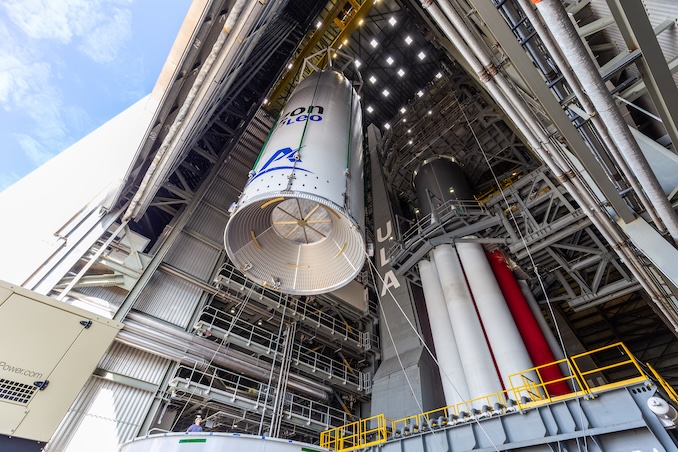
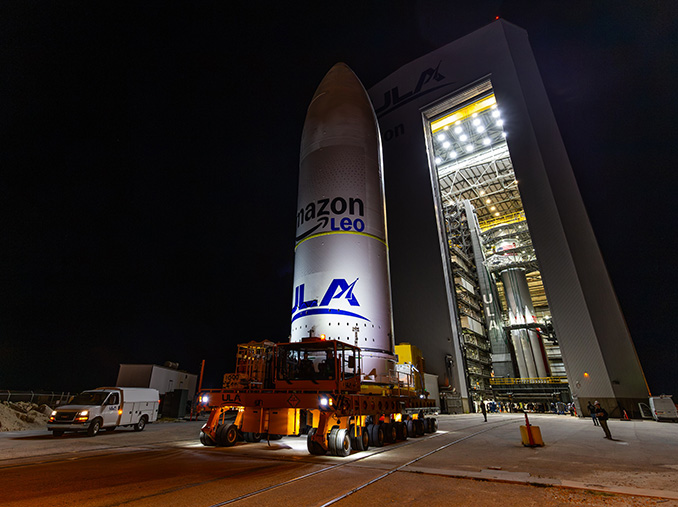
The payload fairing containing the 40 Leo satellites departed Amazon’s satellite processing facility near the former shuttle landing strip for attachment to the rocket on Oct. 21.
Amazon said a second vehicle is already assembled for the Vulcan Leo 2 mission in ULA’s original Vertical Integration Facility.