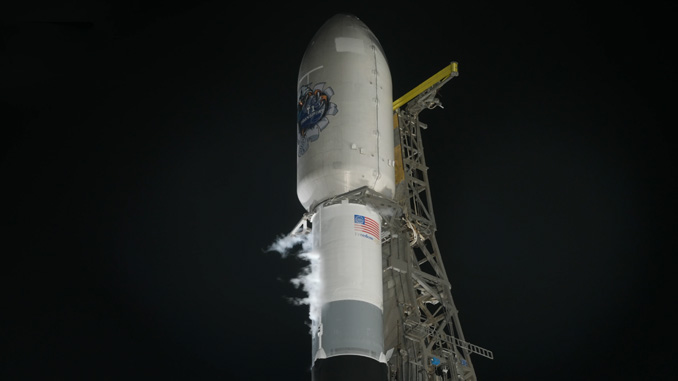
SpaceX early Saturday will try again to launch a Falcon 9 rocket carrying a batch of data satellites for the U.S. military’s Space Development Agency (SDA), five days after a last-minute abort scrubbed the first attempt.
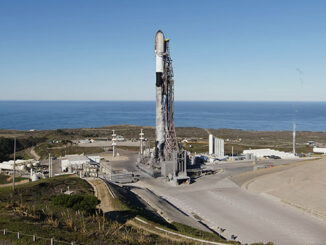
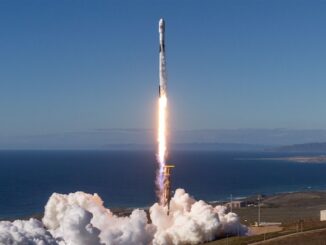
Liftoff from Vandenberg Space Force Base in California is scheduled for 12:39 a.m. PDT (3:39 EDT / 0739 UTC). The Falcon 9 will take a southerly trajectory on departure from Space Launch Complex 4E, currently SpaceX’s only launch facility on the West Coast.
Spaceflight Now will have live coverage starting about 30 minutes prior to launch.
Monday’s launch attempt was halted by an auto-abort with 58 seconds remaining on the clock. The halt was triggered moments after the rocket’s onboard computers took control of the countdown. SpaceX did not disclose the cause of the abort but in a social media post said: “Vehicle and payload are in good health, and teams are resetting for a launch attempt no earlier than tomorrow, October 6.”
However, the vehicle was lowered to a horizontal position at the pad, usually a sign of troubleshooting a hardware issue, and the launch was repeatedly pushed back a day at a time. A missile test from Vandenberg using the Western Test Range on Friday might have contributed to the launch finally settling on Saturday.
The mission, dubbed Tranche 1 Transport Layer A (T1TL-A), is the fourth mission sending production satellites into orbit for the SDA. This is one piece of a broad constellation — called the Proliferated Warfighter Space Architecture (PWSA) — designed to support the U.S. military and its allies through space-based capabilities, like missile tracking and secure communications.
The mission will use Falcon 9 first stage booster B1103. This will be its sixth flight following the launches of the SDA’s T1TL-E, NROL-179, and three batches of Starlink satellites.
Less than 7.5 minutes after liftoff, SpaceX plans to land B1103 at Landing Zone 4. If successful, this will be the 37th landing at LZ-4 and the 668th Falcon booster landing to date.
Building out the constellation
The T1TL-A mission is one of 23 missions awarded to SpaceX as part of the National Security Space Launch (NSSL) Phase 2 contract awarded in August 2020, which is managed by the U.S. Space Force’s Space Systems Command (SSC). The previous missions from the SDA have already been launched:
- T1TL-B – Sept. 10, 2025
- T1TL-C – Oct. 15, 2025
- T1TL-E – July 16, 2026
The T1TL-B and -E missions featured satellites manufactured by York Space Systems and the T1TL-C satellites were produced by Lockheed Martin. Space Force Col. Ryan Hiserote, SSC’s division chief in Assured Access to Space, told Spaceflight Now back in September 2025 that these initial T1TL missions could be launched in any order.
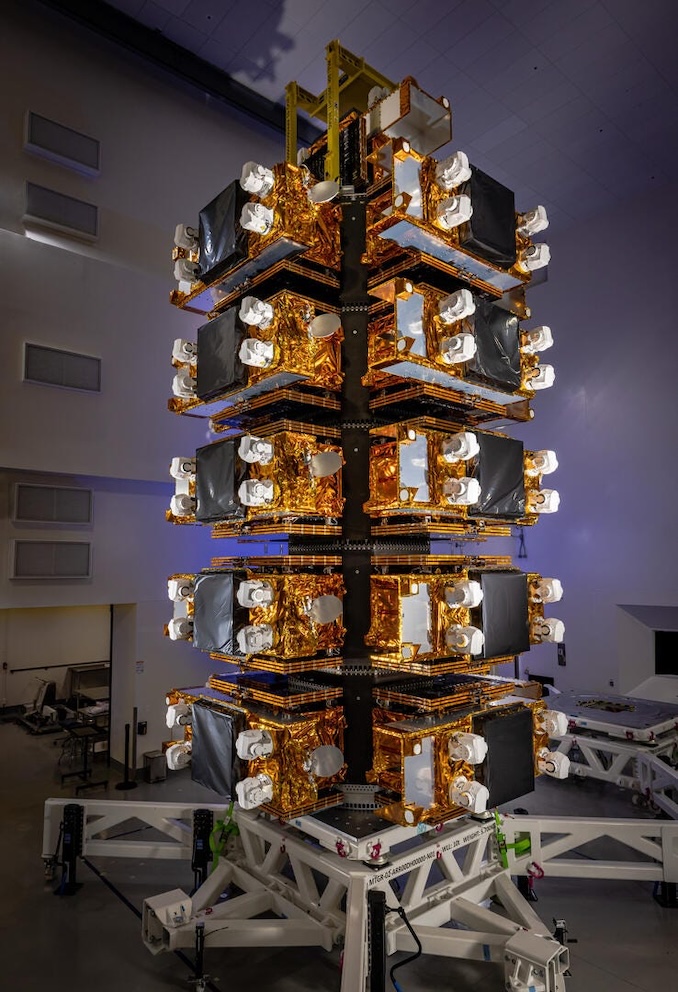
The 21 satellites flying as part of the T1TL-A mission were manufactured by Northrop Grumman and delivered to Vandenberg Space Force Base on Sept. 28.
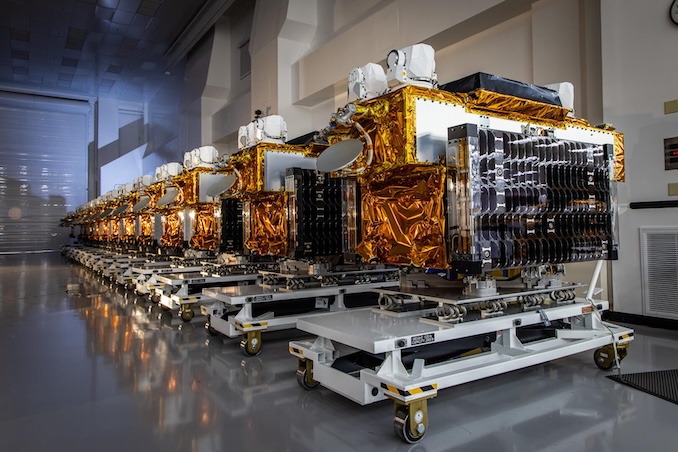
Tranche 1 is the initial component of the PWSA constellation is expected to begin providing operational capabilities to the Department of Defense beginning in 2027. When complete, T1 will consist of 126 Transport Layer satellites, 28 Tracking Layer satellites, and four missile defense demonstration spacecraft.
With the three launches completed to date, there are 63 satellites in orbit.
“In close coordination with Space Systems Command (SSC) and Space Launch Delta 30, the deployment of Tranche 1’s proliferated capability will soon deliver continuous overwatch—neutralizing any first-mover advantage by delivering data to warfighters around the world, nearly instantaneously,” said GP Sandhoo, SDA Director and Space Force Portfolio Acquisition Executive for Missile Warning and Tracking following the T1TL-E launch in July.
The SDA said the Transport Layer will consist of between 300 to 500 satellites in low Earth orbit from 750 km to 1,200 km in altitude. The SDA said once complete, 95 percent of the globe will be in view of at least two of the T1TL satellites at any given time.
“The constellation will be interconnected with Optical Inter-Satellite Links (OISLs) which have significantly increased performance over existing radio frequency crosslinks,” the SDA wrote. “LEO orbits in conjunction with OISLs will reduce path loss issues but more importantly offer much lower latencies, which are deemed critical to prosecute time sensitive targets in today’s wartime environment.”
These satellites will be able to integrate with the Link-16 and Integrated Broadcast System (IBS) to allow for “timely threat warnings and situational awareness information”.
The launches of these satellites are managed by the SSC’s System Delta 80 (SYD 80) and the Space Fore Portfolio Acquisition Executive for Assured Access to Space.