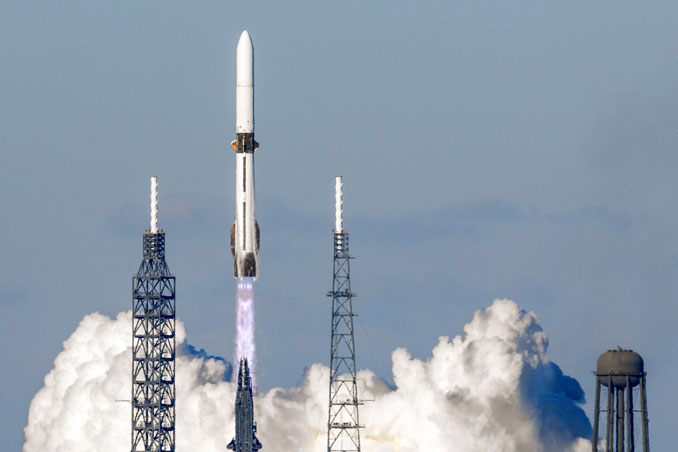
One of Blue Origin’s oft repeated phrases is that the company is paving a road to space with its New Glenn rocket. The company, established by Amazon founder, Jeff Bezos, is about halfway through creating one important lane in that road: launching national security missions.
During a briefing on the sidelines of the Space Force Association’s annual SpacePower Conference, Lt. Gen. Philip Garrant, Commander of the U.S. Space Force’s Space Systems Command (SSC) confirmed that Blue Origin chose a four-launch path to certify New Glenn to launch missions as part of the National Security Space Launch (NSSL) contract.
The company launched two New Glenn rockets in 2025 and on the second flight successfully recovered the first stage booster, Glenn Stage 1 (GS1).
“So two out of the four have been successful, and we’re working very closely and anticipating a third launch earlier in the new year than later and if that goes well, and they get that fourth one on, I think they’re going to be in fantastic place to become our third certified provider and compete for missions,” Garrant said. “Very pleased with the progress to date.”
In April 2025, SSC announced its selection of Blue Origin alongside SpaceX and United Launch Alliance (ULA) as the three companies most qualified to launch payloads to all of the various orbits needed for the government’s national security payloads.
Officially referred to as NSSL Phase 3 Lane 2, SpaceX won about 60 percent of the missions that will be assigned over the next half decade and ULA won about 40 percent of those missions. Blue Origin meanwhile, as the newest entrant to the orbital launch landscape, will launch seven missions as part of this contract, once certified.
However, once the required certification flights are accomplished, Garrant said there will be data review and other analysis needed before Blue Origin gets the green light to fly national security payloads.
“It’s a collaborative effort with the government and the launch service provider. So absolutely, after the fourth launch, it won’t be like the next day they get certified,” Garrant said. “There’ll be a significant amount of review, but at the same time, we won’t take a long time. If the next two flights go as well as the first two flights go, I anticipate timely and quick certification.”
He noted that while the launch certification system has evolved somewhat over the years, it’s largely the same as it has been for many years.

Speaking at a panel on launch and innovation at the SpacePower conference on Thursday, Tom Martin, Senior Director of National Security Programs at Blue Origin said that he’s hopeful that certification of launch systems can evolve over time.
“As the providers evolve their capabilities, evolve the technology that they’re bringing to the rockets that that certification process is also a little bit more adaptable to onboarding those capabilities,” Martin said.
Blue Origin recently unveiled a super-heavy lift version of its New Glenn, which will have nine BE-4 engines instead of the current seven.