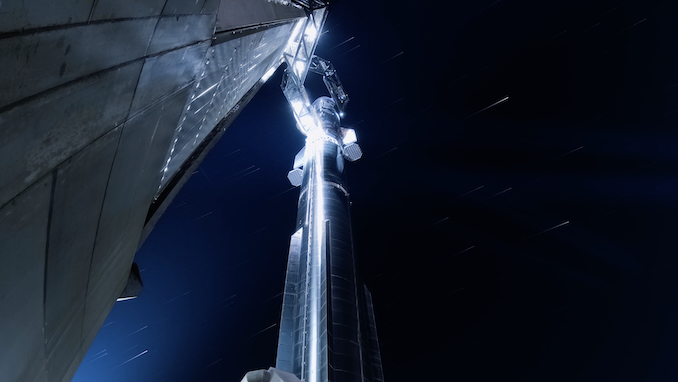
SpaceX assembled a Starship-Super Heavy rocket on the launch pad at Starbase in south Texas early Wednesday as it awaited approval for the vehicle’s first orbital flight.
Liftoff of Starship Flight 14 could come as soon as Monday, Sept. 28, but first SpaceX needs to receive regulatory approval from the Federal Aviation Administration (FAA).
The rocket’s Starship upper stage, designated Ship 41 or S41, began its journey from production site about three miles west of the pad at around 7:45 p.m. CDT (0045 UTC) Tuesday night. Nearly 5.5 hours later, the 52-meter-tall (171 ft) ship was lifted by the launch tower’s chopsticks and carefully placed atop Super Heavy booster B21.
Stacking Starship ahead of Flight 14 pic.twitter.com/jLsgN2jj6d
— SpaceX (@SpaceX) September 23, 2026
With the 124-meter-tall (407 ft) rocket assembled, SpaceX might conduct a fueling test of the full vehicle, known as a Wet Dress Rehearsal or WDR. Although, as of Wednesday morning, the City of Starbase has not annnounced any beach access or road closures.
A temporary flight restriction (TFR) at Starbase was put in place by the FAA on Tuesday afternoon. It lasts from Sept. 23 through Oct. 7 for up to 10,000 feet above ground level.
Assuming approval from the FAA, SpaceX could launch Flight 14 as soon as 7:15 a.m. CDT (1215 UTC) on Sept. 28 on a nearly 10-hour mission that will see the deployment of 26 next generation Version 3 Starlink satellites.
The following video encapsulates what SpaceX is trying to accomplish with this mission and the impact the company hopes it will achieve.