SpaceX launched a revamped Super Heavy-Starship rocket Friday on an “epic” flight to test more powerful engines, enhanced control systems and a host of other upgrades needed to streamline operations and improve safety and reliability.
One of the Super Heavy booster’s 33 methane-fueled Raptor 3 engines shut down early during the climb out of the lower atmosphere and additional engines failed to run properly during an attempt to fly the stage back to its planned splashdown point off the Texas Gulf Coast.
The Starship upper stage was equipped with six third-generation Raptor engines and one of three optimized for operating in vacuum shut down early during the climb to space. The flight computer kept the other five engines running longer than originally planned to make up for the shortfall, putting the craft on an acceptable sub-orbital trajectory.
It was not immediately known what might have triggered the premature engine shutdowns, but once in space, the Starship appeared to perform in fine fashion, deploying 22 Starlink internet satellite simulators from an upgraded Pez-like dispenser. Two of those were equipped with cameras that sent back images of the Starship from the viewpoint of the simulators.
Those cameras will be used on future flights to assess the health of the spacecraft’s heat shield.
Views of Starship in space from a @Starlink satellite pic.twitter.com/5hfw1n8v1o
— SpaceX (@SpaceX) May 22, 2026
Despite the engine issue, SpaceX founder Elon Musk thanked company employees.
“Congratulations @SpaceX team on an epic first Starship V3 launch & landing!” Musk posted on his social media platform X. “You scored a goal for humanity.”
NASA Administrator Jared Isaacman, who flew in to watch the launch, added his own praise.
“Congrats @SpaceX team and @elonmusk on a hell of a V3 Starship launch,” Isaacman posted. “One step closer to the Moon…one step closer to Mars”
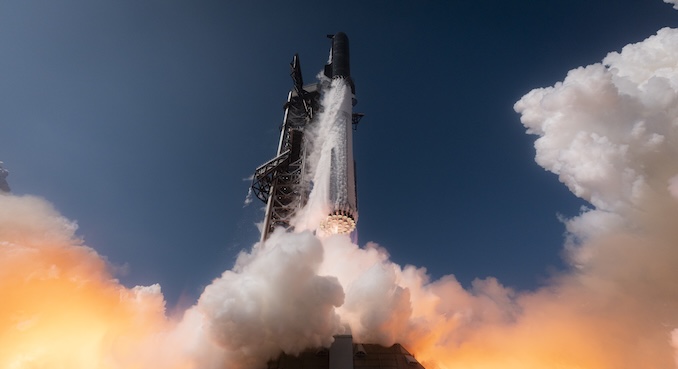
The upgraded Super Heavy-Starship blasted off on time at 6:30 p.m. EDT from a new, beefed up pad at SpaceX’s Starbase launch site on the Texas Gulf Coast. Launch followed a last-minute scrub Thursday due to a minor glitch with a launch pad system and two weather delays before that.
Liftoff of Starship! pic.twitter.com/LQLdjK5V6K
— SpaceX (@SpaceX) May 22, 2026
Generating up to 18 million pounds of thrust — twice the liftoff power of NASA’s SLS moon rocket — the 33 methane-burning Raptor engines at the base of the Super Heavy first stage pushed the 407-foot-tall rocket skyward atop a brilliant torrent of blue-white fire.
It was the first launch of a redesigned “version 3” Super Heavy-Starship and the first use of SpaceX’s second Texas launch pad, designed to better withstand the rigors of repeated launches by the world’s most powerful rocket.
Two minutes and 24 seconds after liftoff, now out of the dense lower atmosphere, the Starship upper stage’s six Raptors ignited just before the Super Heavy first stage fell away.
The booster immediately flipped around as planned to reverse course and head back toward Starbase for a controlled splashdown in the Gulf while the Starship upper stage continued the climb to space.
But multiple Raptor engines did not fire as expected and the booster was not able to reach the planned splashdown point, presumably dropping into the Gulf well short of its target.
The Starship upper stage reached an acceptable sub-orbital trajectory despite the single engine failure it experienced. The Starlink simulators were successfully deployed but a planned in-space Raptor restart was not attempted.
Splashdown confirmed! Congratulations to the entire SpaceX team on the twelfth flight test of Starship! pic.twitter.com/XXBAtryPpL
— SpaceX (@SpaceX) May 22, 2026
The test flight ended on a positive note as the Starship endured the fiery heat of re-entry in apparently good shape with little of the thermal damage seen on previous flights.
During the descent, the ship successfully carried out a maneuver intended to test the structural limits of its rear fins, followed by a dramatic banking maneuver like future Starships will carry out during normal landing operations.
Just before reaching the Indian Ocean, the Starship re-started two engines, flipped to a vertical orientation and descended to an on-target splashdown. It then tipped over as expected, broke apart and exploded in a spectacular fireball.
Other than the single Raptor failure during ascent, the Starship appeared to meet SpaceX’s expectations, coming through the stress of launch and re-entry in apparently good shape.
Version 3 test flights are major milestones for SpaceX as the company works to perfect the first fully reusable rocket for operational use launching government and commercial satellites along with science probes and, eventually, piloted flights to Mars.
The flights also are critical to NASA, which is paying SpaceX to develop a version of the Starship upper stage for use as a lander to carry the agency’s Artemis astronauts to the surface of the moon starting in 2028. Shortly thereafter, NASA plans to begin launching multiple missions per year and to build a base near the moon’s south pole.
In the near term, NASA plans to launch its next Artemis mission in 2027, sending up four astronauts in an Orion capsule atop an SLS rocket to rendezvous in Earth orbit with SpaceX’s lander and an alternative being built by Jeff Bezos’ Blue Origin.
NASA plans tests with both landers during the Artemis III mission, but the flight will proceed even if only one is available. Both companies must launch a successful unpiloted moon landing mission before the agency will attempt to land astronauts in 2028.
Neither company has yet put a moon lander in space and both face daunting test schedules. With version 3 of its showcase rocket now available, SpaceX is working to transition from sub-orbital test flights to orbital missions while continuing work to perfect the systems that will be needed for moon missions.
A major challenge is the ability to autonomously refuel a Starship lander in Earth orbit before it can head for deep space. The version 3 Starship now features the attachment points and fuel-transfer systems that will be needed for those operations.
SpaceX says the first in a series of orbital refueling tests is planned before the end of the year.