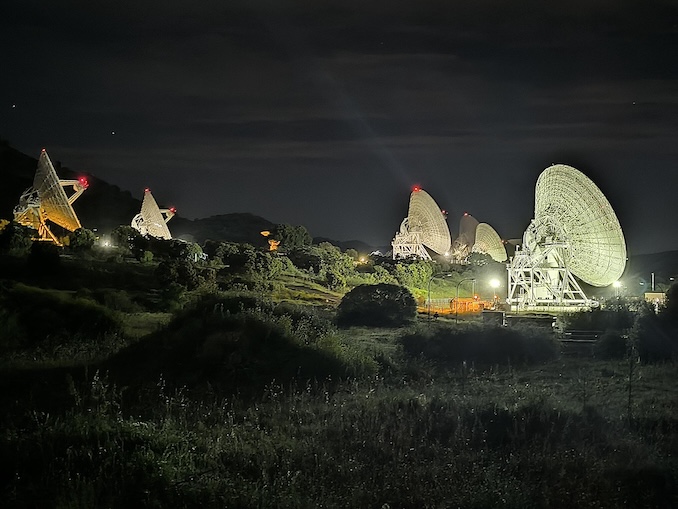
NASA evacuated its Madrid Deep Space Network ground station on Friday as wild fires near the Spanish capital city swept through the area. The agency said all personnel were safe and it had yet to survey the site for damage.
Photos posted on social media appeared to show smoke and flames in the vicinity of the tracking dishes. The Madrid location works in concert with ground stations at Goldstone, California, and Canberra, Australia to send commands to and receive data from spacecraft in deep space.
According to Canal 24 Horas, 90 workers at the site were evacuated and that government officials assured local media that “the impossible is being done” to safeguard the complex. The BBC reports that as of Friday, more than 25,000 people have been evacuated in Spain and more than 20,000 are in lockdown.
Emergency crews in Spain are fighting to shield NASA’s Madrid Deep Space Communications Complex from wildfires.
Robledo de Chavela is 1 of only 3 sites in NASA’s Deep Space Network that provides 24/7 global coverage for spacecraft & tool the 1st image of earth from the apollo 11 pic.twitter.com/VCT43y6bxp— Dr Maggie Lieu (@Space_Mog) July 24, 2026
A NASA spokesperson confirmed the evacuation and noted that any damage that may have occurred as a result of the fire “will be assessed when it is safe to do so.”
“NASA’s SCaN (Space Communications and Navigation) Program is closely monitoring the wildfire activity in coordination with local authorities and the U.S. Embassy,” the spokesperson said. “In the meantime, the agency has seamlessly transitioned support for mission operations to the Goldstone Deep Space Communications Complex in California, ensuring continuity of service and uninterrupted support for spacecraft communications.”
Each of the three sites contains 230-foot (70 m) diameter antennas that weigh about 2,970 U.S. tons (2.7 million kg). The complex in Spain is about 37 miles (60 km) west of Madrid at Robledo de Chavela.
The Deep Space Network has faced challenges with capacity and recently one of its California-based antenna, Deep Space Station 14 (DSS-14) sustained damage due to over-rotation while tracking the Juno spacecraft on Sept. 16, 2025. That was classified as a Type A mishap “based on the total cost of damages,” which are estimated to be between $4.1 and $4.6 million the agency said in early June.