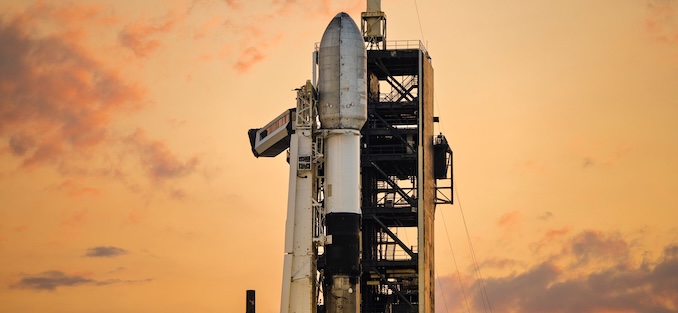
SpaceX is preparing for its 35th Starlink mission of the year, which will launch on a Falcon 9 rocket from Cape Canaveral Space Force Station on Thursday morning.
The Starlink 10-33 mission will add another 29 Starlink V2 Mini satellites to the low Earth orbit megaconstellation, which now consists of more than 10,000 spacecraft.
Liftoff from Space Launch Complex 40 is scheduled for 6:35 a.m. EDT (1035 UTC). The Falcon 9 rocket will fly on a north-easterly trajectory upon leaving the pad.
Spaceflight Now will have live coverage beginning about an hour prior to liftoff.
The 45th Weather Squadron forecast a mixed outlook for a launch on Thursday morning. Launch weather officers predict that there will be a 75 percent chance for favorable conditions at the opening of the window. That drops to 60 percent favorable by the end of the window.
“Although dry conditions will persist today, coastal showers may develop on Thursday, some of which could move near the launch pad during the primary launch window,” meteorologists wrote on Wednesday.
“Additionally, mid-level clouds may approach the region early Thursday, possibly overlapping with the primary launch window, as well. Given this, there is a low risk of a Cumulus Cloud Rule and Thick Cloud Layers rule violation Thursday morning.”
SpaceX will launch the mission using the Falcon 9 first stage booster with the tail number 1077. This will be its 27th flight after launching missions, like NASA’s Crew-5, CRS-28, and NG-20.
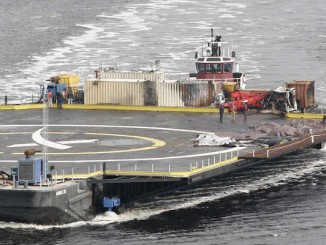
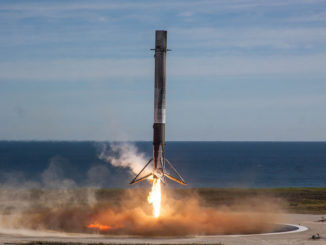
Nearly 8.5 minutes after liftoff, B1077 will target a landing on the drone ship, ‘Just Read the Instructions’, positioned in the Atlantic Ocean. If successful, this will be the 154th landing on this vessel and the 588th booster landing to date.
The 29 Starlink satellites will be deployed from the rocket’s upper stage a little more than an hour after liftoff.