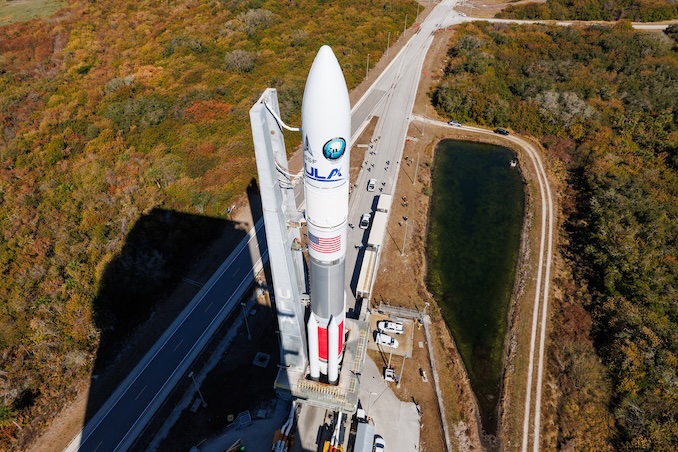
On the cusp of launching its first Vulcan rocket of the year on Thursday, United Launch Alliance leadership announced its goal for 2026 to launch between 18 and 22 times.
Speaking during a virtual media roundtable on Feb. 10, Gary Wentz, ULA’s vice president of Atlas and Vulcan Programs, said the company aims to launch two to four Atlas 5 missions and 16 to 18 Vulcan missions. He said the Vulcan rockets will be split between pad 41 at Cape Canaveral Space Force Station and pad 3 at Vandenberg Space Force Base.
“It’s a balance. We’re working with our customers to determine specific priorities and order of missions and in the case of Space Force and NRO (National Reconnaissance Office), to determine which missions they wan to get off with higher priority,” Wentz said. “And as we finalize that over the next about six to eight months out of the mission, then we’ll assign whether or not its going to be an Atlas mission or a Vulcan mission.”
John Elbon, the interim CEO following the departure of Tory Bruno in December, said that the company has a “strong commitment” from their commercial and government customers, citing a backlog of more than 80 missions.
“Mark (Peller) and I will be laser focused during the next period on continuing to meet our customers’ needs and importantly, getting us set for a reliable and sustainable increased launch rate,” Elbon said.
A large chunk of those missions come from a massive purchase of 47 launches by Amazon to fly its broadband internet satellites, called Amazon Leo, into low Earth orbit. ULA still has all 38 of its Vulcan launches ahead of it as well as four more flights on its Atlas 5 rockets.
ULA also has dozens of missions lined up for the U.S. Space Force and the NRO via the National Security Space Launch (NSSL) Phase 2 and Phase 3 contracts. Wentz offered a glimpse at part of the lineup for the year when it comes to these NSSL missions and said it will go as follows:
- SLC-41:
- USSF-87
- GPS III-8 (Space Vehicle 10)
- USSF-57
- NROL-64
- SLC-3:
- Space Development Agency’s Tranche 1 Tracking Layer (T1TR)-B
- An unspecified NRO mission
- An unspecified mission in late Fall
Regarding the upcoming cargo launch of the Boeing Starliner-1 mission to the International Space Station, Wentz reaffirmed what NASA leaders said during a separate briefing on Monday, that a spot on the manifest is being saved for that mission in April.
“That would go in after, as you described, after GPS and before SF-57 and that is our current plan,” Wentz said. “And then, if they were approved to fly crew, we have a slot in the October/November timeframe, where we would work between Space Force and NRO on priority to put a crew mission out there in October.
In the past couple of years, ULA began the year with goals of launching in the double digits, but ended up flying five times in 2024 and six times in 2025. Elbon pointed to some anomalies that constrained their launch rate with Vulcan.
One notable instance was the solid rocket booster anomaly seen during the second certification flight of Vulcan in Fall 2024. That contributed to the delay of certification for Vulcan to fly national security payloads until March 2025.

“Those are behind us now and so the Vulcan rocket is ready to go. We talked about getting what we call ‘Track A’ online, the new Vertical Integration Facility, the new Vulcan launch platform that allows us to double the rate, as Mark described, at KSC,” Elbon said. “We also will be bringing online later this year SLC-3 out at Vandenberg. And so, we’ll have launches out there.
“And we have in inventory, already built and finished goods, the rockets that will allow us to get up to that rate through this year. And the payloads are ready to go. So what we need to do is execute our launch activities at the Cape and at Vandenberg. And so, it’s very achievable for us to get up to the rate that we need to get up to through this year.”
The aforementioned Track A and additional assets refers to a second VIF built to complement the original VIF, called VIF-G for “government.” Wentz noted that VIF-G is intended solely for government missions, like those awarded under the NSSL contract and the six Starliner missions on Atlas 5.
VIF-A, with the A standing for Amazon, will be dedicated to Vulcan launches.
Progress toward another inaugural heavy-lift launch, as @ulalaunch preps an all-new launch platform (VLP-A) and integration facility (VIF-A) dedicated to Leo missions on Vulcan.
Payload for LV-01 is fully stacked ahead of launch, and processing is already underway for LV-02. pic.twitter.com/9qD2fGLJk0
— Amazon Leo (@Amazonleo) January 20, 2026
Leadership change
The media roundtable on Tuesday was ULA’s first such virtual gathering since the departure of former ULA President and CEO Tory Bruno. In his remarks, Elbon thanked Bruno for his 12 years of work at the company.
Elbon will be holding the reins during a search for the next permanent CEO. He had previously planned on retiring in April prior to Bruno’s departure to Blue Origin.
“[Tory] led us through a transformation, through the development of Vulcan as it was certified. I think in his new role, Tory has an opportunity to focus on defense of our nation, which he has a real passion around. So those are the kind of things I believe factored into his decision,” Elbon said.
“Tory to some degree was the face of ULA, but our strength is really in the engineering expertise and the production expertise and the launch expertise, the 3,000 people that do that work,” Elbon added. “I remain just incredibly proud of that team and we’re going to do great things going forward.”