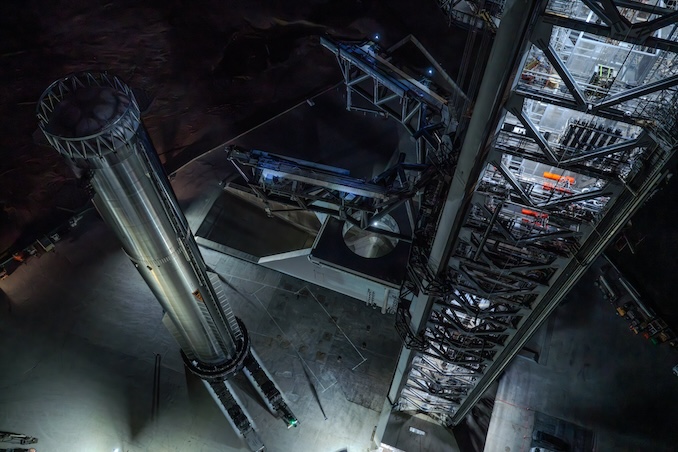
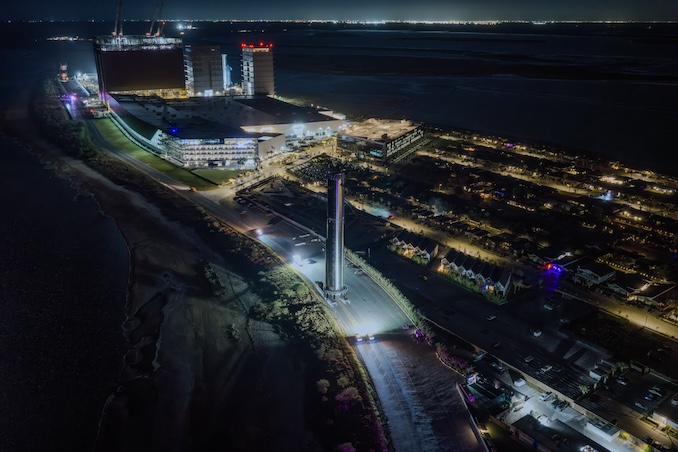
SpaceX placed a Super Heavy booster on the launch pad at Starbase in Texas Monday, as it continues testing and preparations for the first planned orbital flight of Starship, scheduled for launch as soon as Sept. 28, pending final approval from the Federal Aviation Administration (FAA).
The Super Heavy booster, with the tail number B21, departed its assembly building shortly before midnight local time and was placed on the launch mount at Pad 2, roughly two hours later. The stainless-steel booster stands 236 feet tall (72 meters) and boasts a diameter of 9 m (29.5 ft). By comparison, a Falcon 9 rocket has a diameter of 3.7 m (12 ft). The downcomer pipe that carries methane fuel down the center of the Super Heavy Booster’s liquid oxygen tank to the Raptor engines at its base is roughly the size of an entire Falcon 9 rocket.
SpaceX hasn’t said whether it intends to perform a fully integrated wet dress rehearsal tanking test of the rocket once assembled prior to the upcoming launch attempt.
As of Monday morning, there were no road closures published for the City of Starbase, suggesting that it may be a day or two at least before the Starship upper stage, tail number S41, is rolled out to join B21.
Although SpaceX is targeting the launch for Sept. 28 at 7:15 a.m. CDT (1215 UTC), it can only proceed once the FAA approves the license modification needed for SpaceX’s orbital flight plan.
This would be the first time that the FAA grants an orbital license for an object the size of a Starship upper stage (171 ft/52 m in height).
If something were to go wrong that prevented Starship making a planned deorbit burn, it could pose a danger during an uncontrolled reentry. Its heat shield and bulk could result in large portions of the craft crashing to Earth. The FAA wants to ensure that the vehicle and SpaceX are truly ready for this next step.
“In addition to completing the environmental review, license applications must also meet FAA safety, policy/payload, and financial responsibility requirements to receive authorization for flight,” the FAA said in a statement.
Orbital flight is at hand
Depending on when Starship Flight 14 takes place, it very well may be the next Starlink mission for SpaceX and has been given the additional designation of Starlink 31-1. The company recently ceased launches of its V2 mini broadband internet satellites from Florida, but continues to build and replenish its fleet with missions from Vandenberg Space Force Base in California.
SpaceX needs Starship in order to begin launching the larger and more capable Starlink V3 satellites.
During the most recent test flight in July, SpaceX deployed several Starlink V3 satellites along the same suborbital trajectory as the Ship 40 upper stage. Those satellites were able to deploy their solar arrays, capture imagery of the Starship’s heat shield, and briefly connect with the broader Starlink constellation using laser links before they met their planned demise.
View of Starship in space from a Starlink V3 satellite on Flight 13.
This composite is made of imagery from four separate cameras on a single satellite. Six of the satellites were equipped with cameras to scan Starship’s heat shield and transmit imagery down to operators to… pic.twitter.com/sNTHHz5vLr
— SpaceX (@SpaceX) July 31, 2026
On Starship Flight 14, SpaceX aims to deploy 26 Starlink V3 satellites into orbit a 171-mile (275 km) orbit, with an estimated orbital inclination of 30 degrees to the Equator.
“Each Starlink V3 satellite will add 1 Tbps of capacity to the constellation, for a total of 26 Tbps of capacity added on this mission alone. That’s ~10x the capacity compared to a single launch of V2 mini Starlink satellites on Falcon 9,” SpaceX said in a prelaunch mission writeup.
“After deploying from Starship, the Starlink V3 satellites will unfold their antennas and deploy their solar arrays and make initial contact with the ground and the rest of the Starlink constellation via radio frequency and laser links. The satellites will then begin raising their orbits with their onboard thrusters. Following their on-orbit checkouts, the satellites should begin serving customers as soon as a few weeks after launch.”
The Starship preparing for our fourteenth flight test completed a full-duration, 60-second static fire with all six Raptor engines pic.twitter.com/DY11p3KVxU
— SpaceX (@SpaceX) August 21, 2026