
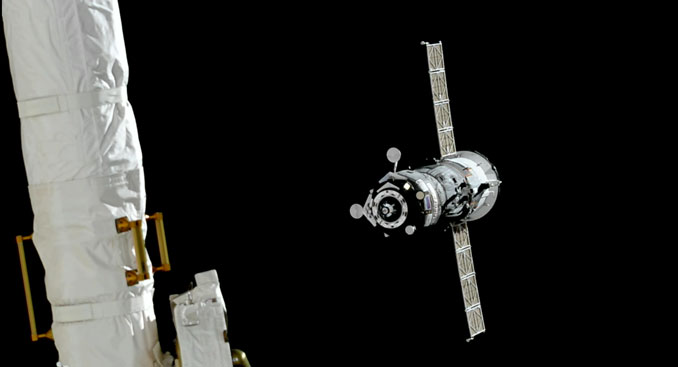
An unpiloted Russian Progress cargo ship arrived at the International Space Station Saturday carrying supplies and equipment for the orbiting outpost.
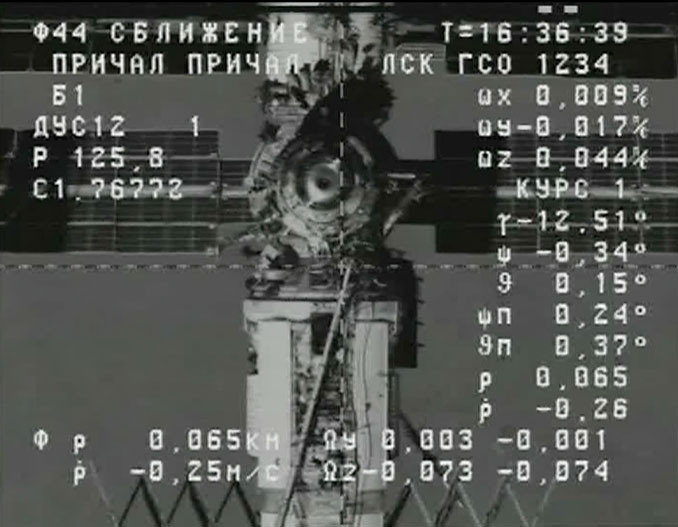
The Progress MS-35 docked at the space-facing port of Russia’s Poisk module at 9:44 a.m. EDT (1344 UTC). It circled the station before making its final approach using the automated Kurs rendezvous system.
Russian cosmonauts Pyotr Dubrov and Anna Kikina were standing by to take manual control of the approach using remote controls, but everything went smoothly as the craft closed in, 260 miles above the Black Sea. A series of hooks inside the docking mechanism were driven closed to complete the docking operation.
Making up the rest of the station crew, dubbed Expedition 75, are NASA’s Jessica Meir, Anil Menon, and Jack Hathaway, Russia’s Andrey Fedyaev, and the European Space Agency’s Sophie Adenot.
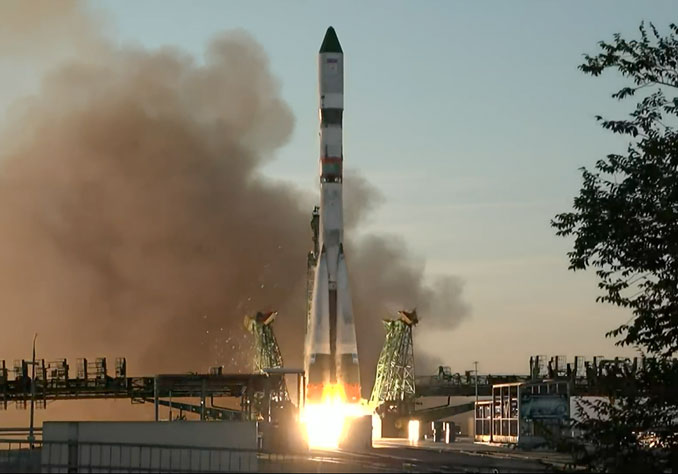
The freighter, operated by the Russian space agency Roscosmos, lifted off from the Baikonur Cosmodrome on Wednesday, Sept. 16, 2026, at 9:33 a.m. EDT (1333 UTC). It was delayed a week due to a problem with the Soyuz-2-1b rocket’s third stage.
Roscosmos did not disclose the nature of the technical issue, which required the rocket to be rolled off the launch pad and returned to its hangar. It was the first time the Soyuz-2-1b variant had been used to launch a Progress mission.
The docking came three days after liftoff, longer than the more typical two-day rendezvous sequence.
“Uncommon but not unprecedented,” said Rob Navias, NASA’s commentator in mission control. “The orbital mechanics for this particular launch date of September 16th drove the Progress to a three-day, 49-orbit rendezvous profile.”
The cargo mission, which NASA refers to as Progress 96, carried 2.8 tons of food, fuel and supplies to the station. The craft is expected to remain docked for about five months.