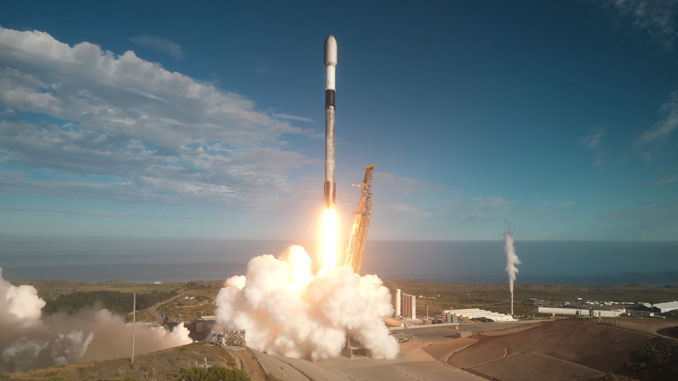
A SpaceX Falcon 9 rocket launched two dozen Starlink V2 Mini broadband internet satellites to its massive low Earth orbit constellation on Tuesday, a day after liftoff was scrubbed by a rare abort during engine ignition.
Liftoff from Vandenberg Space Force Base in California came at 7:49 a.m. PDT (10:49 a.m. EDT / 1449 UTC). The first launch attempt for the Starlink 17-39 mission ended as the countdown clock hit zero when an issue popped up during the ignition sequence. All nine Merlin 1D engines appeared to ignite but then shutdown in a flash of fire and smoke.
But on Tuesday, all appeared to go smoothly, with the rocket lifting off from Space Launch Complex 4 East under mostly clear skies, taking a south-southwesterly trajectory to reach a 97-degree inclination orbit. Deployment of the 24 Starlink satellites came just over an hour into flight.
The mission used Falcon 9 first stage booster B1082, making its 23rd flight after launching missions, including NROL-145, USSF-62, and OneWeb Launch 20.
More than eight minutes after liftoff, B1082 landed on the droneship, ‘Of Course I Still Love You’, which is positioned in the Pacific Ocean, the 212th landing on this vessel and the 640th booster landing to date.
The Starlink 17-39 mission was the company’s 85 Falcon 9 rocket launch of the year. Of those, 67 were in support of the Starlink constellation, which consists of more than 10,800 spacecraft.