FAA requires SpaceX-led mishap investigation before resumption of Starship launches
The Federal Aviation Administration made the determination after analyzing the results of Starship Flight 12, which took place on Friday, May 22.
The Federal Aviation Administration said that SpaceX needs to complete a mishap investigation into the 12th flight of its Starship-Super Heavy rocket before it can launch Flight 13.
In a statement shared on Wednesday, the FAA said that it completed a “thorough assessment of the operation” of the Starship Flight 12 mission, which took place on Friday, May 22. It determined that the off-nominal performance of the Super Heavy booster, tail number Booster 19 “resulted in a mishap.”
“The FAA is requiring SpaceX to conduct a mishap investigation,” the agency said. “The FAA will oversee the SpaceX-led investigation, be involved in every step of the process, and approve SpaceX’s final report, including any corrective actions.”
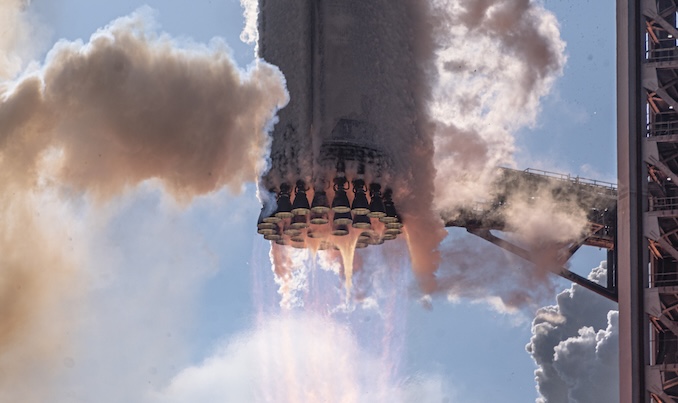
Starship’s Raptor engines ignite during hot-staging separation pic.twitter.com/oNdU0Z4FQI
— SpaceX (@SpaceX) May 22, 2026
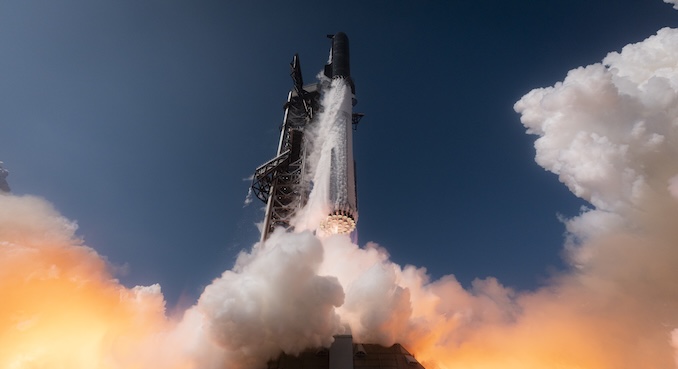
During the ascent phase of the mission, one of the 33 Raptor V3 engines on the Super Heavy booster, tail number B19, went out about 1 minute and 42 seconds into the ascent. Less than a minute later, at about the 2 minute, 22-second mark, SpaceX began intentionally shutting down engines as it progressed towards stage separation.
The staggered shutdown brought the booster from 32 down to five engines burning and then stage separation began. SpaceX’s on-screen graphics representing the engine status showed 12 out of 13 center engines were ignited at the 2 minute, 32-second mark, but as the outer ring started re-igniting several engines were shown to be out, which was not the plan.
“We are not seeing as many booster engines ignited as we expected for boostback, but we are seeing six good engines on ship,” said Dan Huot, a member of the SpaceX communications team, during SpaceX’s broadcast. “It looks like we just had an early boostback shutdown.”
In a post-mission write-up on its website, SpaceX gave an early assessment of what it saw at that point in flight.
“Following stage separation, the Super Heavy booster performed a directional flip maneuver and attempted its boostback burn. It was unable to light all planned engines and performed a partial boostback burn that ended early,” SpaceX wrote. “Super Heavy attempted to reignite its engines for the landing burn before experiencing a hard splashdown in the Gulf of America.”
While one of the three Raptor Vacuum engines on the Starship rocket’s upper stage (tail number S39), SpaceX was able to maneuver that part of the rocket to the intended splashdown site in the Indian Ocean. Teams determined during the mission that they would forego a planned re-ignition of one of the Raptor engines on S39 during its coast phase.
The FAA did not identify the engine issue on S39 as a driving factor for the SpaceX-led mishap investigation. Such an investigation is triggered by a determination from the FAA as part of its oversight role for commercial spaceflight to help ensure public safety.
The agency lists nine potential causes for such a review, including the following:
- Impact of hazardous debris outside of defined areas
- Failure to complete a launch or reentry as planned
- Malfunction of a safety-critical system
In its statement on Wednesday, the FAA confirmed that there “are no reports of public injury or damage to public property.” The agency didn’t state specifically which piece of SpaceX’s 14 CFR (Code of Federal Regulations) Part 450 launch license was violated during the off-nominal performance of B19, but noted that the FAA needs to gain assurance that a return to flight would not adversely affect public safety.
Grounded again
This is not SpaceX’s first rodeo though when it comes to mishap investigations. The company completed similar assessments following the first four launches of Starship-Super Heavy, when it was in its Version 1 configuration, and three mishap investigations following Flights 7-9, which consisted of Version 2 rockets.
This latest pause from launching will cause SpaceX to take a closer look at its Raptor 3 engines, which made their debut on Flight 12. While no public announcement has been made, the combination of a failed boostback burn with the booster combined with an engine out on the ship upper stage make it unlikely that SpaceX will attempt an orbital launch with Flight 13, which would also preclude a catch of the ship with the chopstick arms on the launch tower.
Additionally, SpaceX may also choose to forego a catch of the Super Heavy booster on Flight 13 as well and decide to repeat the soft splashdown in the Gulf planned for Flight 12.
Starship flip and landing burn at the end of its twelfth flight test pic.twitter.com/0iJUox3FJt
— SpaceX (@SpaceX) May 25, 2026
In its financial filing ahead of an anticipated initial public offering, SpaceX said that it aimed to begin deploying its Starlink Version 3 satellites in the back half of 2026. It hasn’t offered additional specifics as to when exactly that may happen.
“Our growth strategy depends on our ability to increase our launch cadence and payload capacity, which is dependent on the successful development of Starship at scale,” SpaceX wrote in its S-1 prospectus document.
“Unexpected design modifications, supply chain disruptions, anomalies, environmental issues, and other unforeseen technical challenges could result in delays or failures to deploy Starship on our anticipated schedule, which would delay or impede our ability to achieve our other business objectives, such as the deployment of our next-generation satellites, the expansion of our satellite-to-mobile connectivity services, and deployment of in-orbit AI compute infrastructure.”
SpaceX does have hardware in flow for Flight 13, which is expected to consist of Ship 40 and Booster 20. The company noted that it moved at least 10 Raptor engines from Booster 20 to Booster 19 after a 10-engine static fire test in March ended abruptly due to a ground-side issue.
It highlighted that test during the first episode of its new in-house docu-series about Starship, which was published in the weeks leading up to Flight 12. A release date for the second episode hasn’t been announced as of May 27.