Update June 24, 10:55 a.m. EDT (1455 UTC): Added a comment from NASA.
More than four months after NASA released a report classifying the 2024 Crew Flight Test of Boeing’s CST-100 Starliner spacecraft as a Type A mishap, the timing of the return to flight mission remains up in the air and could be as far as a year away.
During a public meeting of the Aerospace Safety Advisory Panel (ASAP) on Monday, member Kent Rominger said that NASA was still assessing opportunities to launch the uncrewed Starliner-1 mission. He said the agency and Boeing were still working through post-flight work from the CFT mission and address issues raised in the Program Investigation Team (PIT) report.
“NASA and Boeing continue working toward the goal of Starliner’s crewed certification, which includes defining what is needed and acceptable for the next uncrewed mission to reduce risk and confirm readiness for crew missions,” the former NASA astronaut said. “The Starliner-1 uncrewed mission launch target is under review as work remains to close the final propulsion system issues.”
Spaceflight Now reached out to NASA to ask for its assessment of how soon the Starliner-1 mission could take place. An agency spokesperson said it didn’t have update beyond its May 1 blog post.
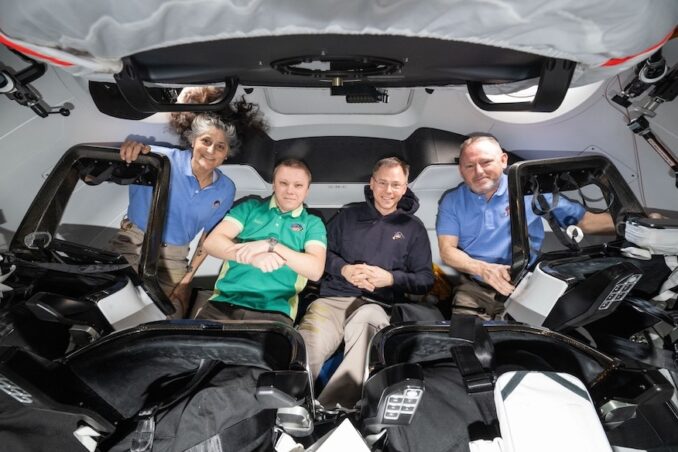
The Starliner CFT mission was marred by multiple anomalies, including five thrusters on the spacecraft’s service module that failed during the rendezvous, which forced former NASA astronaut Butch Wilmore to perform manual piloting.
The capsule also encountered issues with leaks in seven out of eight helium manifolds on the service module along with a reaction control system jet failure. The combination of issues eventually led NASA to remove Wilmore and his crew mate, former NASA astronaut Suni Williams, from the Starliner vehicle for return and fold them into the SpaceX Crew-9 mission.
In his summary of the Commercial Crew Program status for the ASAP meeting, Rominger said recommendations from the PIT report are being addressed and that “management and operational changes have been made.”
The PIT report pointed to “cultural and leadership challenges that undermined technical rigor and exacerbated technical risks.” The report stated that the root causes were as follows:
- NASA’s hands-off contract approach limited insight into the Starliner’s development
- Boeing’s inadequate systems engineering and reliance on subcontractors without sufficient oversight created gaps in hardware qualification
- NASA CCP’s culture prioritized provider success over technical rigor
“The Commercial Crew Program governance model has been updated to provide clarity in roles and responsibilities during missions,” Rominger said. “Compulsion System Delta Qualification Review Team has been established to ensure a comprehensive qualification plan is in place prior to flight and the integrated Boeing and NASA teams have made good progress closing all 72 flight observations and 22 of the 28 implied anomalies from CFT.”
He said among the constraints standing in-between now and the flight of Starliner-1 include the overheating observed within the doghouse structures that house the RCS thrusters on the service module.
Rominger said ASAP was also keeping a close eye on the status of the cultural changes between the Boeing and NASA teams. He pointed to changes in leadership at both NASA and Boeing, pointing out that Boeing mission managers “now work directly with NASA’s CCP mission managers and there is a renewed focus on improving trust and communication between NASA and Boeing.”
“During a quarterly review at [NASA’s Kennedy Space Center], the chief of Boeing Aerospace Safety, Don Newman, made the effort to talk with the panel and emphasize Boeing’s commitment to NASA and Starliner,” Rominger said. “The Astronaut Office also commented that they appreciated the fact that Don reached out to them with his commitment to a safe Starliner service.”
Time is running out
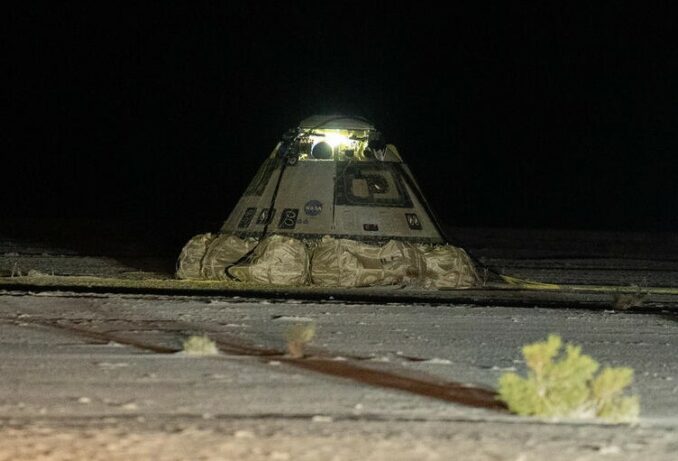
The return to flight mission for Starliner presents questions about how much use NASA will get from the vehicle before the International Space Station is retired.
During Monday’s ASAP meeting, Lt. Gen. Susan Helms, U.S. Air Force (Ret.), Chair and former commander of the 45th Space Wing, said that while the ISS is intended to be in use until at least 2030, the ongoing leaks on the Russian segment are “one of the most significant safety risks to the program.”
She also pointed to the more than 40-year-old spacesuit equipment, which makes the suite of upcoming spacewalks increasingly challenging. Helms did note that there was “a robust life extension plan” in place for those.
“Coincident with operational demands and these risk management challenges, temptation to reduce the ISS budget looms, but the panel would caution that such temptations should be disregarded as budgets decline,” Helms said.
“It is increasingly difficult for NASA to ensure the ISS risks remain manageable for day-to-day operations with enough contingency margin. The ISS program team continues to perform an outstanding job of managing those risks, but the margin to do so is now reduced to an alarming level.”
In November 2025, NASA reduced its definitive number of flights from Boeing to safely ferry its astronauts to and from the space station from six down to four. Then in a May 2026 procurement filing, the agency said it was adding six more post-certification missions (PCMs) to SpaceX, noting the shortfall created by Boeing’s delayed certification of Starliner for crewed flights.
“It is necessary to award additional PCMs to SpaceX given the recently shortened ISS mission durations; technical issues and schedule delays encountered by Boeing; the allocation of missions between Boeing and SpaceX; NASA’s projections for when an alternative CTS [Crew Transportation System] may become available; and the ongoing technical challenges of maintaining a reliable CTS capability for crewed flights to ISS,” NASA wrote.
“Awarding additional PCMs to SpaceX is essential for NASA to fulfill its responsibility of maintaining uninterrupted flight access for ISS’s safe operation and to safeguard against potential anomalies or mishaps, and unforeseen external factors.”
The SpaceX Crew-13 mission is currently slated to fly in September, moving up from its previously planned window in November “to help increase the frequency of U.S. crew rotation missions to the space station.”