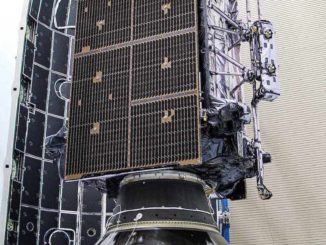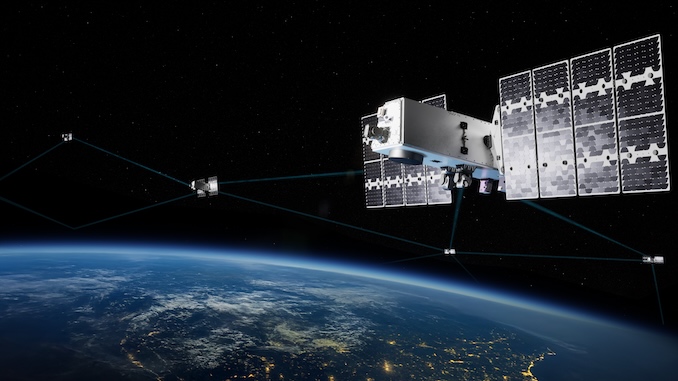
The U.S. Space Force’s Space Development Agency (SDA) awarded roughly $3.5 billion to four companies to begin building out the third generation of its low Earth orbit constellation.
The SDA issued firm fixed-priced Other Transaction Authority (OTA) agreements with L3Harris Technologies, Lockheed Martin, Northrop Grumman and Rocket Lab to build a total of 72 satellites for the Tacking Layer Tranche 3 (TRKT3) of the Proliferated Warfighter Space Architecture (PWSA) constellation in low Earth orbit.
“The Tracking Layer of Tranche 3, once integrated with the PWSA Transport Layer, will significantly increase the coverage and accuracy needed to close kill chains against advanced adversary threats,” said SDA Acting Director Gurpartap ‘GP’ Sandhoo. “The constellation will include a mix of missile warning and missile tracking, with half the constellation’s payloads supporting advanced missile defense missions to pace evolving threats.”
The satellites, which are slated to begin launching in fiscal year 2029 cover two types of sensing capabilities: missile warning/missile tracking (MW/MT) infrared (IR) sensors and missile warning, tracking, and defense (MWTD) sensors.
Each of the four companies will build 18 satellites. Here’s the breakdown of funds going to each company and which satellites they will build:
- Lockheed Martin – $1.1 billion for 18 MWTD space vehicles (SVs)
- L3Harris Technologies – $843 million for 18 MW/MT SVs
- Rocket Lab – $805 million for 18 MWTD SVs
- Northrop Grumman – $764 million for 18 MW/MT SVs
“The addition of these satellites will achieve near-continuous global coverage for missile warning and tracking, along with payloads capable of generating fire control quality tracks for missile defense,” Sandhoo said. “This is a prime example of spiral development: the ability to rapidly integrate the next generation of technologies, and to proliferate the most impactful capabilities for increased capacity and lethality.”
In its own announcement to its investors, Rocket Lab said that the initial amount is a base contract, adding that there are up to $10.45 million in options. The company said it would build these satellites on its Lightning satellite bus and feature “Rocket Lab’s next-generation Phoenix infrared sensor payload, a wide field-of-view (WFOV) solution designed to meet the evolving missile defense needs of national security space” as well as its “advanced StarLite space protection sensors, designed to safeguard the constellation against directed energy threats.”
Rocket Lab said some of the other companies on this contract were also incorporating its StarLite sensors.
“The Tranche 3 Tracking Layer constellation is part of the U.S. Space Force’s strategy to counter rapidly evolving global threats, ensuring the nation’s defense capabilities remain ahead of adversaries. Rocket Lab is honored to play a role in enabling this,” said Rocket Lab founder and CEO, Peter Beck. “Demand for resilient, scalable, and affordable space systems continues to grow, and this award demonstrates that Rocket Lab is uniquely positioned to lead the charge in delivering solutions that meet the needs of national security.”
This is the second SDA contract for Rocket Lab, adding to its $515 million award for 18 satellites with the SDA’s Transporter Layer-Beta Tranche 2 program. That will add “secure, low-latency communications across the PWSA.”

L3Harris is adding to its previous allotments of four missile tracking satellites that launches as part of the Tranche 0 part of the constellation and 34 satellites that are in development across Tranche 1 and Tranche 2.
The company recently opened a new facility on their Palm Bay, Florida, campus designed for production for their Tranche 1 and Tranche 2 satellites.
“L3Harris is proud to support SDA in its mission to deliver a next generation, layered defense architecture that can track threats in real time,” said Christopher Kubasik, Chair and CEO, L3Harris. “Defeating the hypersonic missile threat begins in space, and our Tranche 3 satellites will advance our proven, on-orbit tracking and targeting capability needed to protect our homeland.”

For its part, Northrop Grumman is now responsible for 150 satellites across the first three Tranches for the SDA. The first plane of its Tranche 1 Transport Layer (T1TL) satellites are set to launch “in early 2026.”
“Northrop Grumman’s contributions to both high and low altitude layers of our nation’s missile warning and tracking architecture help protect our nation from a wide range of threats,” said Brandon White, vice president and general manager of space-enabled multi-domain operations division at Northrop Grumman. “With our extensive history of fielding operational Overhead Persistent Infrared (OPIR) satellites, we are poised to rapidly deliver the TRKT3 satellites to the SDA.”
Lockheed Martin is receiving the largest piece of the contract pie for its 18 satellites. The company received a $890 million contract for 18 Tranche 2 Tracking Layer satellites in January 2024.
It launched 21 of its T1TL satellites in October 2025 with 21 more in production.

Lockheed Martin’s 18 TRKT3 satellites will be built on satellite buses from Terran Orbital. They will be built in Terran Orbital’s SmallSat Processing and Delivery Center in Colorado.
In total, Lockheed Martin is currently contracted to build 124 SVs for the SDA.
“Lockheed Martin’s ongoing investments and evolving practices demonstrate our commitment to supporting the SDA’s Proliferated Warfighter Space Architecture,” said Joe Rickers, vice president of Transport, Tracking and Warning at Lockheed Martin. “These innovative approaches position Lockheed Martin to meet the warfighter’s urgent need for a proliferated missile defense constellation.”
All of the satellites in the Tracking Layer will be designed to work seamlessly across all other satellites in the PWSA constellation in low Earth orbit in concert with a common ground system.
“The Tracking Layer will form a global constellation in LEO of IR missile warning and missile tracking satellites that integrate with the Transport Layer’s low-latency mesh communication network to provide mission data directly over tactical data links and enable advanced missile tracking from proliferated LEO,” the SDA said in a statement.
“Resilience is built in through proliferation by fielding refreshed capabilities with targeted technological enhancements approximately every two years with each generation of satellites that launch.”