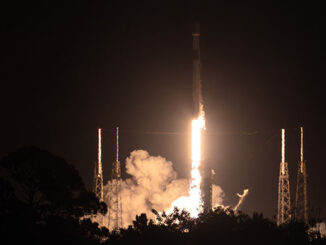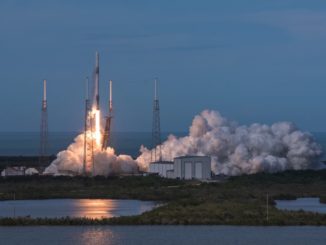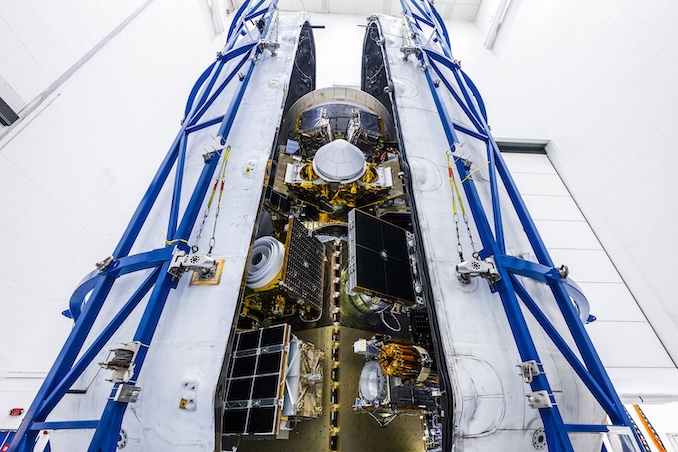
SpaceX will fly its uncrewed reentry Starfall capsule aboard the Bandwagon-5 rideshare mission from Cape Canaveral Space Force Station, scheduled for launch before dawn on Monday.
The 32 payloads onboard the Falcon 9 rocket will take flight from Space Launch Complex 40 during an hour-long window that opens at 6:30 a.m. EDT (1030 UTC). The rocket will fly on a southeasterly trajectory upon leaving the pad.
Spaceflight Now will have live coverage beginning about an hour prior to liftoff.
The 45th Weather Squadron forecast a 55 percent chance for acceptable weather during the launch window, stating that a cold front along southern Florida will bring gusty winds at liftoff that are “approaching constraints” to launch. There is also a moderate to high risk that weather at the recovery site for the first stage booster won’t be acceptable.
“Occasional coastal showers are also possible within the persistent onshore flow, although these are expected to be shallow and low-topped, with some more stratiform in nature,” launch weather officers wrote in a prelaunch forecast. “Therefore, the Cumulus Cloud Rule is a secondary concern.”
SpaceX will launch the mission using the Falcon 9 first stage booster with the tail number B1085. This will be its 19th flight following the launches of NASA’s Crew-9, Fram2, Firefly Blue Ghost Mission 1, RRT-1, SXM-10, SXM-11, MTG-S1, EchoStar25, and 10 batches of Starlink satellites.
Nearly nine minutes after liftoff, B1085 will target a landing on the droneship, A Shortall of Gravitas. If successful, this will be the 167th landing on this vessel and the 672nd Falcon booster landing to date.
Beyond SpaceX’s Starfall capsule, 20 of the remaining 31 payloads to be deployed were manifested by multinational mission management company, Exolaunch. Those include four radio-frequency monitoring satellites from Virginia-based, HawkEye 360; four communications satellites for Finnish micro satellite company, Iceye; and six navigation satellites from California-based, Xona Space Systems.
Return of Starfall
SpaceX first debuted its reentry capsule called Starfall back in June. During that mission, SpaceX played its cards close to the vest, not revealing that its spacecraft was onboard the rocket until fairly close to flight.
Even at that, the company just shared a rendering of the vehicle and didn’t disclose during its launch broadcast when it would be deployed.
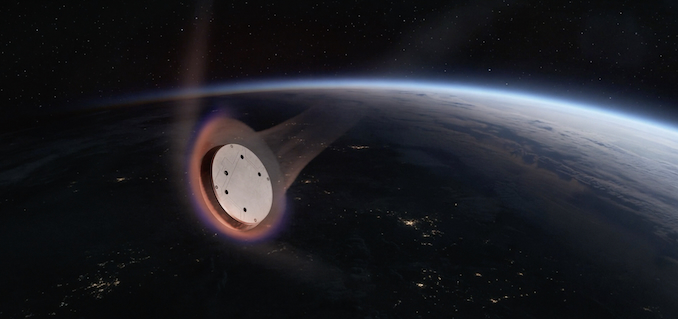
“SpaceX has developed a new spacecraft called Starfall, which at its core is a microgravity lab researchers and entrepreneurs can leverage to develop their products and innovations, said Zachary Luppen, an avionics supply chain engineer at SpaceX and the commentator during the June 23 broadcast.
“As we have seen demonstrated on the International Space Station, there is a huge opportunity to benefit life here on Earth through microgravity research and in-space manufacturing”
The Federal Aviation Administration noted in an environmental assessment of Starfall that the vehicle is about 0.75 meters (2.5 feet) tall, 3.1 meters (10.2 feet) in diameter, and has a mass of about 2,100 kilograms (4,600 pounds). The FAA said a single Starfall capsule has the ability to support up to 1,000 kilograms (2,200 pounds) of payload mass.
SpaceX didn’t state what, if any, payloads were onboard this Starfall mission.
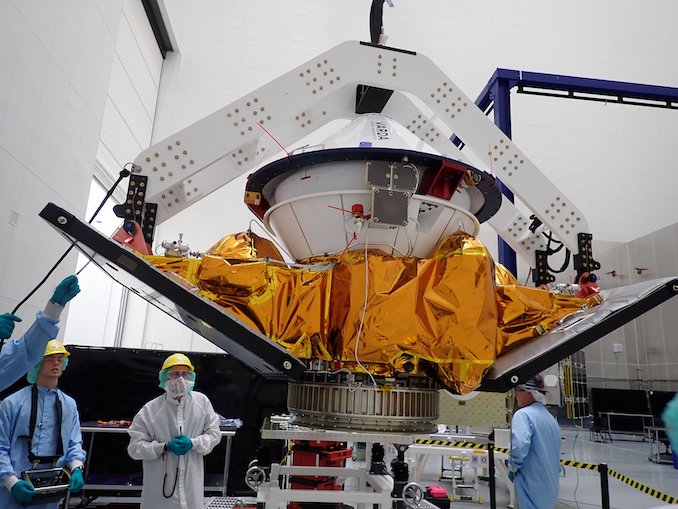
SpaceX’s Starfall isn’t the only reentry vehicle onboard the Bandwagon-5 mission. Varda Space Industries, which focuses on pharmaceutical research missions, is launching its W-Series 7 spacecraft, which is about three times smaller than Starfall.
Despite the name, W-7 will be Varda’s ninth reentry capsule launched to date. W-8 and W-9 were launched earlier this month on the Transporter-18 mission. W-7 features the cancer drug called Protac and will study whether microgravity can improve its solubility.
“In microgravity, molecules can crystallize differently than they do on Earth, potentially producing crystal forms with improved properties, including better solubility,” Varda wrote on its website prior to launch. “If successful, the experiment could help turn powerful protein-degrading molecules into more practical and effective cancer treatments.”
Also onboard Bandwagon-5 is the Starburst-1 demo mission from Portal Space Systems Inc. The 260 kg spacecraft is designed to perform orbital maneuvers and support a customer payload of up to 50 kg.
This first demonstration of the Starburst spacecraft is “fully funded by Portal to prove capability ahead of customer missions,” the company said on its website. Customer flights are advertised as starting in 2027.