The penultimate Vega-C launch of the year is scheduled to take flight from Europe’s Spaceport in French Guiana Monday night.
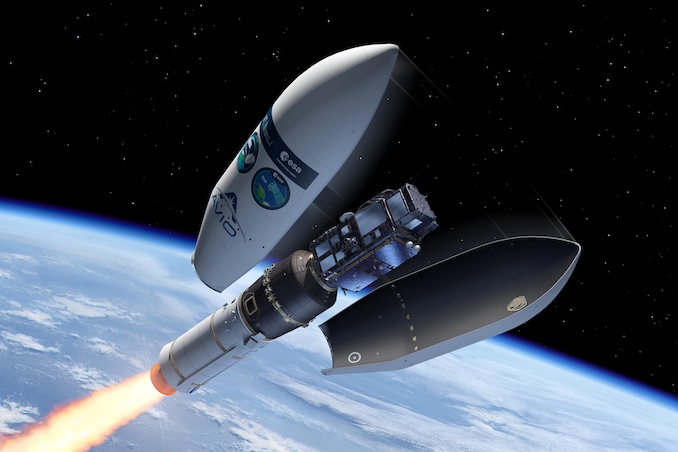
The launch, carrying the designation VV30, hosts two spacecraft onboard: the ocean- and atmosphere-monitoring Copernicus Sentinel-3C, managed by the European Organisation for the Exploitation of Meteorological Satellites (EUMETSAT), and the plant health-monitoring Fluorescence Explorer (FLEX), managed by the European Space Agency (ESA).
Liftoff of the four-stage rocket from Ensemble de Lancement Vega at Europe’s Spaceport in French Guiana is scheduled for 10:21 p.m. local time (9:21 p.m. EDT / 0121 UTC / 3:21 a.m. CEST). Deployment of the Sentinel-3C is scheduled for about an hour after liftoff and FLEX will deploy nearly an hour after that.
Spaceflight Now will have live coverage beginning about an hour prior to liftoff.
The Vega-C rocket stands at a height of 34.8 meters (114.2 ft.) and consists of four separate stages. Three solid-propellant motors power the first three stages (P120C, Zefiro-40, and Zefiro-9) and the Attitude Vernier Upper Module (AVUM+) is the re-ignitable liquid-fueled upper stage.
Avio produces the second and third stages, while the P120C is developed by Europropusion, a joint venture between Avio and Arianespace.
The AVUM+ uses a Ukrainian RD-843 engine and is capable of performing up to seven unique burns. The stage is fueled by hypergolic propellants unsymmetrical dimethylhydrazine (UDMH) and uses dinitrogen tetroxide (N2O4) as the oxidizer.
The VV30 mission will be the second managed solely by Italian company, Avio, and not jointly with Arianespace. This will also be the second Vega-C launch of 2026 and the eighth overall.
The Vega-C rocket has the capability of delivering up to 2,300 kg of mass to a 700-km Sun-Synchronous Orbit (SSO), which is about 50 percent more capacity than its predecessor, Vega. The last launch of the original Vega rocket (VV24) took place in September 2024.
The two spacecraft on this particular mission will be deployed to an altitude of 820 km with an inclination of 98.6 degrees. It will take about 116 minutes to deploy both satellites.
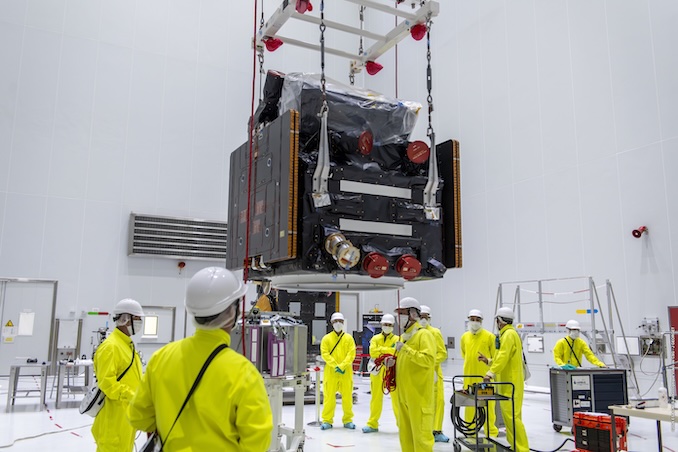
The first payload be deployed, the Copernicus Sentinel-3C. It’s the third in the Sentinel-3 series is scheduled to be released from the AVUM+ upper stage one hour after liftoff.
The spacecraft is equipped with a suit of science instruments designed to monitor ocean color, sea-level rise, and topography. It also tracks atmospheric changes and wildfires.
“The oceans are absolutely at the heart of this story. They absorb around 90 percent of the excess heat generated by human activities, shielding us from even greater impacts of warming,” said Phil Evans, Director-General of EUMETSAT during a prelaunch news briefing.
“But the oceans are paying a price with rising temperatures, changes to ecosystems, accelerating sea level rise, and systems such as Sentinel-3C are critical and essential infrastructure that can provide us with consistent information about what’s going on in the oceans.”
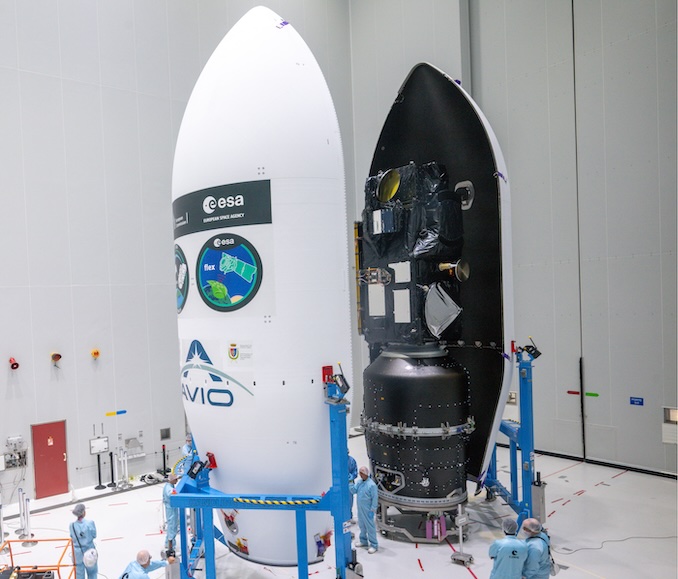
Also onboard the Vega-C rocket, nestled under the secondary payload adapter called Vespa, is FLEX. The 397 kg (875 lbs) spacecraft is the eighth in a series of Earth Explorer missions developed through ESA’s FutureEO program.
Over the course of a roughly 3.5-year planned mission, FLEX will use its Fluorescence Imaging Spectrometer (FLORIS) to help researchers understand “how carbon moves between plants and the atmosphere and how photosynthesis affects the carbon and water cycles,” according to ESA.
Simonetta Cheli, ESA’s Director of Earth Observation Programmes, said that this mission is about technology innovation, given that the FLORIS instrument will be operating in the 500-780 nanometer spectrum range, flying in tandem with Sentinel-3C.
“That’s also why we launch them together because each one of those two satellites will provide relevant information: one more on the status of the health of the vegetation. The other one more on the atmospheric context and all what is surrounding it,” Cheli said. “They will fly one kilometer apart from one of the other with a few minutes, I would say seconds apart. And this FLEX mission will have a revisit period of 27 days. It’s foreseen to live three and a half years, but as you have seen, most of the Earth Explorer mission have lived well beyond their initial lifetime.”
The deployment time for FLEX is scheduled for about one hour 56 minutes after liftoff.