May 15, 2026
Spaceflight Now
  • Home
  • News Archive
  • Launch Schedule
  • Mission Reports
    • Antares Launcher
    • Ariane 5
    • Atlas 5
    • Delta 4
    • Falcon 9
    • Falcon Heavy
    • H-2A
    • Soyuz
    • Space Station
  • Members
    • Sign in
    • Become a member
    • Members Content
  • Live
  • Shop
  • Donate
Breaking News
  • [ May 14, 2026 ] ULA confirms successful solid rocket booster test as Vulcan anomaly investigation continues News
  • [ May 12, 2026 ] SpaceX targets May 19 for debut of Starship Version 3, Launch Pad 2 Mission Reports
  • [ May 12, 2026 ] For a second time, poor weather scrubs Cargo Dragon mission launch to the space station Falcon 9
  • [ May 11, 2026 ] SpaceX launches intelligence-gathering satellites for the National Reconnaissance Office Falcon 9
  • [ May 8, 2026 ] Rescue mission for NASA’s $500 million space telescope passes key testing milestone Mission Reports

Epsilon-2

Mission Reports

Research platform launched to brave Van Allen radiation belts

December 20, 2016 Stephen Clark

Japan launched a research satellite Tuesday to repeatedly fly through the Van Allen belts high above Earth, helping scientists sort out how chaotic geomagnetic storms form and evolve and potentially endanger astronauts, spacecraft and infrastructure vital to life on the ground.

Mission Reports

Live coverage: Japan’s enhanced Epsilon booster blasts off

December 20, 2016 Stephen Clark

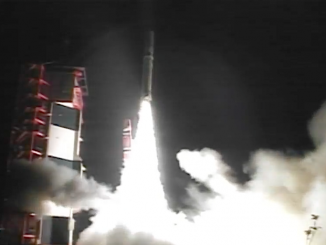
A Japanese Epsilon rocket launched Tuesday from the Uchinoura Space Center, a shoreline spaceport on the southern Japanese island of Kyushu, with a space weather research probe to study phenomena inside the turbulent Van Allen radiation belts. Liftoff of the 85-foot-tall rocket occurred at 1100 GMT (6 a.m. EST).

Mission Reports

Timeline of events during Epsilon rocket’s launch with the ERG mission

December 19, 2016 Stephen Clark

An Epsilon rocket is set to send a Japanese space weather research probe into an orbit stretching more than 20,000 miles above Earth to investigate how the Van Allen radiation belts shrink and swell with variable solar activity.

Mission Reports

Japan prepares launch of satellite to probe Earth’s radiation belts

December 19, 2016 Stephen Clark

Japanese engineers aim to launch an upgraded Epsilon booster Tuesday with a satellite to study the origins of powerful geomagnetic storms, phenomena that trigger picturesque polar auroras but could disrupt communications and and damage electric grids.

News Headlines

  • ULA confirms successful solid rocket booster test as Vulcan anomaly investigation continues
    May 14, 2026
  • SpaceX targets May 19 for debut of Starship Version 3, Launch Pad 2
    May 12, 2026
  • For a second time, poor weather scrubs Cargo Dragon mission launch to the space station
    May 12, 2026
  • SpaceX launches intelligence-gathering satellites for the National Reconnaissance Office
    May 11, 2026
  • Rescue mission for NASA’s $500 million space telescope passes key testing milestone
    May 8, 2026
  • Rocket Lab announces five-launch Neutron deal as it continues aiming for late 2026 debut
    May 7, 2026
  • SpaceX launches 24 Starlink satellites on Falcon 9 rocket from Vandenberg SFB
    May 5, 2026
  • Lockheed Martin joins collaboration with Firefly Aerospace and Seagate for off-shore launches
    May 4, 2026
  • SpaceX launches South Korean Earth observation satellite, plus 44 more payloads on midnight Falcon 9 rideshare mission
    May 2, 2026
  • SpaceX marks May Day, National Space Day with Starlink mission on a Falcon 9 rocket from Cape Canaveral
    May 1, 2026
  • Home
  • News Archive
  • Launch Schedule
  • Mission Reports
    • Antares Launcher
    • Ariane 5
    • Atlas 5
    • Delta 4
    • Falcon 9
    • Falcon Heavy
    • H-2A
    • Soyuz
    • Space Station
  • Members
    • Sign in
    • Become a member
    • Members Content
  • Live
  • Shop
  • Donate

© 1999-2026 Spaceflight Now Inc