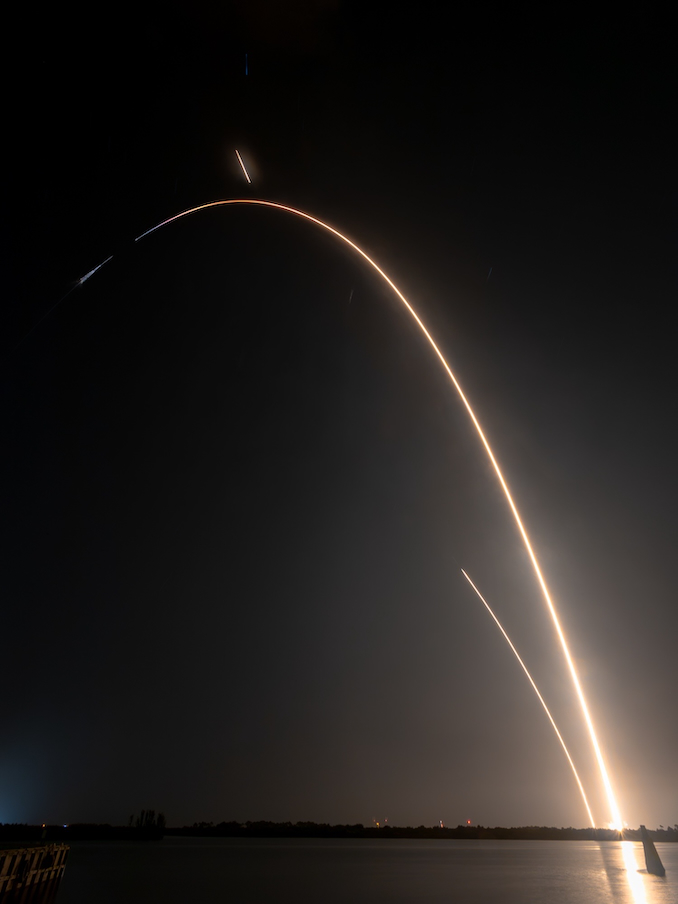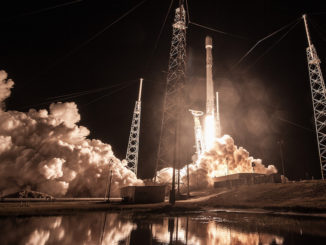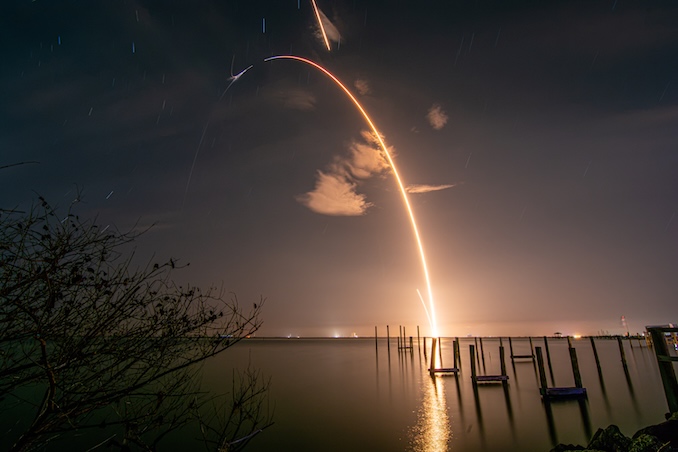
SpaceX launched back-to-back missions for Globalstar and the U.S. Space Force Saturday night, shrinking its time between launches down to a record 38.5 minutes.
First up was a batch of eight satellites for Globalstar as part of its work to replenish its low Earth orbit satellite constellation. The first Falcon 9 rocket took flight from Cape Canaveral Space Force Station at 9:12 p.m. EDT (0112 UTC).
SpaceX launched that mission using the Falcon 9 first stage booster with the tail number B1090, marking its 14th flight. It then went on to flip and land back at Landing Zone 40, adjacent to the launch pad, about eight minutes after liftoff.
This was the 52nd orbital launch from Florida’s Space Coast this year.
While that rocket’s upper stage was in the midst of its coast phase, SpaceX was also counting down to the liftoff of another Falcon 9 rocket over at Vandenberg Space Force Base in California.
That was the launch of a classified payload for the United States Space Force with a mission dubbed USSF-366. The Space Force didn’t disclose any information about the payload prior to liftoff, but a spokesperson for USSF’s Space Systems Command said, “The mission was assigned under a previously awarded [National Security Space Launch] Phase 3 Lane 1 task order.”
Liftoff of that second Falcon 9 rocket came at 6:50 p.m. PDT (9:50 p.m. EDT / 0150 UTC). Its booster, tail number B1088, safely landed on the droneship, Of Course I Still Love You, positioned in the Pacific Ocean.
Its recovery marked the 650th landing of a Falcon booster to date.
The Globalstar flight, dubbed Globalstar 2-R Launch 1 Mission, was publicly announced by Globalstar in the springtime. It said the launch was scheduled to happen on Sunday, May 17, but the flight was pulled to “allow more time for Globalstar teams to prepare the satellites for launch.”
The flight announcement came about a month after Amazon announced its intention to acquire Globalstar, which would allow the Amazon Leo to add direct-to-device capabilities to its constellation and compete with companies, like SpaceX and AST SpaceMobile in that domain.
“This launch represents another important step in sustaining and strengthening the infrastructure our customers rely on every day,” said Dr. Paul E. Jacobs, Chief Executive Officer, Globalstar, in a May 12 press release. “As we continue executing our long-term strategy, replenishing our existing constellation remains a critical part of delivering resilient satellite services around the world.”
In its latest earnings statement published Aug. 6, Globalstar said it would not be holding any further earnings calls or updates to its forward-looking guidance while the Amazon acquisition is pending. That deal is expected to close sometime in 2027.