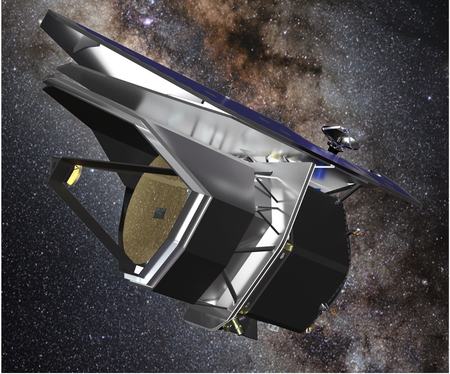
On the heels of launching its Nancy Grace Roman Space Telescope, NASA announced a new observatory, the Probe far-Infrared Mission for Astrophysics or PRIMA.
The agency said Wednesday PRIMA was moving into what’s referred to as Phase B development. That allows for further development of the preliminary design and for NASA to conduct technical and budget reviews.
If approved, PRIMA will move forward into Phase C with a max project cost of $1.2 billion, not including launch and other costs.
PRIMA also ushers in a new class of missions within NASA’s Explorers Program: Probe Explorers. It will be developed by NASA’s Jet Propulsion Laboratory in collaboration with NASA’s Goddard Space Flight Center and Marshall Space Flight Center as well as the space agencies of Canada, France, Germany, Japan, South Korea, and the United Kingdom.
The California Institute of Technology’s (Caltech) Infrared Processing & Analysis Center (IPAC) is designated as the mission science center “where raw data from the telescope is received, processed, and archived for use by astronomers seeking to answer some of the universe’s deepest mysteries,” according to Caltech.
“The PRIMA mission is humanity’s next window into the deep universe. It will unveil the obscure across cosmic time to better understand the formation of planets, stars, black holes, and even how water on Earth came to be,” said Nicky Fox, associate administrator, Science Mission Directorate, NASA Headquarters in Washington.
PRIMA features three primary instruments for observations:
- A cryogenically cooled 1.8-meter telescope
- An imaging polarimeter (PRIMAger)
- A high-resolution spectrometer (FIRESS)
The detectors stem from three decades of research conducted by Caltech and JPL (managed by Caltech). They helped develop the type of detectors featured on PRIMA that will allow it to operate its far-infrared cameras and spectrometer.
“PRIMA represents a giant leap for far-infrared astronomy,” said Caltech President Ray Jayawardhana. “By combining detector technology pioneered by our colleagues with deep scientific expertise across Caltech, JPL, and IPAC, PRIMA will help reveal fundamental cosmic processes that have long been hidden from view.”
PRIMA is scheduled to launch in 2033. NASA will select a launch provider at a later time.