
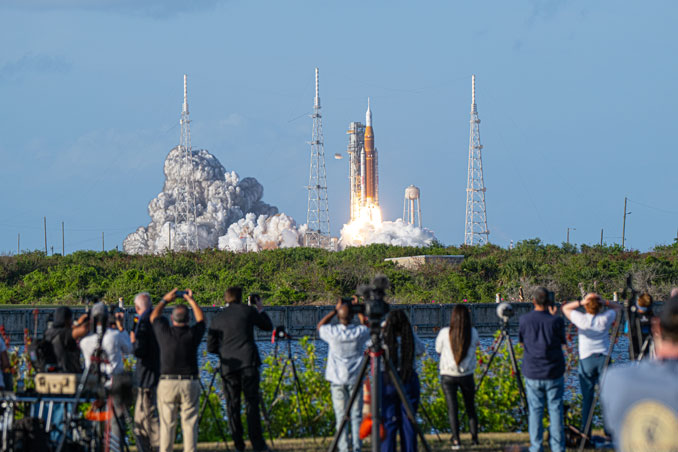
A three-man one-woman crew blasted off on a voyage to the moon Wednesday, riding atop the world’s most powerful operational rocket as it roared away on a trail-blazing flight to help pave the way for upcoming lunar landings and an American moon base.
It was the first piloted moonshot since the end of the Apollo program 53 years ago, a flight expected to carry Artemis 2 commander Reid Wiseman, Victor Glover, Christina Koch and Canadian astronaut Jeremy Hansen farther from Earth than any astronauts before them.
The crew will not land on the moon or even go into lunar orbit. But they plan to thoroughly test their Orion capsule, making only its second flight — its first with a crew on board — to make sure it’s up to the task.
At the same time, the mission will test flight controllers and procedures needed to safely send astronauts back to the moon for long-duration stays as NASA sets its sights on winning a superpower space race with China, which plans to send its own taikonauts to the moon before the end of the decade.
“This is a test flight,” NASA Administrator Jared Isaacman told CBS News. “This is the opening act in a series of missions that will send astronauts to and from the moon with great frequency as we return to stay, to build the moon base and realize the scientific and economic potential on the lunar surface.”
For the Artemis 2 astronauts, named to the mission with great fanfare in 2023, the launching came two months later than planned because of work to fix hydrogen leaks in the Space Launch System rocket’s first stage and to resolve an upper stage propellant pressurization problem.
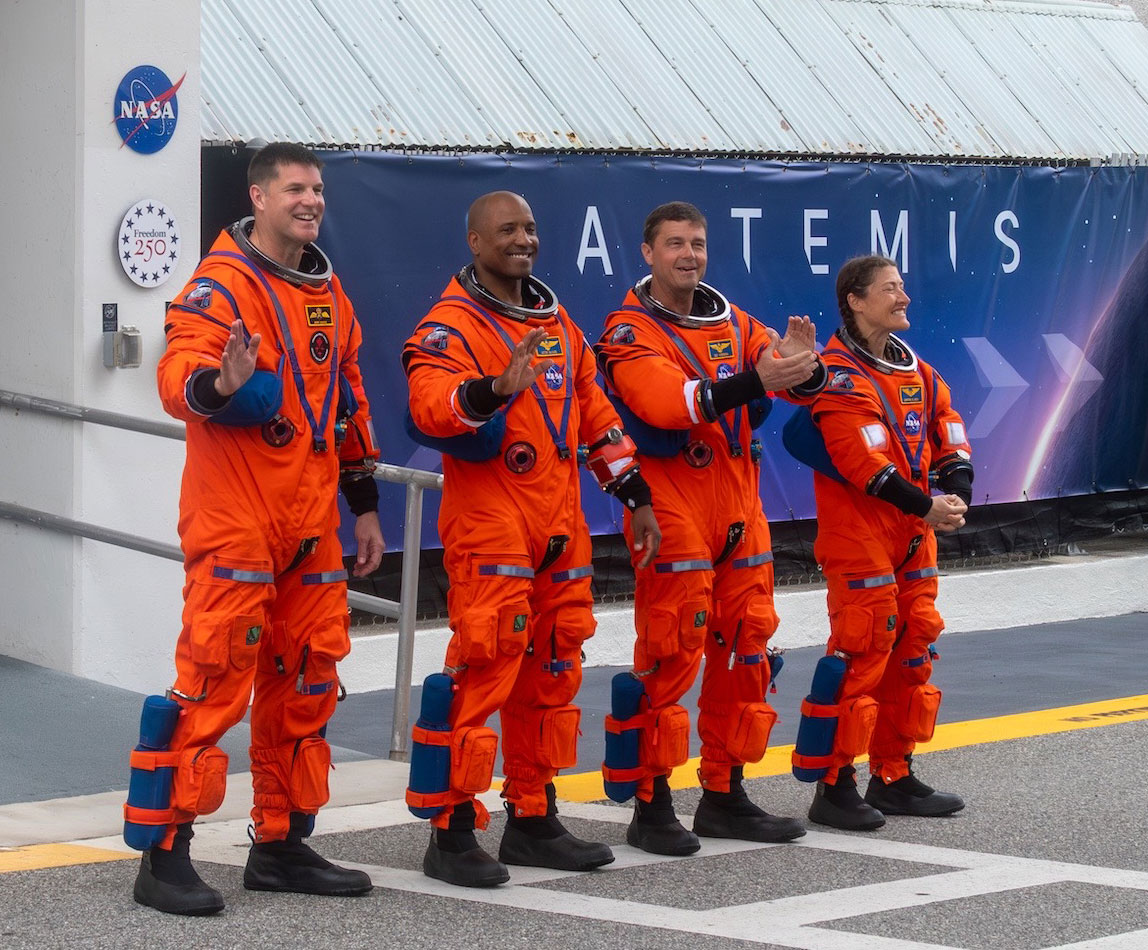
On Wednesday, the launch team ran into a couple of what turned out to be minor problems, extending a final planned hold in the countdown at the T-minus 10-minute mark to make sure everything was ship shape and ready to go.
Launch Director Charlie Blackwell Thompson then conducted a poll of engineers in Firing Room 1 asking Wiseman if the crew was “go” for launch. The astronauts all said yes.
“On this historic mission, you take with you the heart of this Artemis team, the daring spirit of the American people and our partners across the globe and the hopes and dreams of a new generation,” Blackwell-Thompson said to the astronauts. “Good luck, Godspeed, Artemis II, let’s go.”
From that point, the countdown ticked smoothly to zero, and the SLS rocket thundered to life with billowing clouds of steam at 6:35:12 p.m. EDT, just 11 minutes late, when its four shuttle-era main engines ignited and throttled up to a combined two million pounds of thrust.
After a lightning-fast round of computer checks, the rocket’s two extended strap-on solid fuel boosters ignited, explosive bolts holding the SLS to its launch pad shattered and the 5.7-million-pound rocket climbed away from pad 39B at the Kennedy Space Center atop a combined 8.8 million pounds of thrust.
Like the Orion, it was the rocket’s second launch in three years and its first with astronauts on board.
Generating an ear-splitting roar that shook the ground for miles around, the huge rocket reached about 120 mph — straight up — in less than 10 seconds. Consuming 8,000 gallons of liquid propellant and 24,000 pounds of solid fuel per second, the SLS rapidly accelerated as it burned through propellant and lost weight.
Moments after clearing the launch pad’s gantry and lightning towers, the SLS arced away to the east over the Atlantic Ocean, putting on a spectacular show for tens of thousands of area residents and tourists who flocked to Florida’s “Space Coast” to witness NASA’s first piloted moon launch in a half century.
The SLS rocket broke through the “sound barrier” 55 seconds after liftoff and smoothly raced through the region of maximum aerodynamic pressure as it plowed out of the dense lower atmosphere.
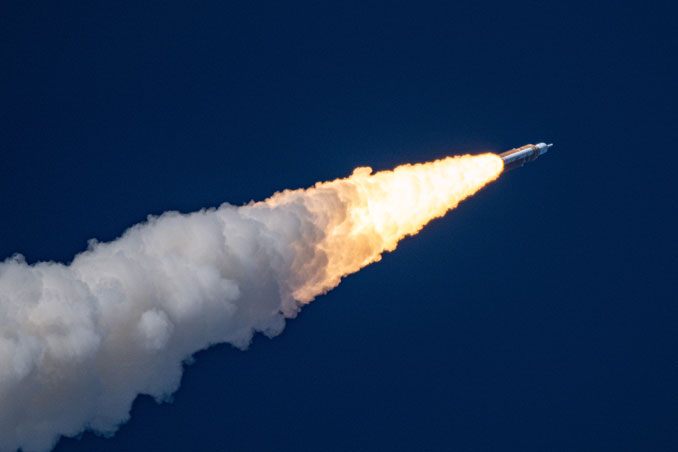
The twin strap-on boosters, providing two-thirds of the rocket’s liftoff thrust, exhausted their propellant and fell away about two minutes after launch. The SLS core stage continued the ascent on the power of its four RS-25 main engines.
Eight minutes and 10 seconds or so after liftoff, the engines shut down, the core stage fell away and the Orion crew capsule, the astronauts now weightless, continued coasting upward, still attached to the rocket’s upper stage, known as the Interim Cryogenic Propulsion Stage, or ICPS. The spacecraft’s four solar wings unfolded a few minutes later.
At that point, the astronauts were in an elliptical orbit with a high point, or apogee, of about 1,380 miles and a low point, or perigee, of just 17 miles or so. The ICPS fired its main engine for the first time about 50 minutes after liftoff, raising the low point to a safe 115 miles.
An hour later, the ICPS engine fired a second time, raising the high point of the orbit to some 43,760 miles, higher than any astronauts have flown since the final Apollo moon mission in 1972.
The Orion capsule, attached to a European Space Agency-supplied service module housing air, water, propellant, maneuvering thrusters and a single main engine, separated from the ICPS three hours and 20 minutes after launch.
The orbit adjustments were designed to put the astronauts in a highly elliptical 24-hour-long orbit, giving them plenty of time to check out the Orion capsule, making sure the ship’s communications, navigation, propulsion and life support systems are working properly before heading to the moon.
That includes the capsule’s cramped toilet compartment, resembling a small telephone booth built into the floor of the capsule. Koch reported problems shortly after reaching orbit as she was activating the system.
“Christina, with the toilet, the fault that you reported, the toilet cannot spin up,” a flight controller radioed. “You can still use it for fecal collection, but you’ll have to use (contingency bags) for urine.”
He said engineers were working on a repair plan and within an hour or so, Koch was able to restore it to normal operation.
A major objective of the flight came a little more than three hours into the mission when Glover took over manual control of the Orion capsule, flying in formation with the spent ICPS stage that helped boost them into orbit. He said he was able to precisely re-position the capsule with no problems, approaching the ICPS and backing away as planned.
He described the sound and feel of Orion’s thrusters firing as “a little rumble, like driving on a rocky road.”
“We are essentially going to make sure that the vehicle flies the way that we think it does, that we designed it to do,” Glover said before launch. “And so we’re going to not only fly the vehicle manually, we’re going to execute the six degrees of freedom, so (moving) forward, backwards, left, right, up and down.”
He also re-oriented the capsule in roll, nose up-and-down pitch and side-to-side yaw.
“But we also want to give qualitative and quantitative feedback to the ground team, so letting them know what it feels like now that we can hear and feel the thrusters and to just understand the human experience.”
The crew will end an 18-hour day with two four-hour “sleep” periods early Thursday. They’ll get up after the first break to monitor a firing of their own service module engine to again raise the low point of the orbit and slightly boost the high point up to around 44,555 miles. At that point, the crew will get another four hours to nap.
In the meantime, NASA’s mission management team will review Orion’s performance to that point and, if all goes well, declare the spacecraft “go” for the all-important “trans-lunar injection,” or TIL, service module main engine firing.
The planned six-minute TLI burn, starting around 7:30 p.m. Thursday, will increase the spacecraft’s velocity by about 900 mph, breaking the ship out of Earth orbit to finally head for the moon.
The TLI burn will put the Orion on a free-return trajectory. From that point on, the crew’s path back to Earth will be set. As the ship loops around the moon, lunar gravity will bend the trajectory back toward a precisely targeted Pacific Ocean splashdown off the southern California coast on April 10.
The coast out to the moon will take about four days. All the while, Earth’s gravity will continue pulling on Orion, steadily slowing the ship as it flies farther away. But on Monday, the astronauts will enter the “lunar sphere of influence” and begin speeding up again as the moon’s gravitational pull finally begins exceeding Earth’s.
Later that day, the spacecraft is expected to reach a distance of 248,655 miles from Earth, equaling and then passing a record set by the Apollo 13 crew in 1970.
The Orion will pass behind the leading edge of the moon as seen from Earth and out of contact with mission control for about 40 minutes starting around 6:40 p.m. Monday. Sailing over the far side of the moon, the astronauts will pass within about 4,000 miles of the lunar surface at close approach and reach a maximum distance from Earth of some 252,800 miles.
During passage around the far side, about a quarter of the moon will be in sunlight, giving the astronauts a chance to observe, photograph and shoot video of features never before seen by human eyes.
“We are going to maximize every minute of looking at that far side,” Koch said. “There are launch windows where we could have illumination that will allow us to see things for the first time ever with human eyes, and that actually makes a difference to the people doing the scientific data analysis.”
Added Glover: “Twenty-four men have seen the moon, and we’re going to send the first set of woman’s eyes. They think that she can potentially see colors that we may not see. And so I think that’s also very important.”
The flyby phase of the flight is expected to come to a close Monday evening and the spacecraft will leave the lunar sphere of influence Tuesday afternoon as it heads back to Earth, steadily picking up speed as the planet’s gravity again becomes dominant.
Next Thursday, the astronauts will attempt a ship-to-ship call with the crew of the International Space Station followed by a crew news conference later that afternoon. That will set the stage for re-entry on Friday, April 10.
A critical thruster firing Friday afternoon will fine-tune the crew’s approach before they jettison the no-longer-needed service module.
Flying heat shield forward, the Orion will hit the top of the discernible atmosphere around 8 p.m. while moving at some 25,000 mph. The heat shield will experience temperatures of up to 5,000 degrees as the spacecraft rapidly slows in a blaze of atmospheric friction.
Once through the zone of maximum heating, the capsule will be descending at a much more more sedate velocity. A series of parachutes will sequentially deploy to slow the craft to a relatively gentle 15 mph splashdown. Navy crews will be standing by to help the astronauts out of their spaceship for short helicopter rides to a nearby revery ship.
“I think Jeremy said it best, when that hatch opens on the Pacific Ocean, we’ll probably be pretty ready to get out,” Koch said. “But a part of us will know that there are some moments left that we will miss forever and probably won’t ever get to have back.”
The astronauts will be extracted from Orion and flown by helicopter to a waiting recovery ship for initial medical checks and calls home to family and friends before heading home to Houston for debriefing and reunions with family. The Orion, meanwhile, will be towed into the recovery ship’s flooded “well deck” and secured for the trip back to shore.
With the Artemis 2 crew back on the ground, NASA’s focus will shift to the Artemis III mission and beyond, gearing up for another Orion crew to test rendezvous and docking procedures next year with one or both moon landers being built by SpaceX and Blue Origin.
If that goes well, NASA plans to launch one and possible two moon landing missions in 2028 using whichever landers are deemed safe and ready for flight. Agency managers say they plan to increase the flight rate to moon landings every six months to begin building a moon base near the lunar south pole.
But that will depend on steady funding from from Washington across multiple presidential administrations. The Trump administration kicked off the Artemis program, but it’s not yet known how the project will fare over the long haul.
Isaacman is optimistic.
“It’s important because we’re fulfilling a promise … for America’s return to the moon as a stepping stone for all the things that we are going to do farther out into our solar system, like some day American astronauts planting the stars and stripes on Mars,” he said in an interview with CBS News.
“So you’re doing it for the scientific potential, the economic potential as a technological proving ground to do the things on the moon that you’re going to need on Mars.
“And how about inspiring the next generation?” he added. “How many kids after this mission are going to dress up as astronauts for Halloween and want to grow up and contribute to this great adventure?”