It’s the end of an era as SpaceX transitions all of its planned Dragon flights from Launch Complex 39A (LC-39A) at NASA’s Kennedy Space Center to Space Launch Complex 40 (SLC-40) at Cape Canaveral Space Force Station.
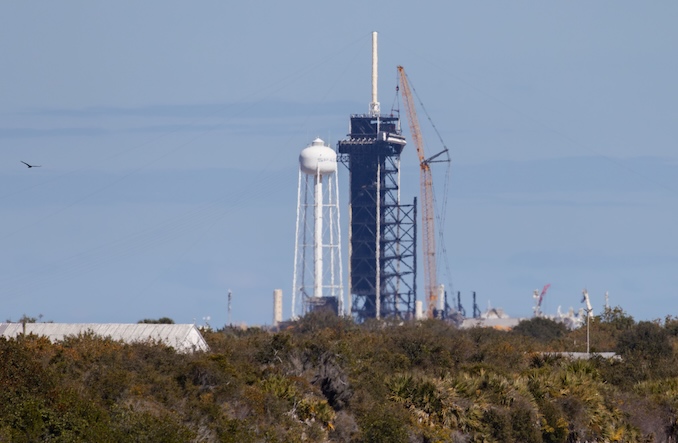
During the predawn hours of Feb. 4, the company erected a Leibherr LR13000 crane beside the crew access tower at LC-39A. It then proceeded to secure a support structure around the crew access arm, either in preparation for removal or to support repair work.
In a statement to Spaceflight Now, a NASA spokesperson said that SpaceX let the agency know about work it planned to perform on the crew access arm, but deferred to SpaceX for details. We reached out to SpaceX for comment, but didn’t receive a response in time for publication.
During a Jan. 30 news conference at NASA’s Johnson Space Center in Houston, Texas, Lee Echerd, SpaceX’s senior mission manager for Human Spaceflight Mission Management, talked about the shift for the company. He explained why there’s been a lack of Falcon 9 launches from LC-39A since December.
“It’s great to have two launch pads off the Florida coast. For our manifest going forward, we’re planning to launch most of our Falcon 9 launches off of Space Launch Complex 40. That will include all Dragon missions going forward,” Echerd said. “That will allow our Cape team to focus at 39A on Falcon Heavy launches and hopefully our first Starship launches later this year.”
Dragon arrives at the hangar at pad 40 ahead of the upcoming Crew-12 launch to the @Space_Station pic.twitter.com/Sq18mdmR39
— SpaceX (@SpaceX) February 3, 2026
Kiko Dontchev, SpaceX’s vice president of Launch, made similar comments regarding upcoming changes to its pad at the Kennedy Space Center in a social media post in mid-December.
“Worth noting that [Starlink 6-99] was also our last single stick from 39A for some time as we put full focus on Falcon Heavy launches and ramping Starship from the Cape!” he wrote.
A NASA spokesperson clarified in a statement on Thursday how this change factors into the agency’s ability to fly its astronauts to the space station.
“NASA’s Commercial Crew Program does not specify a specific launch pad for crew rotation missions and maintains a launch capability at Space Launch Complex 40 at Cape Canaveral Space Force Station in Florida,” the spokesperson said. “If needed, SpaceX could still support NASA crewed launch operations from pad 39A in the future.”
SpaceX began the process of modifying SLC-40 to support crewed missions back in 2023 and it was completed in 2024. The first Dragon mission to launch from this site to the International Space Station was the CRS-30 cargo flight in March 2024.
The first humans to launch from here were NASA astronaut Nick Hague and Roscosmos cosomonaut Aleksandr Gorbunov on the Crew-9 mission in September 2024. Four more crew members are on deck to fly from SLC-40 with the Crew-12 mission slated to launch no earlier than Feb. 11.
NASA officials previously said that having the additional launch capability for crewed missions in Florida was a big benefit, since it gave the agency options to work around busy launch manifests.
“You wouldn’t have guessed this ten years ago out here at KSC, but what’s become one of the biggest constraints to launching is pad availability because business is booming here at the Space Coast and at Kennedy with not just SpaceX, but all of the folks launching,” said Daniel Forrestel, Launch Integration Manager for NASA’s Commercial Crew Program back in February 2024. “Bringing 40 online just gives us more flexibility to continue our primary mission.”
Starship looming
About an hour before Echerd’s remarks during the Jan. 30 Crew-12 briefing, the Federal Aviation Administration (FAA) announced the publication of a pair of documents permitting SpaceX to move forward with up to 44 launches and 88 landings annually of its Starship-Super Heavy rocket as well as construction of infrastructure to support such operations, from an environmental standpoint.
The evaluation came about half a year after the FAA published a draft Environmental Impact Statement (EIS) in August 2025 and took in public comment as part of compliance with the National Environmental Policy Act.
“SpaceX’s activities would continue to fulfill the United States’ expectation that increased capabilities and reduced space transportation costs will enhance exploration (including within the Artemis and Human Landing System programs), support U.S. leadership in space, and make space access more affordable,” the FAA’s Record of Decision document stated.
“By providing a reusable launch vehicle with increased lift capability that returns to its launch site, the Proposed Action would reduce the cost of a launch and increase efficiency, delivering greater access to space and enabling cost-effective delivery of cargo and people to the moon and Mars.”
In order to execute the full realization of Starship at LC-39A, SpaceX proposed about 70,000 square meters (roughly 800,000 square feet) of infrastructure changes “to include launch and landing pads and towers, propellant generation, and stormwater/deluge ponds.”
In order to comply with existing environmental laws, the FAA stated that SpaceX needs to coordinate with the St. Johns River Water Management District and the Florida Department of Environmental Protection (FDEP) for its water use. SpaceX is estimated to use 297 million gallons (1.1 billion liters) of water annually.
“SpaceX would construct onsite bulk storage for water and commodities and would reuse or recycle as appropriate,” the FAA wrote. “Based on the analysis of potential effects […], the FAA does not anticipate significant effects to utilities and infrastructure distribution systems and service capacity.”
The FAA said the Kennedy Space Center Fire Marshal and Safety Office will assess the construction of a liquified natural gas (LNG) facility. This will require additions, like “a flammable vapor gas dispersion zone [and] design sufficient to withstand wind forces without loss of structural or functional integrity.”
“Until the LNG facility is constructed, commodities such as liquid oxygen and liquid methane would be trucked in by contractors,” the FAA wrote.
When assessing public safety, the FAA noted that closures related to static fire tests, launches and reentries could account for nearly 10 percent of a calendar year. It estimates up to 396 hours for static fire tests and 462 hours for launches and reentries.
The timing of the first launch of Starship from Florida is still up in the air, but may come as soon as the second half of 2026. During an address at the 7th Space Coast Symposium and Expo in August 2025, Dontchev assured members community members that Starship would be a proven rocket before it starts launching from the Sunshine State.
“Never has there been a case where a rocket at this scale has been tested and flown as many times as it has will actually come to Florida for the first time. That’s never happened. It’s usually Florida is the test range,” Dontchev said. “The New Glenn, Artemis, all these rockets launch here for the first time, even Falcon. That’s not going to be the case with Starship.
“Starship, you’re going to get a vetted machine that shows up ready to party.”
The next test flight of Starship will be the debut of the third iteration of the vehicle, called Starship Version 3, which features, among other upgrades, new versions of the Raptor engines built by SpaceX. A launch date hasn’t been announced, but SpaceX founder Elon Musk said the test flight could take off from Starbase, Texas, as soon as early March.