Q&A with Keith Gendreau, principal investigator of the first X-ray space communications experiment (members only)
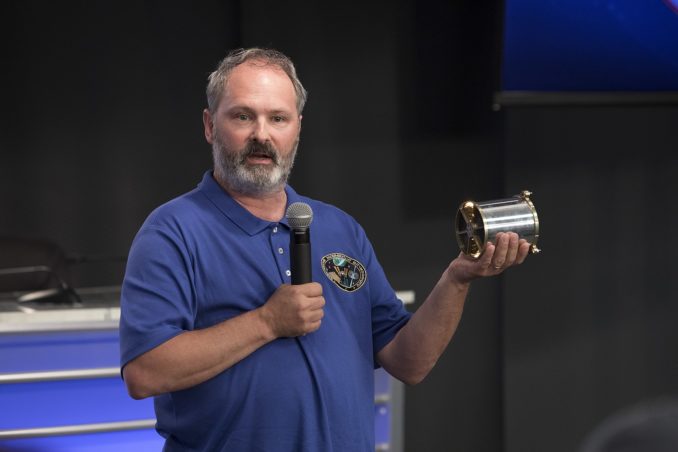
Keith Gendreau, principal investigator for the Neutron star Interior Composition Explorer, or NICER, speaks to members of social media in the Kennedy Space Center’s Press Site auditorium before NICER's launch in 2017. Credit: NASA/Kim Shiflett
Keith Gendreau, an astrophysicist at NASA’s Goddard Space Flight Center, recently spoke with Spaceflight Now about a new experiment on the International Space Station to demonstrate X-ray communications in space for the first time.
The X-ray communications experiment, known as XCOM, is one of several scientific and tech demo payloads inside a U.S. military instrument named STP-H6, which arrived at the space station Monday in the trunk of a SpaceX Dragon cargo capsule.
The space station’s robotic arm will pull the STP-H6 payload, along with a separate NASA instrument to measure atmospheric carbon dioxide, out of the Dragon’s trunk in the coming days for attachment to a mounting post on the station’s truss backbone.
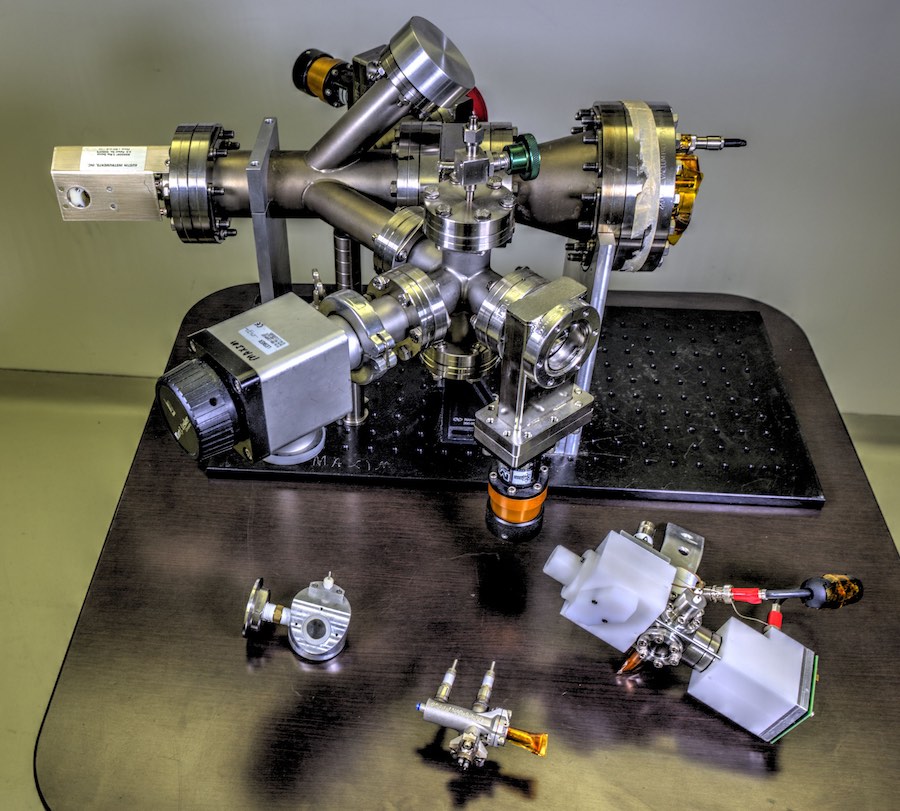
The XCOM experiment includes a transmitter, or source, to emit X-ray signals toward a receiver on the other side of the station. The receiver is actually a NASA astrophysics instrument named NICER, short for the Neutron Star Interior Composition Explorer.
NICER has been on the space station since 2017 measuring X-ray light coming from neutron stars, the super-dense stellar skeletons left behind after lower-mass stars exploded in violent supernovas at the ends of their lives.
The NICER experiment has the ability to log the precise time an X-ray photon falls on its silicon detectors. The time tags allowed scientists to use beams from rapidly-spinning neutron stars, called pulsars, as a tool for in-space navigation for the first time.
The regular pulses of X-ray light from a certain type of neutron star, called a millisecond pulsar, was used to derive a position estimate with NICER in late 2017.
Now NICER is a critical piece of the X-ray communications experiment, which uses an X-ray source originally developed to test the NICER instrument on the ground. The X-ray source is also being used in a new type of CT scan machine that will give patients a tenth of the radiation dose of an existing CT scan.
“This (X-ray) source was developed to calibration of X-ray astrophysical instruments, and it’s got applications now in communications and medicine, and other areas,” Gendreau said. “The core technology was developed by NASA.”
The XCOM experiment’s sponsor is the U.S. military’s Space Test Program. The Defense Department foresees X-ray communications as a more secure way to transmit data around the world, while NASA scientists believe it could be useful in deep space data transmissions.
“They had an interest in this type of experiment, and we knew how to make it,” Gendreau said of the Defense Department’s involvement. “So everybody worked together to get it to this level.”

Q: Tell me about this X-ray communications experiment, and how it works with NICER?
A: “NICER is an X-ray timing experiment, so we look at things in the sky that the X-ray flux changes with time. These include black holes, neutron stars, and other things. With NICER, our big deal is to do really high-precision timing of X-ray pulsars, both for science reasons and technology reasons. One of the technology reasons was to use a subset of millisecond pulsars that are out there like clocks, like we use the atomic clocks of GPS to do navigation, but with pulsars, on kind of a galactic scale as opposed to just low Earth orbit. So it’s all about with NICER, so when we built NICER, we made use an X-ray source that we had developed at Goddard to test it, an X-ray source that we could modulate with arbitrary waveforms that we could make simulated pulsars and make sure that NICER would actually work properly to do the X-ray timing that it was supposed to do for the science and technology applications.
“So this X-ray source we made, we called it a modulated X-ray source, or MXS. As soon as you see that you can do any type of X-ray light curve you want, it was very clear that we could use it to transmit data. So that’s another application that we can do.
“What we’re sending up on SpaceX-17 is essentially a little bit of a more robust version of something that we’ve built in the lab many times to test NICER and other X-ray instruments. We’re sending it up into space to actually do an in-flight demonstration of data communication in X-rays.
“There are a lot of reasons why you might want to do this. X-rays at the very highest energies are penetrating, so they can go through materials. One concept is that it’s a way that you could possibly communicate with a hypersonic vehicle, like a re-entering spacecraft or something like that, like in Apollo 13 where they had that RF blackout because of the plasma. X-rays are above that plasma frequency and could provide a communications link.
“At lower energies, it’s possible to make diffraction-limited optics, where you can make use of the fact that the wavelength of X-rays is very, very small, and the beam divergence of an optical system scales with the wavelength. So you go from radio to laser communication, and the communication beam that’s produced is made much, much smaller. If you can imagine going even smaller than laser communication, that would be in the direction of X-rays. X-rays are much smaller, about 1/1000th of the wavelength of the systems used in optical communication, laser communication, so the beam can be extremely tight.
“There are some national security applications for that type of system. You could imagine point-to-point communication links between geostationary spacecraft and low Earth orbit spacecraft, where the footprint of the beam is very, very small. And if anyone were to intercept it, your signal would go away. So you could really make a secure point-to-point comm link.
“On longer distances, like, say, going from the outer planets to Earth, having a very small footprint means that you’re not spending all of your power in your transmitter spreading your signal over the inner solar system. You’re going to direct it more to the instrument you care about. So you start winning in terms of how many gigabits per second per watt is used in the transmitter.
“What we’re doing with this XCOM demo on the space station that’s going up on SpaceX-17 is something kind of in between, where we’ve made an X-ray source, which is very similar to what we used to calibrate NICER on the ground, so it’s not a very high-energy, penetrating X-ray. It’s also not a super-soft X-ray with diffraction-limited optics. It’s something in between. The idea is to advance the technology readiness level of that type of X-ray source for this application.
“We envision after this initial demonstration that we do with NICER, there will be more and more demonstrations with higher and higher levels of sophistication and fidelity in future systems. What’s going to happen on the space station is when SpaceX-17 goes up and STP-H6, which is carrying the X-ray communications experiment, is installed on the space station, it’s going to be installed on ELC 3 on the space station, which is on the zenith side, port. NICER is on the zenith side, starboard, at ELC 2. What we’ll do is we’ll take NICER, which normally looks at the stars, and we’ll point it at ELC 3, and in particular our X-ray source. And then we will pulse X-rays from our X-ray source, sending some type of data from ELC 3 to ELC 3, and NICER will be the receiver of the first space-based X-ray communication demonstration.
“So it will be a communication demo, which is what the DoD is interested in for their STP-H6 mission. For NICER, it’s going to be the first high-fidelity in-flight calibration of timing. We’ve done it on the ground, but we’ve never done it in space because we don’t have access to this kind of source until today in space. So it’ll be a great timing calibration as well. So there will be technology and science applications out of this experiment, just like NICER has done for other things.”
Q: What sort of data will you be transmitting?
A: “I don’t know at this point. We have a large variety of things we can do. I could take you in my laboratory at Goddard, and I have a similar system, and I do some cheap thrills experiments, where I use my X-ray source, and I hook it up to my iPhone, and I basically transmit iTunes over X-rays to a detector that’s just like NICER. Probably we don’t do anything like that, but it would be kind of cool, right?
“I think what we’re going to do is kind of a (test) pattern. We’ve got communication people on our team that are used to this, figuring out the right thing to send to evaluate the communication efficiency, the bit error rates that you would get, although I would secretly like to send some iTunes over X-rays to NICER if we could do it. It will be a simple experiment like that to prove the X-ray source works up there, that we can modulate and transmit data, that NICER can receive. We can compare what NICER receives with what was transmitted, and verify that they’re the same, and do some evaluation of the quality of the link. That would help inform the next experiment that we do.”
Q: When you say modulation, do you mean the X-ray source can start and stop transmissions at high speed?
A: “In general, the modulated x-ray source can do arbitrary light curves in X-rays. You can do amplitude modulation, or you can do pulse modulation. You can imagine pulses, 1s and 0s, in X-rays. There are different schemes in how to do it. If you want the pulse, or the more digital, approach to communication, you can do pulse frequency modulation. There are a whole bunch of encoding schemes for doing this, but basically we are turning the X-rays on and off very quickly, so that they become short pulses, and we define when the pulses come and go, and the information is encoded in how we do that.
NICER, on the other side, is going to time tag every X-ray it receives with very high precision. Then we can reproduce the pulse signal that the XCOM transmitter produced, and then compare that on the ground with what we told it to do, and see how it worked.”
Q: What’s the range between XCOM and NICER?
A: “It’s on the order of 50 to 60 meters. The space station is kind of the size of a football field, and we’re transmitting almost from one end zone to the other.”
Q: Is this the first X-ray communication experiment in space?
A: “This will be the first. This whole idea of X-ray modulation is really new in terms of realization. Having said that, back in the Apollo days, people knew that the RF blackout was going to occur, and there were people who were talking about the possibility of using an X-ray source to communicate through the plasma. It wasn’t implemented because there are a lot of complications in doing this, particularly in the early days, and particularly the technology that was available to modulate X-rays wasn’t quite as sophisticated as what we have now. What we have now is something that can be made very small and light, and robust. So this will be the first demonstration in flight.
Q: You mentioned the X-ray beam width is very narrow, and I know you can get a lot more bandwidth with an optical communication system than with radio communication. Do X-rays offer a similar jump in bandwidth?
A: “In principle, yes, that’s possible. Right now, we’re taking the baby steps in doing X-ray modulation and coupling with optics, and all of that. In principle, those models continue. So what we’re doing is a very early step to prove that these things work, and these other things don’t work. I think it’s just a matter of engineering. There’s no need of unobtainium here to make this much, much better, just engineering. You should be able to follow this track and reap the benefits.
“The way this X-ray source modulates X-rays is it takes actual UV light, or optical light, that simulates a photo cathode. The photo cathode then produces photo electrons, and then those photo electrons are accelerated into a target, where they stop and make X-rays. So by modulating the optical light, you modulate the photo electrons, and therefore the X-rays. So in principle, you can modulate the X-rays as fast as you modulate optical light. In fact, there are different ways to modulate X-rays even faster than that. But what we’re doing in this experiment is something that is very easy to achieve.
“You could almost imagine, in the future, laser communication systems being upgraded to an X-ray communication system by kind of changing some components. But at the front end, whatever you’re using to drive the optical component of that laser communication system, you could use to drive the X-ray system. So it should be a drop-in replacement, and the beams are tighter, which means more secure and more directed power where you care for it to go.”
Q: What’s your UV light source?
A: “It’s an LED, a UV LED, and it’s just more purplish, it’s a little bit better at creating photo electrons from a photo cathode. It’s a small UV LED that we’re modulating, which kicks off the whole shebang.”
Q: Logistically, when do you expect to get installed on the station and start your experiment?
A: “It’s all hooked on the launch. You get up there, and I would imagine within a week or so, STP-H6 would be put on site at ELC 3. STP-H6 is going to hold a number of other experiments. I think at the STP-H6 level, they have a sequence of events.
“In terms of the actual XCOM experiment, I need to coordinate it with NICER operations. NICER, right now, works 24 hours a day, seven days a week, doing astrophysics mostly. What I need to do is pause from that program to do the X-ray communication link. I’ve got scientists around the world that are proposing to use NICER to look at their favorite things. So I can’t take NICER out of the mix for a very long time. What we’re envisioning is a number of a few-hour experiments where we can validate the X-ray communication concept and the source.
“Probably, after the installation, I would imagine within a month or two we would do our first X-ray communication demo. We’d like to do it during spacecraft night … We’re going to look for the space station, the sun and the Earth to line up just right when we have the longest dark nights to do this experiment, mostly because the way we’re going to line up this instrument is we have a star tracker that’s on the NICER payload, and we’re going to image ELC 3 and try to line up NICER with the X-ray source. If it’s daytime, it’s too bright. At kind of dusk, we can actually see where we’re supposed to be. That’s one reason for doing it at night.
Q: What’s the beam width?
A: “In this particular experiment, we’re not coupling the X-ray source with any optics, so it’s just the bare X-ray source, and it’s shining through a pin hole, so the beam width is doing to be a few degrees. It’s not going to be as tight as what we will ultimately have in an X-ray communication system. The point of this first experiment is to kind of prove out X-ray communication, the general concept, and to elevate the TRL level of the X-ray source. On follow-on experiments, we can look at coupling X-ray optics to the X-ray source.
“Getting back to laser communication … laser communication has a very tight beam, and the big challenges they have is pointing a laser communication transmitter accurately enough. It gets challenging. You’re pointing at your receiver, and the spacecraft is moving, so you adjust some gimbals to change your transmitter direction, but it’s got mass, and that’s kind of causing the spacecraft to move. It gets very complicated to point a laser communication system.
“One of the long-term challenges for X-ray communication, is it’s going to be even harder to point an X-ray communication system because the beam is much, much finer. But that’s engineering, right? Engineers are going to do what they always do, and make something 10 times better than it needs to be. It’s just engineering to overcome these difficulties.”