Update Jan. 24, 8:40 p.m. EST (0140 UTC): Added additional comment from Col. Bulson.
February 2026 is shaping up to be a blockbuster month for launches from Florida’s Space Coast. In addition to a now regular cadence of Falcon 9 launches from SpaceX, Cape Canaveral is poised to see launches from Blue Origin, United Launch Alliance and potentially NASA via its Space Launch System rocket.
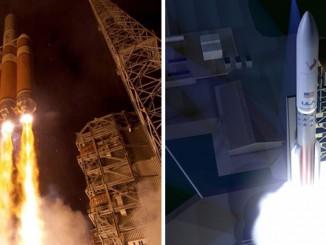
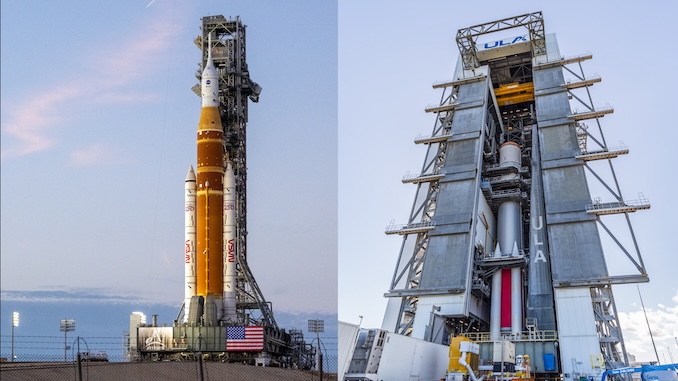
The current schedule has two marquee operations scheduled for the same day, Feb. 2: the launch of USSF-87, a national security mission, on a ULA Vulcan rocket and the wet dress rehearsal tanking test for the SLS, a critical milestone on the road to launching Artemis 2, a crewed flight around the Moon.
With both operations having critical importance to the interests of the U.S. federal government, Col. Joyce Bulson, the deputy commander of the USSF’s Space Systems Command (SSC) Space Launch Delta 45, said a lot of effort went into making sure that both are achievable on the same day.
“It took a lot of work to get to that, a lot of deconfliction of range assets because Artemis uses quite a bit of our range capabilities, similar to a test mission,” Bulson said.
“Those are more resource-intensive from a range perspective. They (NASA) understandably want a lot of data for how the rocket is going to perform as well as for safety factors. So that takes a lot of range resources.”
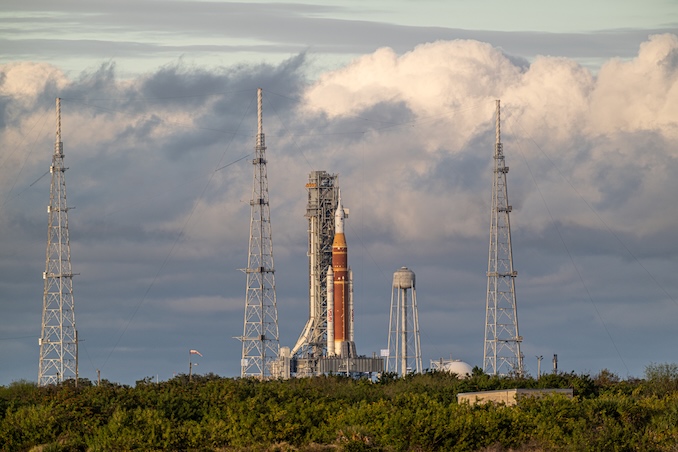
The Eastern Range, which encompasses the launch pads across NASA’s Kennedy Space Center and Cape Canaveral Space Force Station in Florida, is responsible for a multitude of elements that allow for smooth and safe launch operations.
Teams have been preparing for years for a ramp up in launch cadence and last year helped support a record 109 orbital flights. Bulson said one of the things that they keep tabs on is commodity usage.
“Today the government, or the Department of War, is not involved in commodities. That is something that the launch providers secure themselves or come up with their own solutions for. And in the case Artemis and Vulcan generally share GN2 (gaseous nitrogen) resources through the NASA pipeline,” Bulson said.
“So, that is something that has taken several weeks of work action to make sure that there is enough capacity, whether it’s bringing in additional trucks to the GN2 plant or shifting operations slightly by a couple hours to get to that point.”
Generally speaking, Bulson said there are a number of resources that factor into any launch campaign, like analyzing pad and flight safety weeks or months in advance with nominal data and then feeding in more particulars, like weather, as launch day approaches. Air and sea surveillance is also an important piece of the pie.
When it comes to the actual launch of Artemis 2 though, Bulson said they are taking additional measures to help ensure that NASA has a wide berth to get the SLS rocket off the pad.
“We have protected for up to four launch attempts for that mission because where it’s going, it has a very specific window that it needs to launch in,” Bulson said. “So we are prepared to support up to four launch attempts. If they do eat into that window, it may not be possible for them to do four launch attempts. So that’s going to be the priority on the range until Artemis goes. It’s protected for those additional launch attempts with their window.”
NASA published the available launch dates to it in the months of February, March, and April. Next month, they have just five days where they could fly between Feb. 6-11 with a carveout on Feb. 9.
The following month also has five available flight days ranging from March 6-9 and again on the 11th. Then in April, the mission could fly on April Fools’ Day, Apr. 3-6 or Apr. 30.
Because of the limited launch availability for the Artemis 2 mission, Bulson said that once the launch countdown begins, that will be a key focus for the range.
“From a range asset perspective, it’s a number of hours to turn the range, and all of those different assets. Because Artemis is so resource intensive, we really wouldn’t want to be going back and forth between missions,” Bulson said. “Really, realistically, couldn’t do that and still protect for the four launch attempts. So, we don’t plan on having anything else scheduled in.”
That said, Bulson added that SpaceX will still be able to launch Falcon 9 rockets from Space Launch Complex 40 “with no known conflicts.”
“Normal frequency deconfliction would still need to occur,” she said.
Rare launches for the Artemis program aside, the Eastern Range is preparing for another big year in orbital launches. Teams are readying for a future where by 2035, according to some external studies, the Cape may juggle 350 or more launches per year from a host of launch providers.
“Not all launches are equal in what they need from a resource perspective, but it at least gives us a starting point from a commodities, potentially power and water, perspective and then adjusting that based on any individual needs of the launch vehicles,” Bulson said.
She said the Space Force and NASA jointly hosted some reverse industry days to hear from the launch providers about their future ambitions and their projected needs. They’re also keeping an eye on the emergence of new companies at the Cape with their debut flights.
“We are watching both Stoke (Space) and Relativity (Space) and the production on their respective launch complexes on the Eastern Range,” Bulson said. “It’s very possible that you could have a launch by either of them by the end of the calendar year. Stoke is a provider on Lane 1 of [the National Security Space Launch contract]. Relativity is not, but we’re excited to see both of those successes.”