
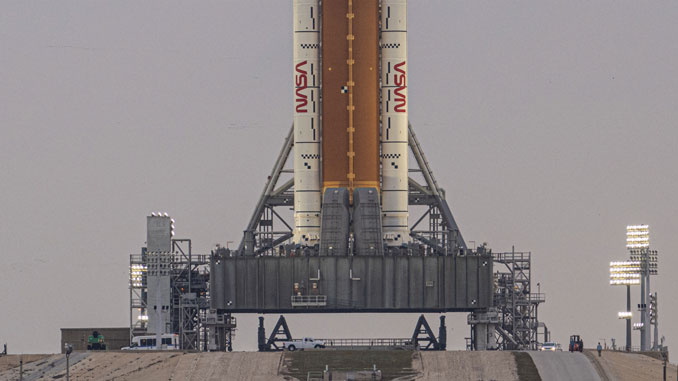
NASA is loading liquid hydrogen aboard its Space Launch System moon rocket at the Kennedy Space Center on Thursday for an unpublicized but crucial test of the repairs made to a leaky umbilical that derailed a countdown rehearsal on Feb. 2.
The operation to load liquid hydrogen into the huge fuel tank on the rocket’s core stage was thought to be already underway at launch complex 39B on Thursday morning. The test will determine if new seals installed in the launch pad umbilical are working.
“As part of our work to assess the repair we made in the area where we saw elevated hydrogen gas concentrations during the previous wet dress rehearsal, engineers are testing the new seals by running some liquid hydrogen across the interface and partially filling the core stage liquid hydrogen tank. The data will inform the timeline for our next wet dress rehearsal,” a NASA spokesperson said about the previously unannounced test.
During the Wet Dress Rehearsal or WDR, the launch team managed hydrogen leaks from the umbilical at the base of the rocket that feeds the propellant into the rocket by stopping and starting the process, allowing the umbilical seals to warm and plug the leaks.
Liquid hydrogen is notoriously difficult to handle because its tiny molecules can escape through even the smallest imperfection in the propellant system. It is also extremely explosive when mixed with air.
The launch team was able to fully load the propellant tanks during the Feb. 2 fueling test but called off the countdown because of a large spike in hydrogen leakage when the fuel tank was pressurized during the final minutes of the countdown.
The spokesperson did not immediately provide any additional details, including the amount of hydrogen to be loaded aboard the rocket or if the propellant tank would be pressurized to duplicate the conditions that interrupted the WDR.
Following the Feb. 2 dress rehearsal, technicians disconnected the hydrogen lines which are located on a plate that retracts into a three-story-high structure that rises from the deck of the mobile launcher. There are two tail service masts, one for liquid hydrogen and one for liquid oxygen. Engineers removed and replaced the seals on two hydrogen lines.
If all goes well with the hydrogen testing on Thursday, NASA could schedule a second Wet Dress Rehearsal as soon as next week.