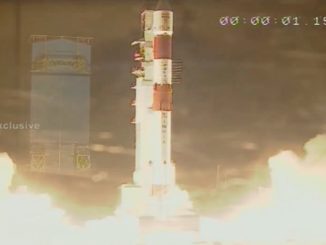
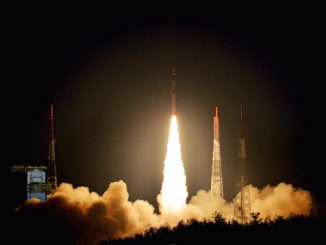
India’s first launch of 2026 ended in failure due to an issue with the third stage of its Polar Satellite Launch Vehicle (PSLV).
The mission, designated PSLV-C62, was also the second consecutive failure of this four-stage rocket with both anomalies affecting the third stage. This time, 16 satellites were lost, including those of other nations.
“ The performance of the vehicle, up to the end of, close to the end of the third stage was as expected,” said V. Narayanan, the chairman of the Indian Space Research Organization (ISRO), in the aftermath of the anomaly. “Close to the end of the third stage, we were seeing a little more disturbance in the vehicle roll rates. And subsequently, there was a deviation observed in the flight path.
“We are analyzing the data and we shall come back at the earliest.”
The rocket lifted off from the the Satish Dhawan Space Centre in India at 10:18:30 a.m. IST (0448:30 UTC), carrying onboard an Earth observation satellite from NewSpace India Limited (NSIL) as well as 15 other rideshare payloads.
The third stage engine ignited 264.2 seconds into the mission while at an altitude of roughly 220 km. About 110 seconds later, moments after a launch controller announced that performance was normal, the graphical representation of the PSLV’s third stage started spinning while showing the engine still firing.
The burnout — or end of engine firing for the third stage — was called out about 396 seconds post liftoff while it was at an altitude of 346 km. A graphic shown during the broadcast stated that PS3 separation occurred 494.3 seconds after liftoff with PS4 engine start at 505 seconds.
A view from an onboard camera seen on a screen in the launch control center also appeared to show the vehicle in a tumble.
The previous launch of the PSLV rocket, designation C61, was back in May 2025 and it also experienced an issue with its third stage.
The four-stage launch vehicle is a mixture of solid- and liquid- fueled stages. Both the first and third stages are solid-fueled, while the second and fourth stages are powered by liquid propulsion.
The PSLV Rocket has flown in multiple configurations since it debuted in September 1993 and achieved 58 fully successful launches with the payloads on those missions reaching their intended orbit.
ISRO said it initiated a “detailed analysis” to determine the root cause of the anomaly.