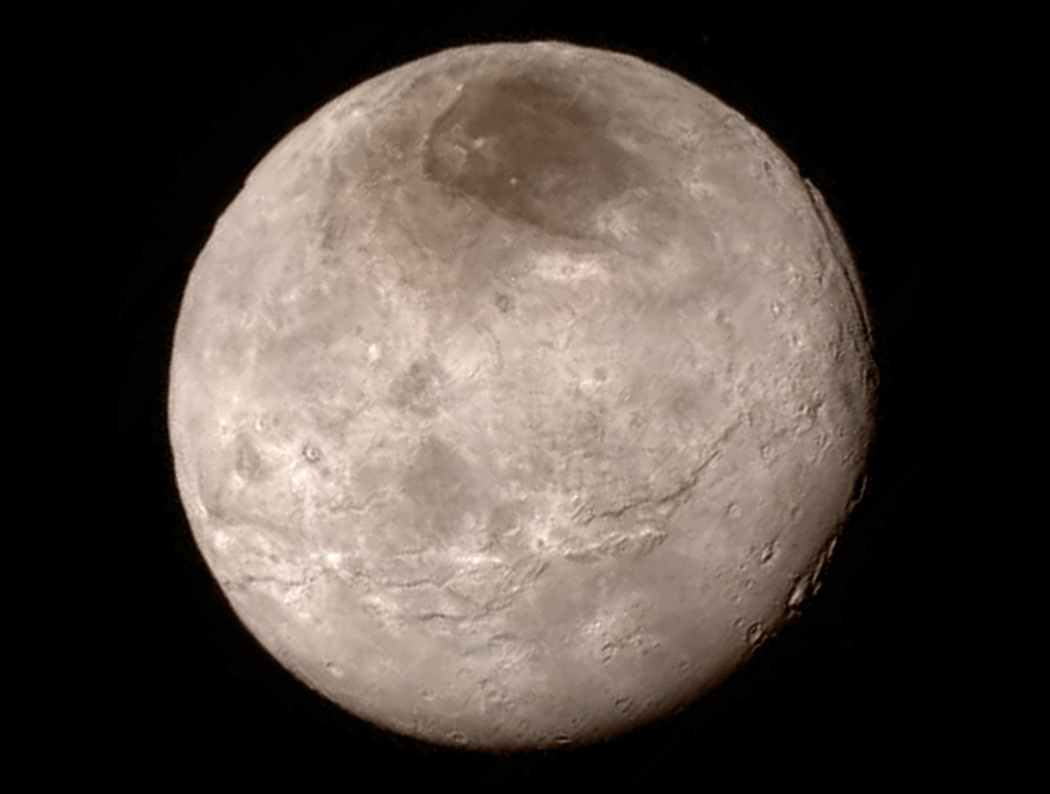
A spectacular sampling of imagery from NASA’s New Horizons spacecraft reveals mountains and water ice bedrock on Pluto, an active crust on its largest moon Charon and the first resolved views of the icy world’s tiny mini-moons.
A snapshot of Pluto shows fresh deposits of water ice bedrock and 11,000-foot mountains, revealing evidence Pluto’s surface is one of the youngest in the solar system. Photo credit: NASA/JHUAPL/SWRINew Horizons found few craters on the surface of Pluto’s Texas-sized moon Charon, evidence of recent geologic activity. Credit: NASA/JHUAPL/SWRITuesday’s New Horizons flyby revealed Pluto’s tiny moon Hydra. The first resolved image of the object shows it to be 28 miles long and 19 miles in diameter, and better images are to come. Credit: NASA/JHUAPL/SWRI
New maps produced from data gathered during the New Horizons spacecraft’s flyby of Pluto last year show surprisingly widespread water ice shaping mountains capped by methane snow and forming an underlying bedrock blanketing the distant world.
The New Horizons spacecraft speeding toward Pluto has returned a new image of the icy world lurking at the solar system’s outer frontier — the first photo beamed back to Earth since the probe suspended science operations Saturday.
NASA’s New Horizons probe, now just 10 million miles from Pluto and 14 days from a historic July 14 flyby, is operating in near flawless fashion, making increasingly detailed observations of the enigmatic dwarf planet and its large moon Charon, project engineers and scientists reported Tuesday.