Q&A with Jeff Bezos, founder of Blue Origin
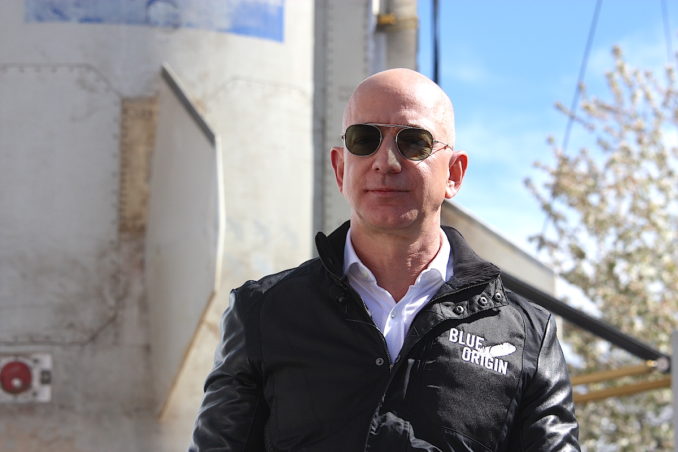
Billionaire Jeff Bezos, founder of Amazon and the surging space company Blue Origin, spoke with reporters at the 33rd Space Symposium in Colorado Springs, Colorado.
Backdropped by Blue Origin’s five-times-flown single-stage New Shepard booster and a prototype of the company’s crew capsule, Bezos discussed his company’s plans for suborbital space tourism and the launch services industry.
The New Shepard will be followed by the New Glenn, an orbital-class booster set to debut around 2020 from Cape Canaveral.
Bezos began his remarks inside the crew capsule mock-up, which was outfitted with flight-like seats and large windows affording riders a panoramic view outside the spaceship.
“When you get in here, I think you’ll have that same emotion many of us, certainly me, have lived with since we were little kids and we wanted to go to space. Everybody says that when you go to space it changes you. All the astronauts come back with stories like that. It’s very emotional to see this Earth, and see the thin layer of the atmosphere. I hope you guys get a chance to come in, and I hope you get a chance to ride New Shepard one day up into space.
Over here, you can see the New Shepard booster. This is the first rocket-powered vehicle to fly above the Karman line into space and then land vertically under rocket power on the Earth. It’s an incredible achievement that a lot of very hard working Blue Origin teammates built over a large number of years.
You can see it’s a little scarred. We have tortured this vehicle, including on its last flight, where we did a very stressing escape test. Inside the crew capsule, when you go in, you’ll see there’s kind of a table top thing in the center. That’s where the solid rocket escape motor is located. Right at maximum dynamic pressure, right at transsonic, we decided that we would torture this beautiful booster by lighting that solid rocket motor and see what would happen to the booster. We were pretty confident that things would go well for the crew capsule, but the booster was never designed to survive an escape event. Why should it really? The whole reason you’re escaping is that something bad has happened to the booster, but the booster has been built very robustly, and it was able to fly through those escape motor disturbances. But it did take quite a beating.
But we’re glad we got it back because we get to show it off and bring it to events like this. We’re going to send it on a short road show to various venues, and then we’re going to retire it to a museum somewhere.
This is all about reusability. Reusability is the key to getting millions of people living and working in space. It has to real operational reusability. It can’t be just theoretical reusability. If you recover and spend a lot of time and money X-raying, revalidating everything and refurbishing everything, it’s not actually going to lower costs. You have to get much more like airliner operations. You have to be able to land, refuel, maybe do some minor inspections, and then off you go again, and that’s where we going to get to. This vehicle, between flights, had a very small amount of refurbishment.
We had to touch up the thermal protection system on the aft, but that’s easy. It’s just spray-on. It wasn’t very difficult. And we inspected it, and we learned a lot. All of the learnings that we’re getting from New Shepard. We’ve already learned so much just by designing and building and flying New Shepard, and all of those learnings are already incorporated into our New Glenn design.

Q: When will New Shepard resume test flights? Is that being put aside while you work on the BE-4 engine?
A: The short answer to your question is when it’s ready. I always remind the team that we’re not racing. This vehicle is going to carry humans. We’re going to make it as safe as we can make it. we’re not going to take any shortcuts, so we’ll put humans on this vehicle when we’re ready, and not a second sooner. We’re really not constrained by our BE-4 activities. Both things are fully staffed, so we’re making great progress on BE-4, and we’re making great progress on New Shepard. Slow is smooth, and smooth is fast. It’s a mistake to race to a deadline when you’re talking about a flying vehicle, especially one that you’re going to put people on.
Q: What kind of launch cadence do you expect when you start commercial service? Is it time yet to start taking orders and selling tickets?
A: We’ll probably start taking down payments and selling tickets when we’re closer to commercial operations. We have a whole test program ahead of us. The vehicle that we’re building right now — it’s really two vehicles — it’s the crew capsule and the booster. The vehicles that we’re building right now are the ones that are designed to carry humans. These are the human-rated articles. The good news about our architecture is it’s completely autonomous, so we can fly these vehicles with no humans, even though they’re human-capable, and do that as many times as we want until we’re confident and comfortable, and then we can put humans on-board. If we had to have pilots, for example, we couldn’t use that approach, but the fully autonomous nature of the vehicle makes it easy to do that. So we’ll take advantage of that autonomy, and we’ll test this.
When that test program is done, then we’ll know when our first dates will be, and that’s probably a good time to start selling tickets. I’m hopeful that will still be 2018. We’ll see, but it’s really going to be when we’re ready.
As for cadence, we can build as many of these vehicles as we need. Rhe real question is what will the customer demand be. You can do research and surveys and ask people if they want to go, but it’s really hard to know. Really, you just have to do the experiment, so we’re very close to finding out what the customer demand will be, but I think nobody knows that for sure yet.
Q: What will the passengers need to go through with their training? What is there to do in Van Horn?
A: Very minimal training. It shouldn’t be more than a day of training. The system has been designed from the very beginning so that the training can be very minimal. You have to know how to strap yourself in and a few other things. But it’s not a significant amount of training.
And there is a lot to do in Van Horn. I’m working on that. That’s where the 10,000-year clock is, don’t forget. So if you want bring your family and visit the 10,000-year clock while you’re doing your training, you can do that.
Q: What are you trying to learn by operating frequently with this vehicle suborbitally, and how does that translate into the orbital vehicle?
A: Of course, all boosters are suborbital. There’s no such thing as an orbital booster. In fact, I’m thinking it might be interesting to build a small second stage for this New Shepard booster because we could use it to put small satellites into orbit. It would be perfectly capable of being a first stage for small orbital vehicle.
The learnings are often at the detail level. When you’re designing for engine life, the kinds of things you’re learning about are where are the problems? What kind of seals do you want to use? What kind of bearings do you want to use? What kind of materials do you want to choose? And so on and so on. A lot of those details are the things that you learn, and you can’t learn them at the conceptual level. You have to learn them through actual practice. Amazingly, we humans get better at everything we practice, and one of the reasons that we haven’t made as much progress in spaceflight as I think most of the people around here would have liked to have seen over the last 50 years is we just haven’t been able to practice that much.
The most used launch vehicles in the world, in a good year, will fly a dozen times per year. That’s a good year. Anything you do a dozen times a year, you never get truly great at. You need to be flying with much higher frequency. But to do that, you need a mission that supports that. That’s one of the reasons that the the tourism mission for New Shepard can be so valuable, because that can hopefully support a much higher flight rate than just 10 or 12 times per year.
You’ll learn so much through that practice effect. At the same time, rockets want to be big. One of the reasons that we chose the vertical landing architecture for New Shepard is that we knew it would scale to New Glenn. When you’re doing vertical landing, you’re solving the inverted pendulum problem. You know this already. The smaller the object, the harder it is to balance on the tip of your finger. So as we go to larger and larger vehicles, that problem just gets easier and easier. The booster stage has a higher moment of inertia, and it’s easier to land. So we’re really excited about that step, but we have learned so much, and most of it’s in the details.

Q: Last year, you told us you hoped to have Blue Origin personnel flying on New Shepard test flights by the end of this year. Is that still the case? Second, you and SpaceX seem to be reading the same book as far as the lessons of reusability. Any comments on the reflight of the Falcon last week?
A: I think we’re very like-minded in a lot of ways. I believe deeply in vertical landing as a good architecture because it’s scaleable. I think that reusability is the key to lowering costs. I think you should do that first with the booster stage. Many of these things are very similar. It’s a little different in that, instead of starting with an expendable vehicle, and then kind of working your way toward a reusable one, I wanted to start with a high flight-rate New Shepard vehicle, learn all those lessons at this scale, and then build New Glenn already knowing all those lessons, designed from the ground up to be reusable. The engineering approach is a little different, but I think we’re very like-minded.
The vehicle we’re building is the human-rated vehicle. We’re going to go through the test program, and we’ll put humans on it when we’re happy. I don’t think it’s going to be 2017 at this point. It could be, but I still think we can do commercial paying passengers in 2018.
Q: Will Blue Origin be as disruptive and competitive as Amazon?
A: Well, of course, we’ll be just as competitive. But how do you compete? When people say that an entrant is disruptive in an industry, what they really mean is that customers are adopting that new way. At Amazon, we’ve had a lot of inventions that we were very excited about, and customers didn’t care at all. Believe me, those inventions were not disruptive in any way. So the only thing that’s disruptive is customer adoption.
If you can invent a better way, and customers agree that it’s a better way, then they will use that. So that’s exactly what we’re trying to do at Blue Origin. We’re at an equilibrium in space. The whole space industry is too small. It’s a very small industry. The whole launch services market is $2.5 billion. It’s not a very big industry. The reason is we don’t fly very often. If airplanes flights cost the same as they did in 1940, that would also be a small industry today. But actually there are millions and millions of passenger miles flown, and it’s because the costs have come down so significantly, and we need to get there.
If we can make access to space low-cost, then entrepreneurs s will be unleashed. You will see creativity. You will see dynamism. You will see the same thing in space that I’ve witnessed on the Internet over the last 20 years, and believe me, that’s fun.
Right now, you can’t see that, and the reason you never get there is because the price of admission is too high. If I’m a kid in my dorm room, I can create the next Snapchat because the price of admission to create Snapchat is low. But I can’t create the next planetary mission, or the next exploration satellite.
Most of the things you want to do in space that are really interesting right now have a very high price of admission, and as a result, you can’t unleash the creativity of thousands and thousands of start-up companies and kids in dorm rooms everywhere. But if we can reduce the cost of launch by a factor of 10, and then by a factor of 100 — believe me, that’s going to take time and a lot of hard work — but if we can do that you will be living in a completely new world. It will be a golden age of space exploration. You’ll see so many people. Then it will be a big industry, and a very dynamic and fascinating one. It’ll be a golden age.
Q: Have you thought about a ticket price for a New Shepard flight? What is the number of people you want to fly in the first year or two?
A: Unfortunately, I don’t know the answer to either question. I don’t know yet what the ticket price is going to be. We’re working on that, and we’ll figure something out, but we still have time. It’s not an urgent thing to figure out because we’re not ready to sell tickets anyway.
The customer demand is going to be up to the customers. I’ve thrown parties before that nobody came to, and I don’t think that’s going to be the case here. I’m super optimistic, but customers get to decide what the flight rate is. I hope they decide they want to fly.
Q: Do you have any plans to raffle off tickets for people who can’t afford to pay for a flight?
A: That’s a fascinating idea. We have not spent a lot of time thinking about that, but I kind of like that idea. Maybe we should do something like that.
If you use airlines as an analogy, back in the 1940s and 1950s, when people first started using airlines as a mode of transportation, it was really expensive, and you either had to be taking an important business trip, or you had to be really well-heeled to transport yourself by aircraft. Of course, you fast forward to today, and airline tickets are very accessible to a very large cross-section of people, so that’s what we’ll have to get to.
We’ve got to chip away at it. It’s step-by-step ferociously. Gradatim Ferociter!
Q: Can you tell us a little more about how you see the cost curve coming down?
A: It’s going to be very difficult, I think, in advance to know what the cost curve is going to be — how low it’s going to come down. Here’s what I can tell you though: I am determined to lower the cost of access to space, and we at Blue Origin only need three things to make that happen: talented people, money and patience, and we have all three.
Q: You mentioned putting up small satellites. Is that a disruptive thing in terms of cost?
A: Small satellite launchers are not necessarily low-cost in terms of price per pound, or price per kilogram. It’s not necessarily attractive with a small satellite launcher, but they do have certain advantages if you’re doing, say, placement of low Earth orbit constellation satellites. So there are some missions for small satellite launchers.
I think, for most satellite launches, New Glenn would be a much better vehicle, but it would be interesting to use a small second stage, and use it as a small satellite launcher. It’s perfectly suited for that task.
Q: A lot of people experience space sickness and throw up after they get to zero gravity. Do you have plans to mitigate that on your vehicle?
A: There are some astronautss around, and maybe you should ask them. (Jeff) Ashby is around here. It takes about three hours before you start to throw up, so it’s a delayed effect, and this journey takes 10 or 11 minutes, so you’re going to be fine.
Q: In an extreme scenario where no one shows up to this party, and people dont buy tickets on New Shepard, what would that mean for the business model? Would you have to shift things around? What would be the impact on the company?
A: My business model right now — this isn’t the future business model — but my business model right now for Blue Origin is I sell about a billion dollars per year of Amazon stock, and I use it to invest in Blue Origin. So the business model for Blue Origin is very robust.
I think it’s very important that Blue Origin stand on its own feet and be a profitable sustainable enterprise. That’s how real progress gets made. I do not want Blue Origin to be a not-for-profit. I want Blue Origin to be a thriving enterprise and to help open the gateway to this new generation of people who will have this dynamic entrepreneurial explosion in space. Thats what we’re going to do. That can only be done if it’s sustaining. It’s a long road to get there, but I’m happy to invest in it.
Q: Do you have plans to handle human waste in the spacesuit?
A: Go to the bathroom in advance. If you have to pee in 11 minutes, you’ve got problems. You can’t even see a movie. The current plan is to board at T-minus 30 minutes, so the whole thing from boarding until you’re back on the ground is probably 40 or 41 minutes, something like that. So you’re going to be fine. You could dehydrate ever so slightly if you have a weak bladder.
Q: SpaceX recently indicated it has spent something like $1 billion to develop a reusable system. About how much would you estimate you’ve spent to date to do the same?
A: I haven’t disclosed that figure. I can tell you that we’ve spent a lot of money to date, and I think New Glenn is going to be on the order of $2.5 billion or so.
Q: You recently signed contracts for New Glenn launches. How aggressive will you market New Glenn, what do you see opportunties for military launches, or people?
A: It’s premature. I just can’t answer these questions because I don’t know the answers. If I knew, I would tell you. My singular focus is people in space. I want humans in space. When you build something that has a high fixed cost like New Glenn, to make the business model close, you have to also use it for other things. So our satellite customers are going to be a super important customer base for us because they’re going to cover the costs in the early innings.
But, I think, ultimately, most of our flights will be taking people up in space. That is going to take a while. We’ll fly New Glenn in 2020. We won’t have humans on New Glenn in 2020. It’ll be years after that.