|
|
|

|
|
Russian Soyuz-TMA spacecraft NASA PRESS KIT Posted: April 16, 2004
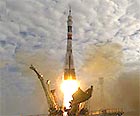
The Soyuz spacecraft is launched to the space station from the Baikonur Cosmodrome in Kazakhstan aboard a Soyuz rocket. It consists of an Orbital Module, a Descent Module and an Instrumentation/Propulsion Module. Orbital Module The opposite end of the Orbital Module connects to the Descent Module via a pressurized hatch. Before returning to Earth, the Orbital Module separates from the Descent Module -- after the deorbit maneuver -- and burns up upon re-entry into the atmosphere. Descent Module The module has a periscope, which allows the crew to view the docking target on the station or the Earth below. The eight hydrogen peroxide thrusters located on the module are used to control the spacecraft's orientation, or attitude, during the descent until parachute deployment. It also has a guidance, navigation and control system to maneuver the vehicle during the descent phase of the mission. This module weighs 2,900 kilograms (6,393 pounds), with a habitable volume of 4 cubic meters (141 cubic feet). Approximately 50 kilograms (110 pounds) of payload can be returned to Earth in this module and up to 150 kilograms (331 pounds) if only two crewmembers are present. The Descent Module is the only portion of the Soyuz that survives the return to Earth. Instrumentation/Propulsion Module The propulsion system, batteries, solar arrays, radiator and structural connection to the Soyuz launch rocket are located in this compartment. The propulsion compartment contains the system that is used to perform any maneuvers while in orbit, including rendezvous and docking with the space station and the deorbit burns necessary to return to Earth. The propellants are nitrogen tetroxide and unsymmetric-dimethylhydrazine. The main propulsion system and the smaller reaction control system, used for attitude changes while in space, share the same propellant tanks. The two Soyuz solar arrays are attached to either side of the rear section of the Instrumentation/Propulsion Module and are linked to rechargeable batteries. Like the Orbital Module, the intermediate section of the Instrumentation/Propulsion Module separates from the Descent Module after the final deorbit maneuver and burns up in atmosphere upon re-entry. TMA Improvements and Testing The TMA increases safety, especially in descent and landing. It has smaller and more efficient computers and improved displays. In addition, the Soyuz TMA accommodates individuals as large as 1.9 meters (6 feet, 3 inches tall) and 95 kilograms (209 pounds), compared to 1.8 meters (6 feet) and 85 kilograms (187 pounds) in the earlier TM. Minimum crewmember size for the TMA is 1.5 meters (4 feet, 11 inches) and 50 kilograms (110 pounds), compared to 1.6 meters (5 feet, 4 inches) and 56 kilograms (123 pounds) for the TM. Two new engines reduce landing speed and forces felt by crewmembers by 15 to 30 percent and a new entry control system and three-axis accelerometer increase landing accuracy. Instrumentation improvements include a color "glass cockpit," which is easier to use and gives the crew more information, with hand controllers that can be secured under an instrument panel. All the new components in the Soyuz TMA can spend up to one year in space. New components and the entire TMA were rigorously tested on the ground, in hangardrop tests, in airdrop tests and in space before the spacecraft was declared flight-ready. For example, the accelerometer and associated software, as well as modified boosters (incorporated to cope with the TMA's additional mass), were tested on flights of Progress unpiloted supply spacecraft, while the new cooling system was tested on two Soyuz TM flights. Descent module structural modifications, seats and seat shock absorbers were tested in hangar drop tests. Landing system modifications, including associated software upgrades, were tested in a series of airdrop tests. Additionally, extensive tests of systems and components were conducted on the ground. |
|
|
|
 |
|||||||||||||||||||||||||||||||||||||||||||||||||||||||||||||||||||||||||||||||||
|
MISSION STATUS CENTER |
|||||||||||||||||||||||||||||||||||||||||||||||||||||||||||||||||||||||||||||||||||||||