



![]() | ||
|
|
||
|
|
||
|
BY JUSTIN RAY July 24, 2000 -- Follow the countdown and launch of a U.S. Air Force Minotaur rocket with the Mightysat 2.1 technology demonstration satellite. Reload this page for the very latest on the mission.
MONDAY, JULY 24, 2000
WEDNESDAY, JULY 19, 2000 Ground controllers have established contact with Mightysat through a tracking station, confirming the craft had been released from the rocket's upper stage. Initial data from the satellite indicates it is in good health, the two power-generating solar arrays are deployed and the orbit achieved is nominal. Mightysat 2.1 is embarking on a year-long demonstration of its 10 onboard advanced technology experiments. Mission operation costs are projected at $2.5 million. The Spectrum Astro-built craft's prime object is to test for the first time in space a new camera system called the Fourier Transform Hyperspectral Imager. The system might be flown on future military reconnaissance satellites because it should be able to distinguish the type of terrain or composition of objects being observed by studying the spatial signature. Today was the second flight of the Minotaur space launch vehicle. The rocket features decommissioned first and second stages from a Minuteman 2 ICBM missile and its third and fourth stages are solid-fuel motors used by Orbital's Pegasus vehicle. No further Minotaur launches are firmly scheduled currently. There are three more sets of Minuteman stages earmarked for Minotaur missions, however. But the rocket can only used for launches of national need carrying government or university payloads.
2100 GMT (5:00 p.m. EDT)
2048 GMT (4:48 p.m. EDT)
2040 GMT (4:40 p.m. EDT)
2021 GMT (4:21 p.m. EDT) Once the data is relayed, engineers must pick through the information to determine a successful mission. We will provide updates as soon as they become available.
2020 GMT (4:20 p.m. EDT)
2019 GMT (4:19 p.m. EDT)
2018 GMT (4:18 p.m. EDT)
2017 GMT (4:17 p.m. EDT)
2016 GMT (4:16 p.m. EDT)
2015 GMT (4:15 p.m. EDT)
2013 GMT (4:13 p.m. EDT)
2012 GMT (4:12 p.m. EDT)
2011 GMT (4:11 p.m. EDT)
2010 GMT (4:10 p.m. EDT)
2009 GMT (4:09 p.m. EDT)
2008 GMT (4:08 p.m. EDT)
2007 GMT (4:07 p.m. EDT)
2006 GMT (4:06 p.m. EDT)
2005 GMT (4:05 p.m. EDT)
2004 GMT (4:04 p.m. EDT)
2003 GMT (4:03 p.m. EDT)
2002 GMT (4:02 p.m. EDT)
2001 GMT (4:01 p.m. EDT)
2000 GMT (4:00 p.m. EDT)
1959 GMT (3:59 p.m. EDT)
1954 GMT (3:54 p.m. EDT) Once the rocket lifts off from the Commercial Launch Facility on southbase of Vandenberg Air Force Base in California, the vehicle will head southward toward a polar orbit. The four stages of the vehicle will need 11-1/2 minutes to deliver Mightysat 2.1 into an orbit about 340 statute miles above the planet. And now a reminder -- like the previous Minotaur launch the Air Force is will not have an airborne telemetry relay plane to collect data from the rocket once it passes out of range from the Vandenberg tracking station. Therefore, about 10 minutes into the flight the rocket's signal will be lost while the fourth stage is still firing. Confirmation of a good fourth stage burn and separation of Mightysat won't come until passage over the McMurdo ground station in Antarctica about 30 minutes after launch.
1948 GMT (3:48 p.m. EDT) The countdown is proceeding very smoothly toward an on-time 2009 GMT (4:09 p.m. EDT) launch today.
1946 GMT (3:46 p.m. EDT)
1939 GMT (3:39 p.m. EDT) The Minotaur rocket uses decommissioned Minuteman 2 first and second stages with new third and four stages from the Orbital's Pegasus launcher. This will be the second flight of the rocket, which is designed to loft small government and university satellites into Earth orbit. Officially known as the U.S. Air Force Orbital/Suborbital Program-Space Launch Vehicle, or OSP-SLV, the rocket was given the marketing name Minotaur by Orbital Sciences, which is responsible for integrating and launching the vehicle.
1935 GMT (3:35 p.m. EDT)
1929 GMT (3:29 p.m. EDT)
1924 GMT (3:24 p.m. EDT) Also, the launch team verifies the rocket's inertial navigation system guidance computer is in ground align mode.
1915 GMT (3:15 p.m. EDT) Meanwhile, upper level winds have been verified "go" for launch and alignment of the rocket's navigation unit is starting.
1909 GMT (3:09 p.m. EDT)
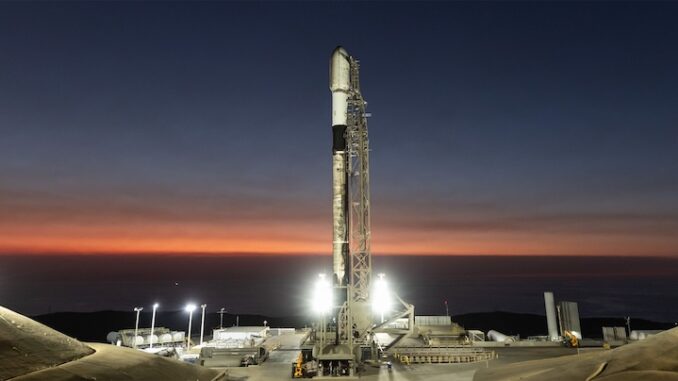
1857 GMT (2:57 p.m. EDT) Today's launch will be the second to occur from the CLF operated by Spaceport Systems International. SSI is a limited partnership between ITT Industries and California Commercial Spaceport, Inc. The commercial pad is not run by the U.S. Air Force or NASA, and is aimed at a variety of small- to medium-sized rockets like the state-run Complex 46 at Cape Canaveral. The CLF is situated the southern most corner of Vandenberg Air Force Base near Space Launch Complex-6, which would have been used by the space shuttle. Construction of the new pad was completed on May 1, 1999. SSI also operates a payload processing facility (IPF) located at Space Launch Complex-6, which is where most of the launch team is positioned this afternoon to control the countdown.
1846 GMT (2:46 p.m. EDT) Pad crews are now rolling the mobile service structure, called the "shelter", away from the rocket to parked position for today's launch. There are no technical problems being discussed by the Air Force/Orbital Sciences launch team and liftoff remains set for 2009 GMT (4:09 p.m. EDT) from Vandenberg Air Force Base in California.
1828 GMT (2:28 p.m. EDT)
1812 GMT (2:12 p.m. EDT) Countdown clocks remain on schedule for an on-time liftoff today. There are no problems being worked.
1700 GMT (1:00 p.m. EDT) Most of the launch team is located inside the Integrated Processing Facility at Space Launch Complex-6. The IPF is just a short hop northeast from the Minotaur's commercially-run launch pad operated by Spaceport Systems International. The IPF was supposed to be the space shuttle payload processing facility at SLC-6, but when plans to launch shuttles from Vandenberg were scrapped SSI leased that one building.
0401 GMT (12:01 a.m. EDT) Launch remains targeted to occur at 2009 GMT (4:09 p.m. EDT) today from the commercial pad on South Vandenberg, which is operated not by the government but Spaceport Systems International. Weather forecasters are still calling for a 60 percent chance of acceptable conditions. The threat is strong winds violating the 35-knot constraint against rolling back the protective service structure from around the rocket at the pad. Check back later today as we provide continuous reports throughout the final hours of the countdown and the launch.
TUESDAY, JULY 18, 2000 Liftoff of the second Minotaur rocket from the Commercial Launch Facility at Vandenberg Air Force Base in California is scheduled for 2009 GMT (4:09 p.m. EDT), the opening of an 86-minute window extending to 2135 GMT (5:35 p.m. EDT). The $21.5 million Mightysat 2.1 spacecraft will orbit about 340 statute miles above Earth to test high-risk technologies that satellite designers wouldn't otherwise want to incorporate into operational missions. A follow-on to Mightysat 1 launched from space shuttle Endeavour in December 1998, Mightysat 2.1 is the first of what was envisioned as a five-satellite series to demonstrate advanced concepts in space. However, the Air Force has scaled back funding and Wednesday's launch could be the last for the Mightysat program, officials say. Over the next year, Mightysat 2.1 will conduct its tests of 10 onboard experiments under the watchful eye of controllers at Kirtland Air Force Base's Research, Development, Test and Evaluation Support Center in New Mexico. The primary focus of the satellite will be the operation of a new military space camera system called the Fourier Transform Hyperspectral Imager, or FTHSI. The device will observe selected ground targets to capture spectral images. Lt. Jacob Freeman of the Mightysat program office explains, "It takes a spectral image of some object, say for instance concrete or dirt. These objects have a special spatial signature; they put out a certain spectrum of reflective light at various frequencies. The imager can then take an image, compare that with known signatures and identify what it is looking at." Future spy satellites could be outfitted with such an imager to spot and classify hidden enemy targets. Commercial spin-offs include agricultural monitoring from space. Other technologies on the satellite include testing an advanced, high-speed computer processor against space radiation, new solar array hardware and composite material used to form the satellite's structure. "With our 10 experiments, we will see a big payoff down the road," said Capt. Mark Mocio, Mightysat mission manager. "There is no substitute for flying these things. We can test them, we can plan them, we can design them, but to actually fly them and see how they work on-orbit, I think we will be a lot smarter when we build the next generation satellite." Launch countdown activities will get underway at 1509 GMT (11:09 a.m. EDT) Wednesday morning, or five hours prior to the scheduled liftoff time. That is when members of the launch team arrive on console at Vandenberg. Over the course of the following two hours, the team will perform a thorough checkout of the rocket's systems. With three hours to go before launch, the management team will take their positions to guide the countdown. The critical milestone in the count, which will determine the liftoff time and length of the launch window, is scheduled to occur at Launch-Minus 2 hours. Technicians at the launch pad will pull the ground power supply to Mightysat 2.1, terminating charging to the craft's onboard batteries. At that point, the satellite must be launched within three hours or else wait until another day. Since there still will be two hours left in the countdown, the launch window will be shortened to just 60 minutes in duration, said launch vehicle mission manager Lt. Blair Morris. The 52-member launch team will be split into two locations. Some personnel will be stationed at the Air Force's Launch Operations Control Center, while the members actually running the countdown, mostly Orbital Sciences employees, will be inside the Integrated Processing Facility at Space Launch Complex-6. The IPF is just a short hop northeast from the Minotaur's commercially-run launch pad operated by Spaceport Systems International. The IPF was supposed to be the space shuttle payload processing facility at SLC-6, but when plans to launch shuttles from Vandenberg were scrapped SSI leased that one building. The weather forecast is calling for a 60 percent chance of acceptable conditions for launch. The main concern is gusty winds won't permit the mobile service structure to be moved away from the rocket, which is scheduled about an hour and 45 minutes before liftoff. The wind limit is 35 knots and the forecast predicts winds up to 30 knots. The launch-time wind constraint is 47 knots. Launch Weather Officers Capt. Joe Kurtz and Dr. Chris Crosiar have issued this forecast: "The long wave, upper level trough that has persisted over the eastern Pacific is forecasted to remain quasi stationary through this week. This trough will produce southwesterly flow in the upper atmosphere. The surface based high pressure area to the west of California and the thermal low in the desert southwest will result in increased wind speeds from the north, northwest direction. The atmosphere remains dry, with cloud cover limited to high cirrus clouds and the ever, present summer marine layer stratus clouds in the morning. For launch window, expect ... maximum upper-level winds at 34,000 ft will be west-southwest at 60 kts." The launch time forecast shows scattered stratus clouds at 700 feet, scattered cirrus clouds at 30,000 feet, 7 miles of visibility, northwesterly winds 25 to 30 knots, temperature of 60 to 64 degrees F and no significant weather. Should the launch be delayed to Thursday afternoon for some reason, the forecast improves to an 80 percent chance of good weather. High winds during tower removal again will be the concern, but they are expected to drop to 22 to 28 knots. Spaceflight Now will have extensive live coverage during the final countdown and launch on Wednesday.
|
Video vault PLAY (292k, 32sec QuickTime file) Download QuickTime 4 software to view this file. Snapshots ![]() The Mightysat 2.1 patch. Photo: AFRL/Kirtland AFB
|
|||
|
INDEX | PLUS | NEWS ARCHIVE | LAUNCH SCHEDULE ASTRONOMY NOW | STORE ADVERTISE © 2009 Spaceflight Now Inc. |
||||