

|
|
|

|
|
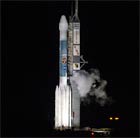
Probe roars away from Earth on voyage to orbit Mercury BY WILLIAM HARWOOD STORY WRITTEN FOR CBS NEWS "SPACE PLACE" & USED WITH PERMISSION Posted: August 3, 2004 A Boeing Delta 2 rocket roared to life early Tuesday and climbed into space, launching NASA's ambitious MESSENGER probe on a round-about six-and-a-half-year voyage to Mercury, a $427 million quest to fill in one of the most glaring blanks in planetary exploration.
MESSENGER, too, will fly past its target three times in 2008 and 2009, collecting a wealth of data, photographing the entire planet and using its gravity to set up a fourth and final encounter in March 2011. But unlike Mariner 10, humanity's second robotic emissary to Mercury will not end its mission with yet another flyby. Instead, the craft will brake into orbit for a full Earth year of close-up investigation. Among the questions scientists hope to answer:
Figuring out how Mercury ended up so different from the other three terrestrial planets - Venus, Earth and Mars - will provide valuable insights into how the solar system formed 4.5 billion years ago. It also will help astronomers establish benchmarks for use when studying other solar systems. MESSENGER "is a highly ambitious, highly capable mission that if successful, will orbit Mercury for the first time to help us understand the forces that shaped the planet," said Orlando Figueroa, director of the solar system exploration division at NASA headquarters. "It will collect images of the entire planet and gather highly detailed information on its geology, the nature of its atmosphere, the magnetosphere, the make up of its core and the character of its pole materials. MESSENGER will enable a new era of comparative planetology providing a new context that links Mars, Earth, Venus and the moon." To Robert Strom, a member of the Mariner 10 team and a co-investigator with the MESSENGER project, today's fiery launching marked the end of a frustrating three-decade wait. "Mariner 10 was a mission that designed as a reconnaissance of Mercury in order to characterize it to plan a Mercury orbiter," he said Saturday. "That orbiter was supposed to be planned and launched by about 1980. Well, it's been 30 years and until now, nothing has happened. "So now we've got not only a mission to Mercury, an orbiter to Mercury, but we have a world-class orbiter of Mercury. This is a super mission, never in my wildest imagination did I think that we would get a spacecraft like this for a Mercury orbiter. It has the instruments on board to answer the questions that were raised by Mariner 10 and its going to do that in spades." But it won't be easy. Unlike recent robotic missions to Mars, the Galileo mission to Jupiter and the ongoing Cassini exploration of Saturn, MESSENGER is going the other way, plunging deep into the inferno of the inner solar system. Once in orbit around Mercury, the side of the spacecraft facing the sun will be hotter than a pizza oven. "Cassini and the other orbiters of, say, Mars and Jupiter and Saturn, they're kind of orbiting paradise compared to (MESSENGER), which is going to orbit hell," Strom said. "But it's a very interesting hell." Running a day late because of heavy cloud cover, Tuesday's launching went smoothly and MESSENGER was released from its spent third stage 57 minutes after liftoff as the craft sailed 690 miles above the northern coast of Australia. A few minutes later, at 3:29 a.m. EDT (0729 GMT), the probe's two mirrored solar arrays unfurled as planned to begin recharging the craft's batteries. Engineers plan to spend the next several days checking out the health of MESSENGER's instruments and other on-board systems. This was the 60th successful Delta rocket launch in a row dating back to 1997 and the 113th success out of 115 flights since 1989. Using a Delta 2 rocket, NASA could not launch a spacecraft with enough fuel to fly directly to Mercury, deep in the sun's gravity well, and brake into orbit. While such a three-and-a-half-month flight is possible in theory, it would require an expensive heavy-lift booster and a spacecraft that was 85 percent fuel. Instead, NASA opted for a less-expensive approach using the gravity of Earth, Venus and Mercury itself to provide the braking needed to slow the craft's plunge into the inner solar system. MESSENGER will fly past Earth on Aug. 1, 2005, twice past Venus in 2006 and 2007 and three times past Mercury in 2008 and 2009. If all goes well, MESSENGER's main engine will fire for 15 minutes on March 18, 2011, putting the spacecraft into an elliptical orbit tilted 60 degrees to the planet's equator with a low point of about 125 miles above the northern hemisphere and a high point of 9,420 miles. Equipped with seven miniaturized instruments, including two cameras, four spectrometers, a magnetometer and a laser altimeter, MESSENGER will photograph the entire planet in color and stereo, map its magnetic field, the mineralogy of its crust and probe the nature of its hidden core. A large sunshade covers the side of the spacecraft facing the sun and insulation blankets protect the side facing Mercury from heat radiated from the planet, keeping the instruments and the craft's electronic systems at room temperature. Scientists can't wait to fill in the blanks in solar system evolution that Mercury will provide. "The family of the four inner planets - Mars, Venus, Earth and little Mercury - shared a common origin," said Principal Investigator Sean Solomon of the Carnegie Institution in Washington. "They all formed in the disk of gas and dust, the solar nebula, that surrounded our young sun. They formed by the same processes, they formed at the same time, their outcomes were extremely different. And Mercury is the most extreme of those four planets. Besides being closest to the sun, it's the most dense, the highest variation of temperature over its surface, it's of course the smallest of the four. "What we know about Mercury mostly came from Mariner 10, which flew by Mercury three times in 1974 and 1975. Mariner 10 imaged less than half the surface and so there's an entire hemisphere we've never seen. Mariner 10 discovered that little Mercury had a magnetic field and made a number of other discoveries that raised profound questions that we're trying to address. "One of those questions is how Mercury ended up so dense, so massive for its size," Solomon continued. "On the basis of that density, Mercury must be at least two thirds iron metal and that's a much higher fraction of any of the other inner planets. Why did Mercury end up that way? One possibility is that the solar nebula had a chemical gradient for some reason and that at Mercury's distance from the sun, more metals were present than in regions farther out. "But competing ideas say Mercury started out more like the Earth, with a larger volume of rocky materials surrounding that metal core, but that silicate shell was largely removed, either because it was vaporized by the extremely hot temperatures in the inner solar nebula or it was blasted away by the impact of an object almost Mercury's size," Solomon said. All three theories make predictions that MESSENGER will test. "If Mercury formed out of a solar nebula that had a chemical gradient only in the ratio of iron metal to silicates, then the composition of the silicate material at Mercury's surface should have the major elements in approximately solar proportions," Solomon said. "If Mercury was once more earth-like in composition but lost most of its silicates as a result of high temperatures because it was bathed in the solar nebula that was very, very hot, the consequences of that would have been vaporization of the upper part of the planet. But different elements vaporize at different temperatures. One would expect under that kind of scenario to see primarily a deficiency of the elements that would tend to vaporize easily and a concentration of what are known as the more refractory elements that tend to stay behind the longest. Those consequences are very different from the chemical gradient scenario." And if Mercury suffered a catastrophic impact with a body nearly its own size, the crust that remained would have lower silicate concentrations. "We expect to be able to easily distinguish whether any of these competing ideas are correct," Solomon said. "We may have to discard them all and start over. But it is a nice scientific experiment in this case where we have multiple hypotheses which make different predictions of what we will see." Closely related to the question of how Mercury ended up with such an oversize core is the issue of its magnetic field. "It is the most Earth-like of the magnetospheres in our solar system," Solomon said. "The mystery is, why tiny Mercury has retained a magnetic field when larger planets in the inner solar system - Mars and Venus - do not have a global magnetic field today. Is Mercury's field the result of an Earth-like dynamo mechanism in a fluid outer core? Or is the magnetic field that Mariner 10 measured a fossil?" MESSENGER will answer that question by mapping subtle changes in the planet's rotation rate as the world swings through its highly elliptical orbit and experiences strong solar tides. The magnitude of that variation is dependent on the nature of the core and by measuring slight changes in a point of longitude on the surface, MESSENGER should be able to answer the question. "If only the silicate shell is solid you get one answer," Solomon said. "If the entire planet is solid, you get a different answer." By the end of the mission, he said, "we will be able to know how big the core is, we'll be able to know ... whether there's a fluid outer core or not and of course, that's very closely tied to the question of how we account for the magnetic field today." Another major mystery is the thermal state of the planet. At the equator, sun-side temperatures exceed 800 degrees Fahrenheit while on the darkside, they plunge to more than 300 degrees below zero. That 1,100-degree variation is the most extreme in the solar system. But in permanently shadowed craters near Mercury's poles, scientists have discovered deposits of radar-reflective materials that could be ice that, if confirmed, would give new meaning to the phrase "a snowball's chance in hell." "It has been 30 years since we visited Mercury last when Mariner 10 flew by three times, providing a glimpse of this planet of extremes," said Figueroa. "I'd say we are long overdue for another visit with some permanence to help us unveil the secrets of this planet, the innermost and least understood of the terrestrial planets. Needless to say, we're incredibly excited."
|
|
|
|
 |
|||||||||||||||||||||||||||||||||||||||||||||||||||||||||||||||||||||||||||||||||||||||||||||||||||||||||||||||||||||||||
|
MISSION STATUS CENTER |
|||||||||||||||||||||||||||||||||||||||||||||||||||||||||||||||||||||||||||||||||||||||||||||||||||||||||||||||||||||||||||||||


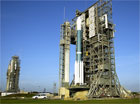
 Mission officials and scientists preview the flight of NASA's MESSENGER space probe to orbit the planet Mercury during this news conference. (41min 36sec file)
